
What Do We Do With a Teenager Who Doesn’t Listen?!
4 Tips to Better Understand Them

As a parent, you often just don't know how to deal with a teenager who doesn't listen! And it's as if everything you're telling him just words in the wind, as if he's intentionally ignoring your advice and breaking the rules, just to challenge you…
Every parent knows that it is extremely difficult to communicate with a teenager who does not listen - who, worse, often wants to defy authority and does only what he likes. And no matter how much you tell him that the rules, the advice, the criticism are only for his good, it's as if you can't reach him. He doesn't understand you and you understand him even less!
Just as examples: you tell him how dangerous it is to walk the streets at night - he doesn't listen, you tell him how harmful smoking is - he doesn't listen, you tell him how important school is for his future - he doesn't listen, you tell him how the vital thing is not to forget the condom - he does not listen!
And the more you repeat something, the more it seems like you don't notice it. … Authority is crucial in communicating with the teenager - but a good parent should not forget two other equally crucial elements: respect (you ask for respect, but you must also offer respect) and empathy (you feel that you can't understand it, but did you try to listen to it?).
What to do with a non-listening teen:
He's tired of being treated like a child! He realizes that he is at an age when he needs to be treated differently - he gives up certain behaviors of over-protection, of excessive involvement, of constant verification! Do you think that if you always check him, he will do the right thing? He will learn to hide better…
As has been said, authority is crucial, but stop behaving as if you were the master and he must always do what you ask of him, without explanation! It's a vicious circle: you treat him like a child, he gets angry and defies you by behaving like an immature, irresponsible child, and then, of course, you treat him like a child again…
Show that you respect his opinion and that you are interested in it, that if you ask him to do something, you have good reasons to ask him that. Give up the ineffective reply: "do this because that's what I said"! Of course, you can't let him do what he wants and make important decisions on his own - not yet; but show him that his point of view also matters! And when he's wrong, don't act like he's wrong because he's a child.
After all, we all make mistakes and the most effective is to teach him to bear the consequences of his own mistakes.
"Must…". Are you facing a teenager who doesn't listen? Well, remember that you were at this age too - the gap between you would not be so big if you remembered the hard times of adolescence.
Many times, a teenager thinks that his whole life is just an endless series of rules! At home, she has to do this and the other one at school has to do this and the other one has to do it. So much for "must" and no one asks him what he would like to do!
The rules are good - but they need a basis, the motivation for their existence, otherwise, the teenager will perceive them as unfair and will ignore and even challenge them.
He has to listen… but do you listen to him? Think about it - do you listen to what he tells you and try to understand what he wants to convey to you? Or do you just take the words as such, without thinking about what they convey to you in-depth?
Are you trying to get out of him what he feels and thinks or are you just interested in him listening to you? In communication, everything has to be mutual: listen and maybe, with a little luck, you will be listened to! Teenagers are going through a series of confusing changes and an intense crisis of independence - but right now he needs advice and someone who can listen without jumping at first…
It is extremely difficult to be such a parent: to show that you are there, that you care what he thinks and wants, but at the same time to show that you do not accept the violation of the essential rules… Practice is everything in communicating with a teenager who does not listen - you try, you fail, but you try again.
Because if you give up and conclude that he simply does not listen and does not understand, you are left with only imposed rules - which, when he wants, he will violate them secretly or openly anyway!
Emotions should not be criticized! Of course, when you talk to a teenager who does not listen, when you feel that what you say to him enters one ear and comes out the other, worse when he defies you, you do not know what to do and resort to criticism, threats, punishments. . You feel like you just can't understand him because he's gone crazy and nothing he does is logical.
But remember one important thing: in communication, very important is not what he does and says, but what emotions he conveys through what he does and says. You can try to understand his actions and words by first trying to find out what emotions they gave birth to! You don't have to criticize what the teenager feels - you criticize an act, but you also think about what emotions it causes him; criticize the action, but understand the emotion; for example, when you find out that he has quit school, that he has gotten into trouble, that he is late at home, do not jump to criticism and punishment at first.
Try to find out why he did what he did and what emotions he feels. He shuddered from fear or rejection of the school environment, he delayed the need for independence, he did something stupid out of the need to rebel against so many rules. See what lies behind his actions and talk to him about how he feels and why he feels. But you can't talk to a teenager if you criticize him at first!
And remember: emotions should never be criticized - you don't decide what you feel, you feel what you feel! If someone were to say, "You don't have to be upset," "You don't have to be sad," "You don't have to worry," would you say? It's stupid to be told how you should feel.
So, every time you have a problem with a teenager who doesn't listen, try to find out what emotions caused an act and discuss them and what can be done to get rid of those emotions. Nobody says it's easy, but it's the only way to at least be able to communicate with a teenager who doesn't seem to be listening…
About the Creator
Keep reading
More stories from Kenan Reyna and writers in Humans and other communities.
When It's Best To Meet Your Partner’s Parents and How to Make a Good Impression?
When you meet your partner's parents - a trial and an experience that you often do not rush to live! It is a step forward in your relationship, but your enthusiasm may be so low that you would rather delay this step.
By Kenan Reyna4 years ago in Humans
Time to change your life.
Is it even possible for you to change your life? A lot of people, more than there should be, are unhappy with their lives. But what are they doing about it? Usually nothing. People talk about how shitty their lives are and want change, but are they not taking the actions to change?
By Jen Phillipsa day ago in Humans
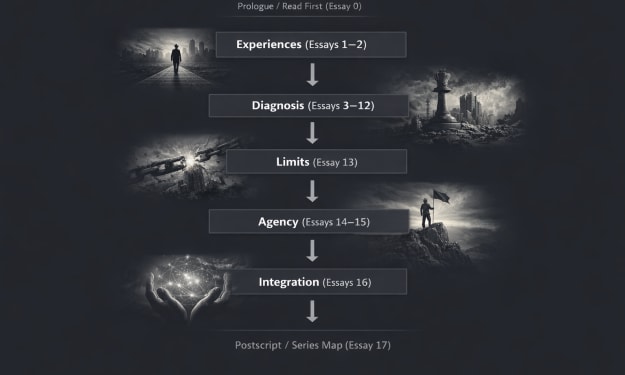
(17) The Shape of the Work
This essay exists to make the structure of the series visible after the fact. It does not introduce new arguments or advance new claims. Its purpose is architectural. It explains how the work is organized, why the sequence matters, and what each movement is responsible for accomplishing. Without this reference, readers may grasp individual insights while missing the coherence of the whole. With it, the series can be understood as a single, intentional construction rather than a collection of adjacent essays.
By Peter Thwing - Host of the FST Podcast7 days ago in Humans



Comments
There are no comments for this story
Be the first to respond and start the conversation.