
(17) The Shape of the Work
How the Series Is Structured and What Each Movement Accomplishes

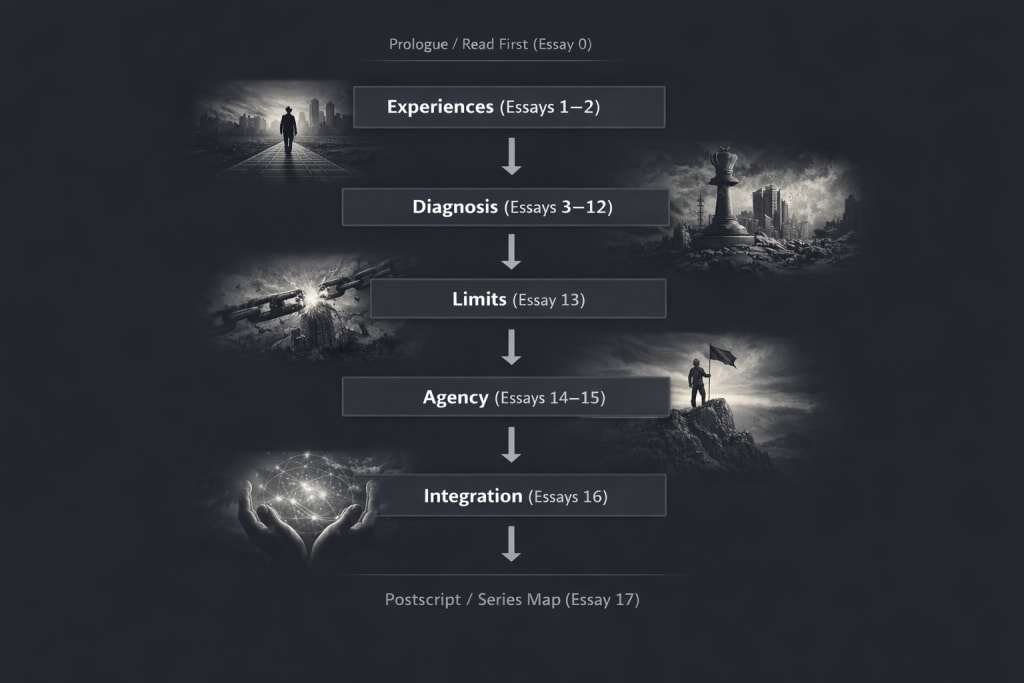
This essay exists to make the structure of the series visible after the fact. It does not introduce new arguments or advance new claims. Its purpose is architectural. It explains how the work is organized, why the sequence matters, and what each movement is responsible for accomplishing. Without this reference, readers may grasp individual insights while missing the coherence of the whole. With it, the series can be understood as a single, intentional construction rather than a collection of adjacent essays.
The series is built around the premise that systemic failure cannot be understood, confronted, or endured unless it is first made legible. Legibility requires sequencing. Certain insights only become intelligible after others have been established. For that reason, the work unfolds in deliberate movements, each one preparing the ground for the next.
The series begins with Essay 0, which functions as a preparatory orientation rather than part of the argumentative arc. Its role is not to explain conclusions or outline the series in advance, but to establish posture. Essay 0 clarifies what kind of work the reader is entering, what it is not attempting to do, and how it should be approached in order to avoid misinterpretation. It prepares the reader intellectually and psychologically for a diagnostic project rather than an advocacy piece. This essay exists to align expectations before the reader encounters any claims, ensuring that what follows is read as structure rather than opinion.
Essays 1 through 5 form the first substantive movement of the series. Their function is experiential coherence. These essays begin with what people feel before they understand why they feel it: pressure without relief, participation without influence, effort without stability, and rules that appear to apply unevenly. These experiences are treated as data rather than as ideology. The purpose of this movement is to establish that these conditions are shared, patterned, and systemic rather than personal, accidental, or purely cultural. By the end of this section, the reader should recognize that something structural is occurring, even if its mechanisms are not yet fully visible.
Essays 6 through 11 constitute the diagnostic core of the work. This movement shifts from experience to mechanism. Each essay isolates a specific structural function and examines how it operates once power becomes insulated from consequence. These essays trace how authority detaches from exposure, how law becomes unequal, how fear replaces legitimacy, how coercion turns inward, how participation becomes hollow, and how collapse occurs through withdrawal rather than revolt. The purpose of this movement is causal clarity. It explains why reform fails, why leadership changes do not alter outcomes, and why systems continue to produce harm even when intentions appear good. By the end of this section, the reader should understand not only that the system is failing, but why it behaves the way it does.
Essays 12 and 13 operate as a threshold between diagnosis and orientation. Essay 12 explains why participation persists even after it loses corrective power and why withdrawal follows when participation no longer constrains authority. Essay 13 defines the conditions under which legitimacy could be restored and explains why surface reform cannot achieve it. Together, these essays close the diagnostic phase. They do not propose solutions. They establish boundaries. They clarify what cannot work and what must be true before anything can.
Essays 14 and 15 shift the focus from systems to persons, but only after the limits of systemic correction have been made explicit. This ordering is intentional. Introduced earlier, personal agency would have been misread as responsibility for failures individuals did not cause. Introduced here, it becomes stewardship rather than control. Essay 14 addresses how to act meaningfully inside a system that has not yet corrected itself, rejecting both submission and revolt as false choices. Essay 15 grounds endurance in meaning that outlasts institutions, explaining how faith and orientation sustain coherence when institutional narratives collapse.
Essay 16 serves as the integrative synthesis. It introduces no new arguments. Its function is coherence. It shows how structural diagnosis, personal agency, and meaning fit together as a single worldview without contradiction. It clarifies why partial engagement fails, why extremes are tempting and wrong, and why clarity itself is stabilizing in periods of decline.
This essay, Essay 17, closes the series by making its architecture explicit. It exists as a reference rather than an argument. It allows readers to locate themselves intentionally within the arc, to revisit earlier sections with clearer context, and to understand why the work proceeds as it does. Essay 0 prepares the reader before entry. Essay 17 explains the structure after completion. The two bookend the series without duplicating one another.
Taken as a whole, this work is not a manifesto, a program, or a call to action. It is a framework. It does not tell the reader what to believe, but it does insist that belief align with structure. It does not promise restoration, but it explains what restoration would require. It does not demand hope, but it preserves meaning by replacing confusion with clarity.
That clarity is the final deliverable of the work.
About the Creator
Peter Thwing - Host of the FST Podcast
Peter unites intellect, wisdom, curiosity, and empathy —
Writing at the crossroads of faith, philosophy, and freedom —
Confronting confusion with clarity —
Guiding readers toward courage, conviction, and renewal —
With love, grace, and truth.
Keep reading
More stories from Peter Thwing - Host of the FST Podcast and writers in Humans and other communities.
(16) A Coherent Orientation
- Seeing the Whole Rather Than the Pieces - At this point in the series, it becomes possible to see what could not be seen at the beginning. Each essay examined a distinct failure mode, but none of them were independent. Representation becoming abstract, authority detaching from consequence, law becoming unequal, fear governing populations, coercion turning inward, participation hollowing out, and collapse arriving through withdrawal were not separate phenomena. They were expressions of the same underlying design failure viewed from different angles. What initially appeared fragmented resolves into a single, intelligible pattern once the system is observed as a whole.
By Peter Thwing - Host of the FST Podcast2 months ago in Humans



Comments
There are no comments for this story
Be the first to respond and start the conversation.