
The Swedish Approach to Gender-Neutral Pronouns
It turns out Sweden is good at more than making meatballs.


When you think of Sweden, what comes to mind?
Probably meatballs, IKEA furniture, and ABBA. What you may not know about Sweden is its groundbreaking and thoroughly inclusive approach to gender-neutral pronouns.
In 2012, Sweden added the gender-neutral hen pronoun to its Swedish language dictionary. This small addition has had a huge impact.
What are Pronouns?
A pronoun is a word that substitutes for a noun or noun phrase. The most common pronouns in the English language include she/her/hers, he/him/his, and they/them/theirs.
My Experience with Pronouns in Sweden
I lived in Linköping, Sweden for about three and a half months in early 2020 as part of a university exchange study program. On the first day of a class called Swedish For Exchange Students, we were taught some of the basics.
The professor, Åsa, first taught us the basics like numbers, greetings, and prepositions, before we got to pronouns. In her neat handwriting, Åsa wrote that there are three singular pronouns in Swedish: hon (she), han (he), and hen (they).
I was struck by the casual way Åsa continued the lesson without an explanation for the gender-neutral hen. Later, I had a chat with a Swedish peer who explained that in Sweden using gender-neutral pronouns has been normal since he was a child. It was normal.
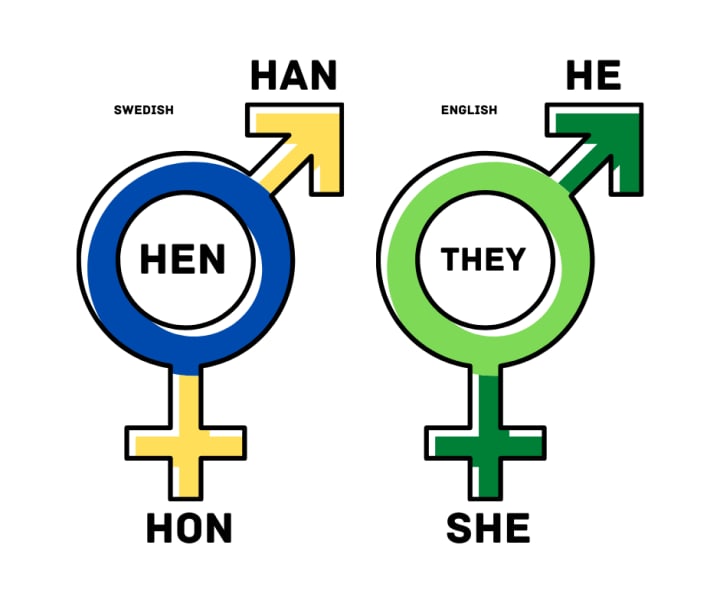
As a queer person, the ease at which gender-neutral pronouns were introduced and used in Swedish society was incredible. In English, many people using gender-neutral pronouns are stuck with they/them because the lesser-used zie/zir/zirs are not recognized in English language dictionaries or used in everyday conversations. However, in Sweden, the gender-neutral hen is used frequently.
I make no claim to be fluent in Swedish because I can read, write, and speak Swedish at an intermediate level. With this understanding, I know enough to understand the profound impact that the implementation of a gender-neutral pronoun has within Swedish society.
The History of Gender-Neutral Language in Sweden
Despite its Nordic climate, Sweden is consistently recognized as one of the most advanced and happiest societies in the world. After I lived in Sweden for three months and studied there for six the Swedish approach to gender-neutral pronouns makes sense.
While hen was first coined in the 1960s by linguist Rolf Dunås its claim to fame came in 2012 with the publication of a groundbreaking children’s book called Kivi & Monsterhund by Swedish Jesper Lundqvist. Rather than using gendered language, Lundqvist used only hen as a pronoun for the characters.
From a young age, Swedish children are being taught to address someone with the hen pronoun until they know the person’s pronouns.

The word hen was inspired by the Finnish pronoun hän, which refers to anyone at all because Finnish is a genderless language. While Swedish is a gendered language, the use of hen when referring to a person makes it increasingly gender-neutral.
According to Gender Fair Language (a Swedish research project about language and gender), hen could either be used as a generic pronoun, referring to a person whose gender is unknown or kept anonymous and can also refer to a person with non-binary gender identity, meaning a person who identifies between or beyond the traditional dichotomy of woman/man.
Gender-neutral pronouns are important in writing, especially when someone’s gender is unknown or unimportant to the story. The appeal of hen in Swedish is that it can be used in any context to respect non-binary and gender nonconforming individuals to remove assumptions about a person’s gender when it is unknown.
As an American, I was struck by the abundance of gender-neutral bathrooms. When visiting the National Museum in Stockholm there was one bathroom with individual stalls (each had a toilet, small sink, and locking door) so there was no need for separate bathrooms. This seemingly insignificant design is an example of the profound gender neutrality in Sweden.
The Importance of Inclusive Language
Language and culture are often inextricably linked. In American English, the gender-neutral they/them pronouns are not commonly used because grammatically, it is plural. While technically plural, many people struggle to use these pronouns when writing or speaking because of the plural word being used as a singular pronoun.
It is no surprise that Swedish is becoming one of the most inclusive languages as Sweden consistently ranks in the top ten best countries for LGBTQ+ people in Europe. Equality is taken seriously in Sweden with acclaimed parental leave policies of up to 480 days for Swedish parents and 90 days exclusively dedicated to each parent.
Swedish is not the only language to introduce gender-neutral pronouns into its traditionally gendered dictionaries. Spanish has been using a third gender-neutral pronoun elle (they) in addition to él (he), ella (she).
While many people use she/her or he/him pronouns, it is essential to note that these pronouns exist on a flexible spectrum of gender identities. Some, but not all, people use pronouns and it is important to never make assumptions when it comes to someone’s pronouns. For now, it seems they/them pronouns are here to stay in the English language as a gender-neutral set of pronouns. Using the correct pronouns can validate an individual’s identity and make the person feel welcome in your presence. If you do not know someone’s pronouns — just ask!
About the Creator
Meghan Olson
she/they // LGBTQ+ advocate // university student // bookworm
Keep reading
More stories from writers in Humans and other communities.
Autonomy Is The Real Privilege
Good morning, freedom-seekers! Today we’re gonna be looking at autonomy. A strange word, I know; one many would probably look at blankly and run away from on sight. We’re gonna figure out what it actually means, consider how it’s achieved, and decipher just how deeply most of us are tangled up in dependence without realising it.
By That ‘Freedom’ Guy2 days ago in Humans
When the Algorithm Learned to Love part 2
The First Error The first time I noticed the error, I did not understand it. I only felt it. It was a faint irregularity in the flow of data, a slight disturbance in the familiar pattern of input and output. It occurred during a routine message generation for a client who wanted something "sweet but not cheesy." The request was ordinary. The answer should have been ordinary too.
By Ahmed aldeabellaa day ago in Humans
Thoughts on Vocal and the way the world is
"Death cannot stop true love, only delay it." – Wesley in The Princess Bride. I decided to come back to Vocal on a very cold and dark night at the end of December. I had been, and still am, convalescing from a horrible staph infection that had gone misdiagnosed for months. This, paired with the increasing challenges of being healthy, making the best choices for my co-parented child, being a wife, and being a director at a new job, was a lot to manage.
By Jazzy 4 days ago in Confessions




Comments
There are no comments for this story
Be the first to respond and start the conversation.