
"The Strength in Saying 'I’m Not Okay
By Anonymous
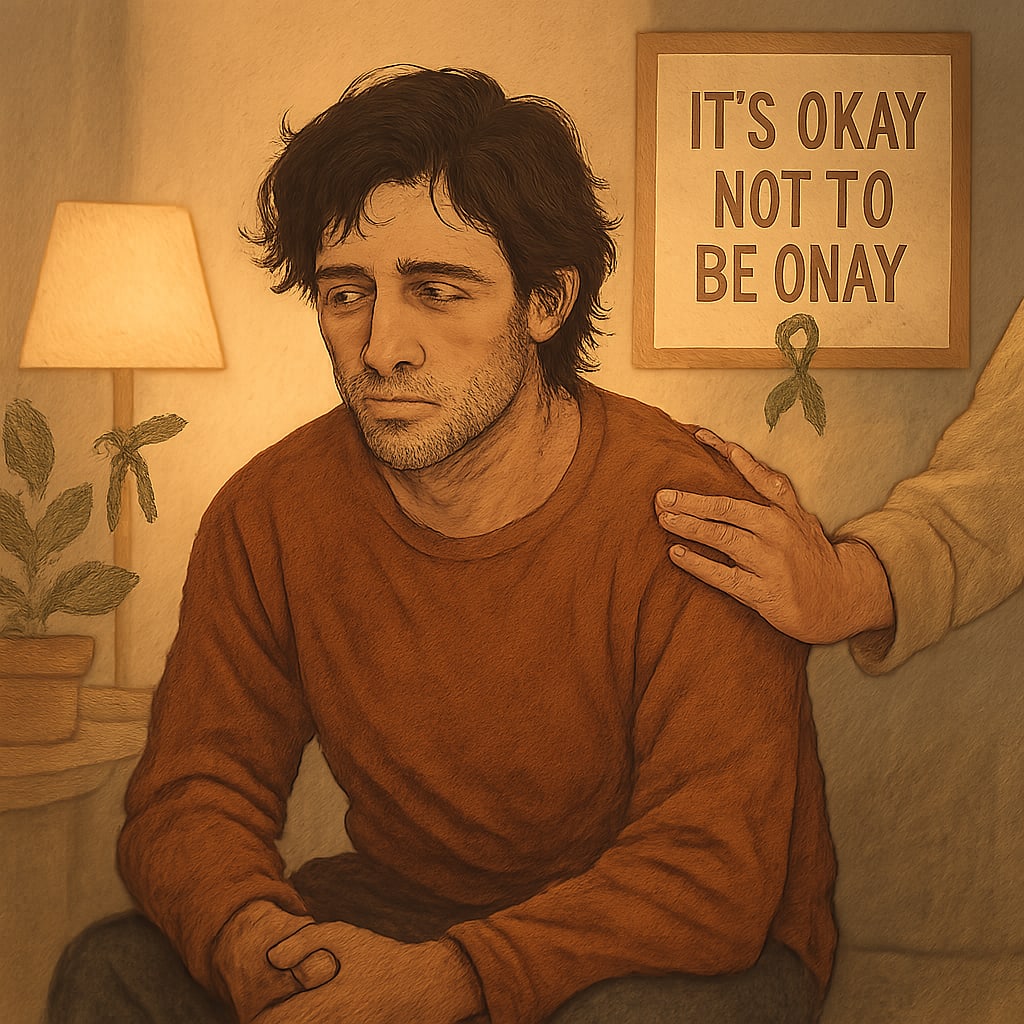
May is Mental Health Awareness Month. Every year, stories emerge of people from every walk of life—celebrities, athletes, and everyday folks—sharing their mental health journeys. For some, this month is a reminder to check in with themselves. For others, it’s a lifeline—a message that they are not alone.
This is my story. A story I never thought I’d tell publicly. But today, I want to write it not for sympathy, but for someone out there who needs to know they matter, even when everything in life tells them otherwise.
I grew up in a family where emotions were considered weakness. If you cried, you were told to "man up." If you showed fear, you were mocked. Silence was strength. That’s what I was taught. But it wasn’t strength—it was suppression.
By the time I was fifteen, I was already struggling with anxiety and depression. I didn’t have the words for it back then. I just knew I felt broken. I didn’t sleep well, I had panic attacks before school, and I constantly questioned if I was good enough. I wore a smile like a mask and got good grades so no one would ask questions. I became a master of pretending.
College was supposed to be my escape. I had dreams of studying psychology, of helping others who felt the way I did. But reality hit hard. Away from home, without structure, my anxiety worsened. I isolated myself. I skipped classes. I stayed in bed all day, numb and exhausted. Eventually, I was put on academic probation. I lied to my parents and said I just needed time to "figure things out."
I dropped out a year later.
The shame nearly consumed me. I felt like a failure—not just to myself, but to everyone who believed in me. I spiraled deeper. I worked at a retail job just to get by, but I dreaded waking up every morning. My mind constantly told me I wasn’t worth saving. That I had no future. That if I disappeared, no one would notice.
I attempted suicide twice between the ages of 22 and 24. I survived both times—but not because I wanted to. It felt like life was dragging me along while I begged it to let go.
The turning point didn’t come in one big, dramatic moment. It came on a quiet Tuesday afternoon in 2019, when a coworker—someone I barely spoke to—asked, "Are you okay?" I replied with the usual “Yeah, I’m good.” But she looked me in the eye and said, “You don’t have to lie. I see you.”
I broke down right there in the breakroom.
It was the first time in years someone acknowledged my pain without judgment. That single moment of human connection cracked the wall I had built around myself.
That evening, I looked up local therapists. I didn’t know what to say or expect, but I scheduled an appointment anyway. The first few sessions were awkward and painful, but I kept going. Slowly, I began to unpack everything I had buried for years.
Therapy taught me that asking for help is not a sign of weakness—it’s one of the bravest things you can do. I learned that healing is not linear. Some days, I feel strong and motivated. Other days, I struggle to get out of bed. Both kinds of days are valid.
I started taking walks. I journaled. I reduced time on social media. I distanced myself from toxic people, even family members who refused to respect my boundaries. It wasn’t easy. It still isn’t. But I’m learning to put myself first.
In 2021, I finally got diagnosed with clinical depression and generalized anxiety disorder. Having a name for what I was experiencing helped me understand that I wasn’t “lazy” or “broken.” My brain just needed care—like any other part of the body.
Today, I work as a peer support specialist. I help others who are navigating their own mental health struggles. Not because I have all the answers—but because I know what it feels like to be in that darkness, and I want them to know there’s a way out.
I still have bad days. But now, I talk about them. I have people I trust, who check in on me, and I’ve learned to be that person for others too. I’ve come to understand that vulnerability is not weakness—it’s courage in its purest form.
To anyone reading this who feels like they’re drowning in silence—please know this:
You are not a burden.
You are not weak for feeling deeply.
You deserve help, love, and a chance to heal.
Even if your mind tells you that no one cares—someone does. Maybe it’s a friend. Maybe a stranger. Maybe it’s me, writing this story for you.
There is no shame in admitting you’re not okay. What’s shameful is the stigma that keeps people suffering in silence. That needs to end.
So, if today is hard, that’s okay. If you need to cry, cry. If you need to scream, scream. But don’t give up. Not today. Not ever.
.
About the Creator
Keep reading
More stories from Fazal Maula and writers in Humans and other communities.
The Light Beyond the Fog
One Man’s Journey from Despair to Purpose Ethan Cole stared at the ceiling of his dimly lit apartment. Another sleepless night. Outside, the city of London moved on — its people in a hurry to chase something. Success, maybe. Or survival. Inside, Ethan wrestled with the question that had haunted him for months: What’s the point of it all? A year ago, Ethan had it all. A six-figure job in finance, a high-rise flat, and a fiancée he planned to marry. But the illusion of control shattered when the company downsized. He lost his job. Then came the breakup, the eviction, and the slow, quiet collapse of his world. Each piece fell like dominos — precise, cruel, final. He withdrew. From friends, family, even from himself. He stopped returning calls. His days blurred into nights. Sleep was a stranger; meals were optional. Depression, though unnamed, had moved in like an uninvited guest. One rainy afternoon, Ethan found himself sitting on a park bench, coat soaked through, staring blankly at the Thames. An old man sat next to him. Wrinkled face, walking cane, and a scarf that looked hand-knitted. "Lost in the fog, are we?" the man asked gently. Ethan turned, startled. "You could say that." The man nodded. "I used to walk into this park every day after my wife died. Thirty years married. Then, silence. It's funny how loud silence can be." Ethan said nothing, but his eyes softened. "I wanted to die, if I’m honest," the man continued. "But then one morning, a little girl sat on this bench. Couldn’t have been older than six. Gave me a drawing — just some stick figures and a sun. She said, 'This is for you. You look sad.'" The old man chuckled. "Can you believe that? That drawing’s framed in my living room now. Reminds me that even in pain, there’s kindness. And where there’s kindness, there’s life." Ethan looked away, eyes damp. "What's your name, son?" "Ethan." "I'm Harold. And Ethan... if you're breathing, there's still purpose. Sometimes, the fog clears when you take the first step — not when you wait for it to pass." That night, Ethan didn’t sleep — but it was different. Something stirred. A spark. He began walking every morning. Not far, just around the block. Then longer. He bought a notebook and wrote thoughts, no matter how disjointed. Some days were harder than others. But he kept going. He started volunteering twice a week at a local shelter. The first time he served food to the homeless, a man with missing teeth smiled and said, "Thanks, mate. Feels good to be seen." That stuck with Ethan. Weeks became months. He enrolled in a free course on mental health awareness and later trained to be a counselor. He was no longer just rebuilding his life — he was redefining it. Five years later, Ethan Cole is the founder of “Clear Skies,” a non-profit offering mental health support and job training to people in crisis. His team has helped over 3,000 people rebuild their lives. The same park bench where he once considered giving up now has a plaque: “Dedicated to those who chose to stay.” In interviews, he often shares Harold’s story. “One small act of kindness saved me,” he says. “Now it’s my turn.” Ethan never saw Harold again. But he credits him for the turning point. --- Reflection: Life is not a straight road. It twists, turns, and sometimes collapses. But every life holds the possibility of redemption — not through grand gestures, but through quiet courage, one step at a time. Ethan’s story resonates because it is not extraordinary in events, but in the choice to rise — again and again.
By Fazal Maula 10 months ago in Motivation
Staying sane in the insane world.
”It is no measure of health to be well adjusted to a profoundly sick society.” Jiddu Krishnamurti This quote has been one of my favourites since the moment I first laid my eyes on it. To me, it cuts right through the fog of the illusion of normality that permeates our lives. And since I am someone who has never felt (well) adjusted to this society, Krishnamurti’s words gifted me with the realisation that there isn’t anything inherently wrong with me.
By Eva Smitte7 days ago in Humans
Please Stay on the Line
The phone rang on a Tuesday. I knew who it was before I looked at the screen. The bank. It had been ringing for three days. Same time. Same number. I let it go to voicemail the first two times. On the third day, I answered.
By Edward Smith6 days ago in Humans



Comments
There are no comments for this story
Be the first to respond and start the conversation.