
The Shoe Behind The Toilet
Two years. Nine specialists. One breakdown & my pelvic floor

It was a Tuesday. I was kneeling on the bathroom floor helping my daughter find her other shoe – the one that's always, somehow, never where we left it. When I stood up, there was this dull pressure in my lower back. Like someone had their thumb pressed into the base of my spine.
I was 34. I'd slept funny before. Pulled muscles. This felt like that.
I took two ibuprofen from the bottle on top of the fridge – the one with the childproof cap I could never quite close properly – and forgot about it. My daughter found her shoe wedged behind the toilet. We were late for school. Life moved on.
Except it didn't go away.
Two years. Nine specialists. One breakdown in a Barcelona emergency room. A £400 chair I used for three weeks. And one random comment from my best friend that finally cracked everything open.
But I'm getting ahead of myself.
The Beginning
A week later, I was sitting at my desk when I noticed I'd been shifting in my chair for the past hour, trying to find a position that didn't feel wrong. Not painful, exactly. Just... wrong. Like wearing jeans that are slightly too tight. You can ignore it for a while, but eventually it's all you can think about.
I started paying attention to my back in a way I never had before. How it felt when I bent down to load the dishwasher. How it tightened when I reached for something on a high shelf. The weird pulling sensation when I tried to put on my socks in the morning, balancing on one foot like a stork.
Two months in, I'd developed what I can only describe as a repertoire of movements. I'd lower myself into chairs carefully, using my arms. I'd brace against the counter when I bent to open the oven. I'd wake up in the morning and lie there for a minute, mentally preparing for the act of getting vertical.
My daughter started noticing. "Why do you make that sound, Mama?" she asked one morning.
"What sound?"
"That hhhh sound. When you pick things up."
I hadn't even realized I was doing it.
I bought things. A lumbar support pillow for my desk chair – blue, with memory foam that smelled like chemicals. A new mattress, medium-firm, that the guy at the store promised would "change my life." A standing desk converter that I used religiously for three days before my legs hurt and I went back to sitting. An ergonomic chair that cost £400 and came with an instruction manual.
Nothing helped. Or maybe everything helped a little, for a while, and then didn't.
Dr. Morrison
The first doctor I saw was Dr. Morrison. I remember everything about that appointment with the kind of clarity that comes from humiliation.
He was tall, maybe in his early fifties, with silver hair combed back and reading glasses that hung from a chain around his neck. His office smelled like antiseptic and old coffee. He didn't look up from his computer when I came in.
"So," he said, still typing, "back pain."
I told him everything. How it had started, how nothing helped, how it was affecting my ability to parent, to work, to sleep. I could hear my voice getting higher, more desperate, as I talked. I hated how I sounded but I couldn't stop.
He examined me – quick, perfunctory movements. Press here. Bend forward. Turn. His hands were cold.
"Your range of motion is fine," he said, already walking back to his desk. "X-rays show normal age-related changes. You're carrying some extra weight – that's not helping." He glanced at me over his glasses. "Are you exercising regularly?"
I felt my face get hot. "I try, but the pain – "
"Pain is often just our body telling us we're out of shape." His voice had that practiced patience people use when they're explaining something obvious to someone slow. "Lose fifteen pounds, do some core work. Physical therapy referral is printing now."
The whole appointment had taken twelve minutes. I know because I checked my phone in the parking lot while I cried.
Barcelona
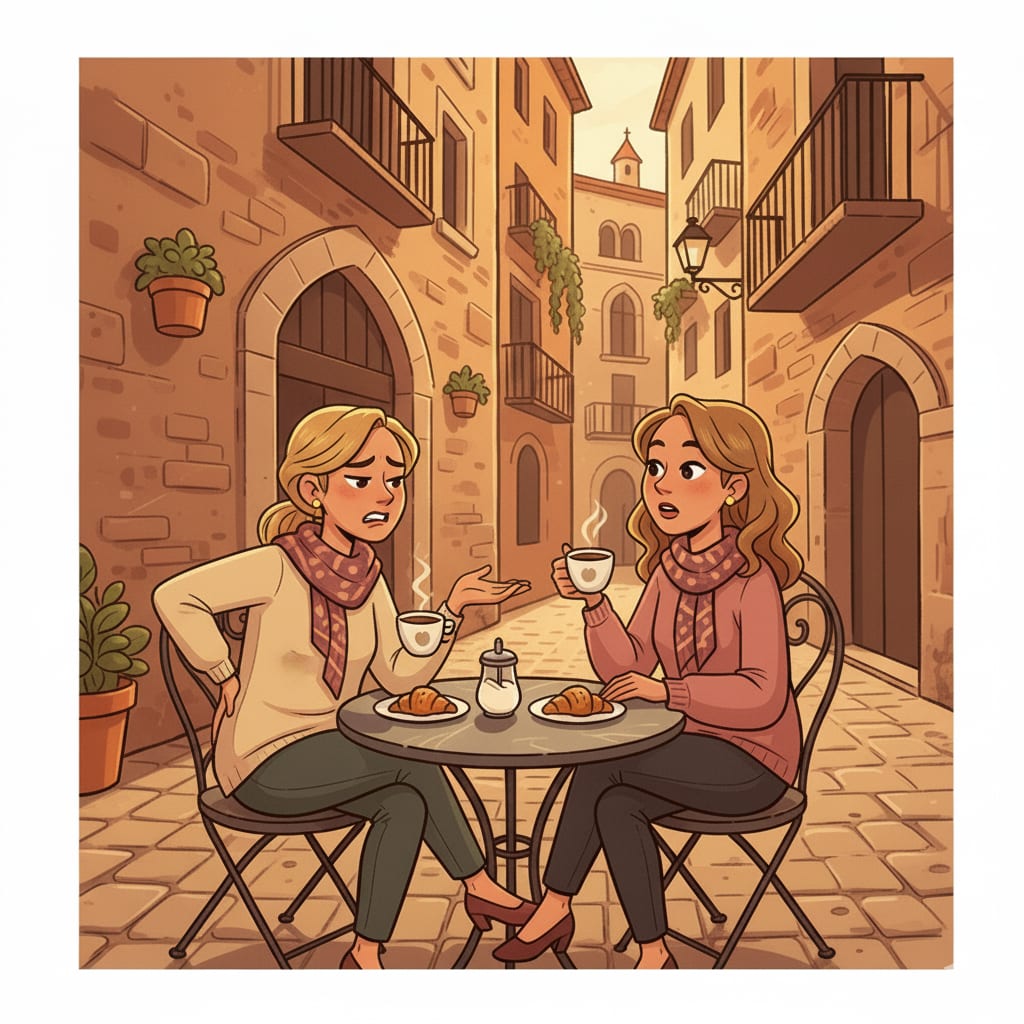
Six months later, Mira convinced me to go to Barcelona with her.
Mira and I had been friends since university – we'd survived terrible boyfriends, worse hangovers, and a truly regrettable decision to get matching tattoos in our twenties. She was the kind of friend who showed up. Always. When my marriage fell apart, she'd slept on my couch for a week. When my daughter was born, she was the second person to hold her.
"You need this," she'd said, booking the flights before I could argue. "When's the last time you did something for yourself?"
I couldn't remember.
Barcelona was supposed to be five days of tapas and museums and sitting in sunny plazas drinking wine. We'd planned it for months. Mira had made a spreadsheet. An actual spreadsheet with color coding.
On day two, we were walking through the Gothic Quarter – those narrow, winding streets that feel like walking through history – when my back seized. Not the usual ache. Something different. Sharp. Radiating.
I stopped walking. Couldn't move.
"Janey?" Mira turned back. "You okay?"
I tried to say yes but what came out was more like a gasp.
Her eyes went wide. She was next to me in a second, hand on my arm. "Okay. Okay, let's sit down."
"I can't." My voice didn't sound like mine. "I can't bend."
A couple of tourists flowed around us like water around a stone. Someone tutted.
"Right." Mira's voice shifted into what I called her crisis mode – calm, focused, the voice she used in her job managing hospital logistics. "We're going to the hospital. Now."
"Mira, no, I just need – "
"Now, Janey." She was already flagging down a taxi, one arm around me, holding me up. "I've seen you push through a lot of shit. This isn't that."
The taxi driver took one look at me and started talking rapid Spanish into his phone. Mira's Spanish was tourist-level at best, but she managed to communicate "hospital" and "rapido" enough times that he nodded seriously and pulled into traffic like we were in a movie.
I remember the drive in fragments. The driver's rosary swaying from the rearview mirror. Mira's hand gripping mine. The way the sun looked coming through the buildings. The absolute certainty that something was very, very wrong.
"Remember when you carried me home from that bar in Camden?" I said.
"You'd had that questionable tequila."
"This is worse than that."
"Nothing's worse than that. You threw up in a plant."
I tried to laugh and it came out as a sob.
"Hey." She squeezed my hand. "I've got you. Whatever this is, I've got you."
The emergency room was chaos – crying children, a man with a bloodied towel around his hand, fluorescent lights that made everything look sickly. Mira strong-armed her way to the front desk, a mix of English and Spanish and pointing.
I don't remember much of what happened next. They gave me something for the pain. The ceiling was very white. Someone spoke to me in English with a thick accent, asking questions I couldn't quite follow. Mira answered most of them, somehow knowing things about my medical history I'd forgotten I'd told her.
The Spanish doctor – younger than Dr. Morrison, with kind eyes and tired smile – examined me gently. He asked questions. Actually listened to the answers. Ordered tests.
Four hours later, I had a diagnosis: a herniated disc that was compressing a nerve. Acute. Serious. Treatable.
"Why didn't anyone find this before?" I asked.
The doctor shrugged. "Sometimes we need the right image at the right time. Sometimes we need to listen better."
Mira stayed with me the entire time. She called my mom to check on my daughter. Rescheduled our flights. Sat in uncomfortable plastic chairs and made jokes about hospital food until I could smile without it hurting.
That night, back at our hotel with a prescription and a plan, she ordered room service and we watched Spanish television we couldn't understand.
"Thank you," I said.
"For what? Ruining our vacation with medical drama?"
"For seeing it. When I couldn't."
She reached over and squeezed my hand. "That's what I'm here for. That, and making sure you don't die in a foreign country before you finish that novel you keep talking about writing."
"I'm never going to write that novel."
"I know. But I'm still not letting you die."
The Long Road
That Barcelona diagnosis was a turning point, but not the end. The herniated disc was real, and treating it helped – for a while. But even after the acute episode resolved, the pain never fully left. It morphed, moved, became something harder to pin down.
I saw more specialists. Did more physical therapy. The exercises helped some, but I always seemed to plateau, never quite getting back to "normal." There were good weeks where I'd think maybe this was it, maybe I was finally past it. Then bad weeks that sent me spiraling back.
My daughter learned to recognize my "pain face" – a thing no six-year-old should have to notice. She started asking before suggesting activities. "Is your back okay for that, Mama?" It broke my heart every time.
I tried acupuncture. Massage. A chiropractor who promised miracles and delivered temporary relief and a lighter bank account. I bought books, watched videos, joined online support groups where people swapped stories of pain and frustration like trading cards.
What I didn't tell most people was how exhausting it was. Not just physically – though that was real – but emotionally. The constant vigilance. The mental energy of managing pain. The guilt of canceling plans. The fear that this was just my life now.
I became someone I didn't like very much. Short-tempered. Withdrawn. My world got smaller.
The Unraveling
My lowest point came on a Saturday afternoon. One of those perfect autumn days – golden light, crisp air, leaves crunching underfoot. Mira had come over with her new boyfriend, and my daughter was playing in the backyard.
"Let's walk to the park," Mira suggested. "It's gorgeous out."
I looked at my daughter's hopeful face. At Mira's encouraging smile. At the beautiful day outside.
"I can't," I said.
"We'll go slow – "
"I said I can't!" It came out sharper than I meant it to.
Everyone went quiet. My daughter's face fell. Mira's boyfriend suddenly became very interested in his phone.
"Okay," Mira said quietly. "That's okay."
But it wasn't okay. They went to the park without me. I sat on the couch, alone in my house on a beautiful day, crying because I'd snapped at the people I loved most. Crying because I was tired. Because I hurt. Because I couldn't see an end to any of it.
That night, after everyone had gone home, I lay in bed scrolling through my phone with that particular brand of desperate hope that comes at 2 AM. Looking for something. Anything. An answer I'd somehow missed.
The Missing Piece
It was Mira who changed everything, weeks later. We were having coffee – decaf for her now, she was trying to get pregnant – and she was telling me about her fertility specialist.
"She asked all these questions about my core and pelvic floor," Mira said. "Apparently everything's connected. She said a lot of back pain is actually – " She paused, noticing my expression. "What?"
"Nothing. Just... go on."
"She said a lot of back pain is actually related to pelvic floor dysfunction. That the muscles work together, and if one part is off, it can cause pain in weird places."
I felt something click in my brain. "Like how?"
"Like... your pelvic floor is part of your core system, right? So if those muscles aren't working properly – especially after having kids – it can affect your back, your hips, everything." She pulled out her phone. "My PT was explaining it. Hold on, she mentioned this one specialist who talks about it really clearly."
She showed me a video. A woman named Lauren Ohayon was explaining the connection between the pelvic floor and back pain in a way that made immediate, obvious sense. She used this analogy about pulling on one end of a shirt and feeling the tug all the way through to the other end.
"Watch this later," Mira said. "It just... made me think of you."
I nodded, not really believing it would help. I'd watched so many videos. Read so many articles. What was one more?
That night, after my daughter was asleep, I watched it. Then I watched it again.
Lauren was explaining how the pelvic floor, the core, the low back – they're all part of one system. How you can't just separate these body parts out and treat them individually. What got me was when she talked about how people with back pain start bracing – locking down movement, restricting how they move, trying to protect themselves. And how that locking down creates this cascade effect. The hips get involved. The knees. Everything starts compensating.
That was me. That was exactly what I'd been doing.
I paused the video. Sat there in the blue glow of my laptop screen.
Pelvic floor symptoms. Hip pain. Lack of hip mobility. Constantly gripping. I had all of that. I'd just never connected it to my back pain.
I spent the next three hours reading everything I could find. About how these muscles work together. About how tension in one area radiates to another. About how pregnancy changes things, sometimes permanently. About postural patterns and breathing and how everything affects everything else.
It made sense. Suddenly, painfully, obviously, it made sense.
I found a program that addressed all of these connections – not just exercises for my back, but a whole-body approach that included the pelvic floor work nobody had ever mentioned to me. Lauren's program, Restore Your Core, became my roadmap. I started working through it slowly, carefully, learning to connect with muscles I didn't even know I could control.
The next morning, I texted Mira: "That video. Thank you."
She replied immediately: "Yeah?"
"Yeah."
Coming Home
I'm not going to tell you everything changed overnight, because it didn't. Real healing rarely does. But for the first time in two years, I had a framework that made sense. A path forward that addressed the actual problem, not just the symptoms.
I learned to breathe differently. To release tension I didn't know I was holding. To strengthen muscles that had been dormant since my daughter was born. The work was subtle, internal, nothing like the dramatic exercises and stretches I'd been doing.
The pain started to shift. Not disappear – not at first – but shift. It became less constant, less consuming. I had good days, then good weeks.
Last month, I took my daughter to the park. We stayed for two hours. I pushed her on the swings, we walked the trails, and when we got home, I felt tired in that good, earned way. Not the exhausting tiredness of pain management, but the simple tiredness of having moved my body in the world.
Mira came over for dinner that night. "You seem different," she said, watching me move around the kitchen without that careful, guarded quality I'd carried for so long.
"I feel different," I said.
"Barcelona callback?"
I laughed. "Yeah. But better. Because this time I figured it out myself. With your help."
"Always," she said, raising her wine glass. "That's what I'm here for."
I still have moments. This kind of journey isn't linear, and I'm learning to be patient with myself. But I'm not that person on the couch anymore, saying no to life because I'm afraid of my own body.
I'm just someone who learned that sometimes the answer isn't where you've been looking. Sometimes it's in the places we forget to check, in the connections we don't think to make, in the quiet foundation we've been standing on all along.
And sometimes, you need a friend who'll get you to a Barcelona emergency room and stay with you through all the hard parts that come after.
About the Creator
Janey Dietsman
Writer. Mom. Usually have at least three tabs open about something I'm trying to figure out. I write personal essays about health stuff, parenting, and the general chaos of being a person.
Keep reading
More stories from writers in Humans and other communities.
My First Time Skiing and I Got Lost, Alone, in the French Alps
Looking back, I can trace some of my life’s biggest adventures to a simple action from my sister. She’d introduced me to Tommy (a very long time ago), a colleague of hers, who had overshared his penchant for Italian-looking women, and I ticked that box.
By Chantal Christie Weiss2 days ago in Humans
Sometimes It's Like That and That'sThe Way It Is
It was the late 1960s, and ten-year-old Gloria Coleman was standing with her grandmother on the side of the highway waiting for the bus. As the Greyhound pulled up, it seemed monstrous and intimidating. Grandma Elizabeth grabbed Gloria's hand, holding it tightly as they boarded.
By Cheryl E Preston2 days ago in Fiction



Comments
There are no comments for this story
Be the first to respond and start the conversation.