
"The Pulse of Humanity in a Digital Age"
"Exploring the Emotional, Ethical, and Existential Questions of Being Human in an Ever-Connected World"
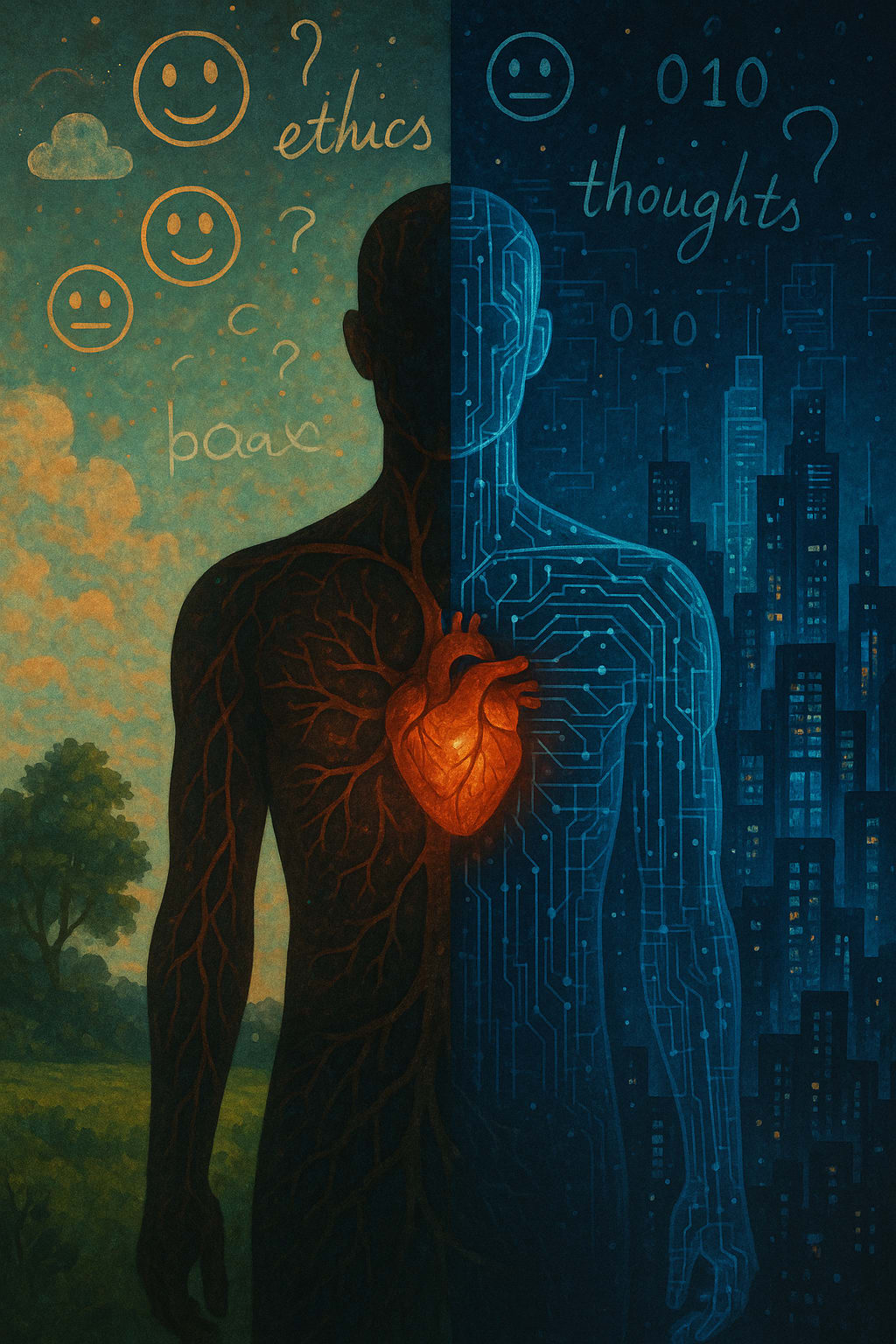
Exploring the Emotional, Ethical, and Existential Questions of Being Human in an Ever-Connected World
We live in a time when technology is advancing faster than ever before—when artificial intelligence can compose music, diagnose illness, write essays, and simulate human conversation. Social media has turned strangers into communities and thoughts into metrics. In this whirlwind of constant innovation, we are left to face a profound and unavoidable question: What does it mean to be human in the digital age?
The heartbeat of humanity—our emotions, ethics, and existential self-awareness—is now pulsing in a digital rhythm. While we celebrate the miracles of modern tech, from smart homes to virtual assistants, we must also ask how these tools shape our understanding of ourselves and each other. Are we gaining clarity, or are we losing something essential?
Emotionally, the digital world has become both a sanctuary and a battlefield. We can connect instantly with friends across the world, form bonds in online communities, and find support in times of crisis. A single post can start a global movement or bring comfort to someone in silence. Yet, in this same space, we also encounter emotional detachment, performative empathy, and the numbing repetition of curated lives. We scroll through suffering and celebration in the same feed, often unsure how to truly feel or respond.
Social media, for all its connectivity, has conditioned us to equate likes with love, attention with validation. This rewiring of emotional expression can erode genuine connection and foster anxiety, comparison, and loneliness. Paradoxically, we are surrounded by more communication than ever, yet many of us feel more isolated. Are we listening, or just reacting?
The ethical dimension of this digital evolution is equally complex. With the rise of artificial intelligence and machine learning, we're creating systems that can make decisions, recognize patterns, and even mimic empathy. But should they? Algorithms now recommend our next book, predict our behavior, and even influence justice systems through predictive policing. As machines take on roles that once required deeply human judgment, we must redefine responsibility and accountability.
Who is to blame when an algorithm discriminates? How do we ensure that data collection does not turn into surveillance? And what rights should we have over our digital selves—our photos, thoughts, preferences, and memories now scattered across servers around the globe? These questions challenge our assumptions about privacy, fairness, and freedom.
At an existential level, technology is reshaping the very boundaries of human identity. The idea that consciousness might one day be digitized, that memories might be preserved eternally, or that human cognition might merge with machines, is no longer confined to science fiction. It is the stuff of headlines, venture capital dreams, and ethical debate.
Does uploading a memory preserve the self or create a copy? Can a machine truly understand what it means to love, to suffer, or to hope? As we move toward increasingly sophisticated simulations of human behavior, we are forced to confront the possibility that humanity might become something more—or less—than what it has always been.
And yet, despite these deep and daunting challenges, there is also immense opportunity. Humanity is not a fixed concept. It has evolved through ages of storytelling, migration, innovation, and adaptation. The digital age is simply another chapter—one that we have the power to write with empathy, ethics, and wisdom.
We can choose to build technology that empowers rather than exploits. We can foster online spaces that nourish truth, creativity, and inclusion. We can teach our children not just how to code, but how to care. The tools of the digital age are neutral by design—it is our intent and action that give them meaning.
The pulse of humanity has always been more than a heartbeat; it is our stories, our choices, our relationships, and our values. As that pulse syncs with digital rhythms, we must remain conscious of who we are and what we wish to become. This era is not about resisting technology—it’s about infusing it with humanity.
Because in the end, being human isn’t about staying the same. It’s about choosing how we evolve.
About the Creator
Muhammad Faizullah
i am a article writer. we write a interesting writing .
Keep reading
More stories from Muhammad Faizullah and writers in Humans and other communities.
Living Through the Storm: Survival Skills for the 21st Century
It wasn’t always this loud. The world, I mean. There was a time when mornings weren’t accompanied by a flood of notifications, when conversations didn’t compete with scrolling thumbs, and when uncertainty was the exception—not the air we all breathed. But somewhere between the rapid rise of technology and the unraveling of once-solid structures—jobs, relationships, the environment—it began to feel like life itself had turned into a storm. And we, unwittingly, were learning how to live through it.
By Muhammad Faizullah8 months ago in History
Autonomy Is The Real Privilege
Good morning, freedom-seekers! Today we’re gonna be looking at autonomy. A strange word, I know; one many would probably look at blankly and run away from on sight. We’re gonna figure out what it actually means, consider how it’s achieved, and decipher just how deeply most of us are tangled up in dependence without realising it.
By That ‘Freedom’ Guyabout 19 hours ago in Humans
Why I No Longer Sell on Amazon
When I published my first book in 2011, I used Lulu. At the time, it was one of the few print-on-demand options that allowed authors to retain control over content, pricing, and distribution. Over the years, I explored other publishing routes, including limited digital placement on Amazon Kindle, but I remained consistent with Lulu for physical books. As of this writing, I am still evaluating whether those remaining Kindle titles will stay available.
By Dr. Mozelle Martin6 days ago in Humans


Comments
There are no comments for this story
Be the first to respond and start the conversation.