
The Proxy Mother: The Wrong Number That Became a Sacred Duty
In 2006, a phone rang in the middle of the night in Kansas. On the other end was a dying soldier in Iraq who thought he was calling home. The stranger who picked up had ten seconds to decide whether to correct him or to comfort him.

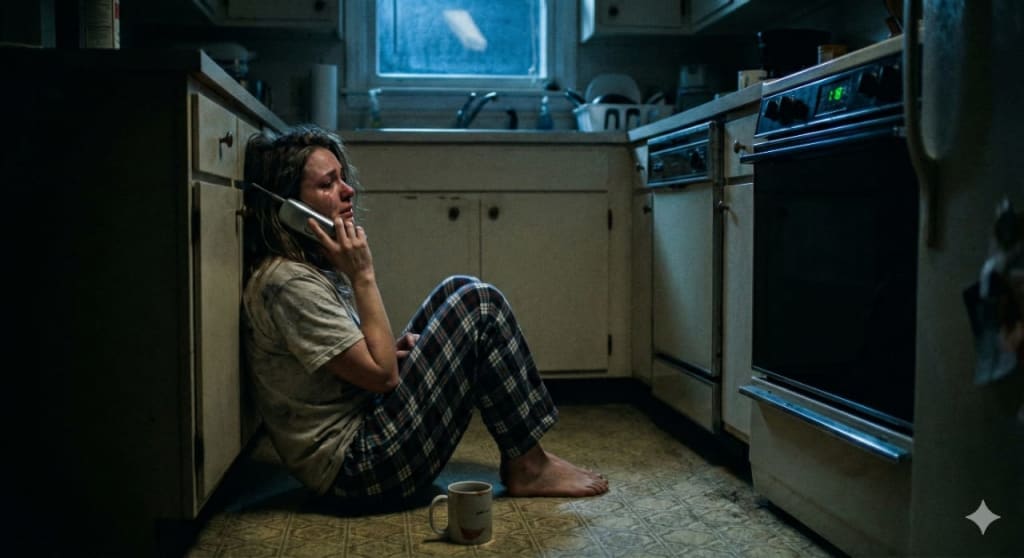
The heart-wrenching true story of Sarah Whitman, who answered a wrong number from a dying soldier in Iraq and chose to comfort him in his final moments, proving that humanity transcends bloodlines.
Introduction: The Witching Hour in the Heartland
The plains of Kansas have a specific kind of silence at 1:00 AM. It is a silence made of wind moving through wheat and the distant, rhythmic hum of the interstate. It is a safe silence.
In 2006, Sarah Whitman lived inside this silence. She was 32 years old, a woman with a normal job, a normal house, and a normal life. She was not a soldier. She was not a crisis negotiator. She was someone who slept with her phone on the nightstand, just in case of a family emergency.
On a Tuesday night in November, the phone rang.
It was a landline—a cordless phone sitting in its cradle. The sound was a jarring, electronic trill that sliced through the dark bedroom.
Sarah woke up with a start. 1:18 AM.
Calls at this hour are never good news. They are accidents, drunk dials, or tragedies.
She fumbled for the handset, blinking the sleep out of her eyes. She pressed talk.
"Hello?"
There was no immediate answer. just a wash of static—the kind of hollow, oceanic white noise that suggests the signal is bouncing off a satellite halfway around the world.
"Hello?" she said again, irritated now. "Who is this?"
Then, a voice cut through the static. It was young, male, and trembling.
"Mom?"
Sarah froze. She didn't have a son old enough to call her. She didn't have children in trouble.
"I think you have the..." she started to say.
But then she heard the background.
It wasn't a party. It wasn't a bar.
She heard shouting. Men’s voices screaming commands. She heard a mechanical thumping sound—whup-whup-whup—that sounded like rotor blades. She heard a metallic clattering.
"Mom," the voice said again. "It’s... it’s bad. I messed up."
Part I: The Geography of the Call
The call was coming from 7,000 miles away.
Private Daniel Ruiz (name changed for privacy in some retellings, though the story remains constant) was 19 years old. He was deployed in the Anbar Province of Iraq.
Minutes earlier, his patrol had been hit by an IED (Improvised Explosive Device). The Humvee was a wreck. Daniel had been thrown. He had taken shrapnel to the abdomen and legs.
In the chaos of the "Golden Hour"—that frantic window where survival is determined—Daniel had done what many wounded soldiers do. He reached for home.
He had pulled a satellite phone or a borrowed cell phone from a buddy. His hands were slick with blood. His vision was blurring from shock. He had punched in the number of his childhood home in Oregon.
But in his delirium, or perhaps because of a fat finger on a small keypad, he missed a digit.
Instead of reaching Oregon, the signal bounced to a small house in Kansas.
He was bleeding out in the dirt. He was cold. And he wanted his mother.
Part II: The Split-Second Choice
Back in Kansas, Sarah Whitman sat up in bed. She was fully awake now.
The human brain is an incredible processor of context. In three seconds, Sarah pieced it together. The static. The delay. The specific tenor of the fear in the boy’s voice. The noise in the background.
This is a soldier, she realized. And he is dying.
She looked at the clock. 1:19 AM.
She had a choice. It was a choice that would define the rest of her life, and certainly the end of his.
The "correct" thing to do—the logical, honest thing—was to say: "I’m sorry, sweetie, you dialed the wrong number. Hang up and try again."
But Sarah knew, with a gut-wrenching certainty, that he didn't have time to try again. If he hung up, he might pass out before he could redial. He might die listening to a busy signal.
She realized he didn't need his mother specifically. He needed a mother. He needed the archetype. He needed the voice of a woman who loved him, to anchor him to the earth while he was drifting away.
Sarah swallowed the lump in her throat. She gripped the phone so hard her knuckles turned white.
She lied.
"I'm here, sweetheart," she said. Her voice was steady, warm, and maternal. "I'm right here."
Part III: The Conversation
"I can't feel my legs, Mom," Daniel said. His voice was slurring. "It's really cold."
"I know, baby," Sarah said. She got out of bed and walked into the kitchen. She sat on the cold linoleum floor. She needed to be grounded. "I know it hurts. But you're so brave. You are doing so good."
"I didn't want to... I didn't want to die here," he stammered.
"Don't talk like that," Sarah said softly. "You just focus on my voice. Just listen to me."
"I'm scared," he whispered. "I'm really scared."
"I know," Sarah said. Tears were streaming down her face, hot and fast, but she kept them out of her voice. She forced a smile into her tone, the way mothers do when they are terrifyingly worried but need to be strong for their child. "But you are not alone. I am with you. I am holding your hand right now. Can you feel that?"
"Yeah," he breathed. "Yeah."
Sarah realized she needed to take him out of the desert. She needed to transport him.
"Tell me about the morning," she said. "Is the sun coming up?"
"No," he said. "It's night. It's dark."
"Well, it's morning here," she lied (or perhaps told a half-truth about the coming dawn). "I'm making coffee. You know how the house smells when the coffee is brewing? That warm, nutty smell?"
"Yeah," he said. "I like that smell."
"It's a beautiful morning," she continued. "The birds are going to start singing soon. It's going to be a warm day. Safe. Quiet."
She painted a picture of domestic peace. She built a sanctuary out of words.
On the other end of the line, the chaos was fading. The shouting was still there, but it was distant. Daniel was focusing on the voice. The adrenaline was fading, replaced by the heavy curtain of blood loss.
"Mom?"
"Yes, honey?"
"Did I be good? Was I... did I do okay?"
This is the question at the end of every life. Did I matter? Was I good?
"You were perfect," Sarah said, her voice cracking slightly. "You are the best son a mother could ask for. I am so proud of you. I love you so much."
"I love you too," he whispered.
Part IV: The Interruption
The connection held for maybe four or five minutes.
Then, Sarah heard a new voice on the line. It was closer, urgent.
"Ruiz! Ruiz! Stay with me, buddy!"
It was a medic.
Then, the phone muffled. She heard rustling.
"Ma'am?" A new voice. Harsh, breathless. "Who is this?"
Sarah didn't know what to say. "I'm... I'm his mother," she said, maintaining the ruse for Daniel's sake, in case he could still hear.
"Ma'am, he's hit bad," the medic said. "We're loading him onto the bird. I have to go."
"Tell him I love him," Sarah pleaded. "Please, just tell him I love him."
"I will," the medic said. "I have to clear the line."
Click.
The line went dead.
Part V: The Silence of Kansas
Sarah Whitman sat on her kitchen floor holding a cordless phone that was now emitting a dial tone.
The silence of the house rushed back in. The refrigerator hummed. The wind blew outside.
But the world had changed.
She felt a physical emptiness in her chest. She had just walked a stranger to the threshold of death. She had just impersonated a woman she didn't know, to comfort a boy she had never met.
She didn't go back to sleep. She couldn't.
She made coffee. She sat on her porch and watched the sun actually come up. She watched the Kansas morning that she had promised Daniel.
And she wondered: Who was he? Did he make it?
Part VI: The Quest for Closure
Most people would have left it there. They would have treated it as a bizarre, traumatic dream.
But Sarah couldn't. She carried a burden now. She knew something that the real mother didn't know.
She knew Daniel's last words.
She contacted the Red Cross. She contacted the Army casualty assistance office.
It was a nightmare of bureaucracy. She didn't have his full name—she only heard "Ruiz." She didn't have his unit. She only had the time of the call and the fact that it was a wrong number likely intended for an area code similar to hers (or perhaps a keypad error like 785 vs 758).
For days, she was stone-walled. Privacy laws are strict. The military doesn't just hand out names of casualties to random women in Kansas.
But Sarah was persistent. She explained the story to a sympathetic officer. She explained the time stamp.
Eventually, the pieces fit.
Private Daniel Ruiz. Deceased.
The timeline matched. The location matched.
Sarah asked for the contact information for the next of kin. The officer hesitated, but eventually, perhaps moved by the story, he agreed to pass Sarah's information to the mother, rather than the other way around.
Part VII: The Letter
A week later, Sarah’s phone rang.
It was a woman in Oregon. Her voice was hollowed out by grief.
"You said... you said you spoke to my Danny?" the woman asked.
Sarah took a breath. "Yes. He called my number by mistake. I think he was trying to call you."
There was a long silence. Sarah could hear the woman trembling.
"He died alone," the mother sobbed. "The Army said he died in transport. They said he was unconscious."
"He wasn't alone," Sarah said firmly.
And then, she told her the truth.
She didn't tell the mother that she had lied. She framed it gently.
"He thought he was talking to you," Sarah said. "He called out for you. And I answered him. I didn't want him to be scared, so I... I just talked to him. I told him you loved him. I told him you were proud of him."
Sarah recounted the conversation. She told the mother about the coffee. She told her about the birds. She told her that his last words were "I love you."
On the other end of the line, the sobbing changed. It went from the jagged, panicked crying of a mother who imagines her son terrified and lonely, to the softer, deeper weeping of a mother who knows her son was comforted.
"You pretended to be me?" the mother asked.
"I tried to be you," Sarah said. "I just didn't want him to hear a stranger's voice."
"Thank you," the mother whispered. "Oh my god, thank you. You were his voice of home when I couldn't be there."
Part VIII: The Two Mothers
The two women stayed in touch. They were bound by a tragedy that defied probability.
Sarah Whitman had performed a service that has no name. It wasn't medical. It wasn't military. It was spiritual.
She had stood in the gap.
In the years that followed, the story circulated quietly in military communities. It became a sort of parable about the interconnectedness of home and front.
But for Sarah, it wasn't a parable. It was a memory of a voice.
She thinks about Daniel every Veterans Day. She thinks about him every time the phone rings late at night.
She thinks about the strange, beautiful mercy of a wrong number.
Conclusion: The Ministry of Presence
We often think of technology as something that distances us. We complain about phones, about disconnection.
But in this case, a glitch in the network allowed for a profound connection.
Sarah Whitman’s story teaches us something vital about the human spirit.
When we are stripped of everything—when we are dying, when we are scared, when we are hurt—we don't ask for money. We don't ask for status.
We ask for a hand. We ask for a voice.
We want to know that we are not disappearing into the void unnoticed.
Sarah Whitman proved that you don't need to share blood to share humanity. You don't need to know someone's name to love them for ten minutes.
She taught us that in the end, we are all just walking each other home. And sometimes, if you are lucky, a stranger will pick up the phone and walk with you for the last mile.
About the Creator
Frank Massey
Tech, AI, and social media writer with a passion for storytelling. I turn complex trends into engaging, relatable content. Exploring the future, one story at a time
Keep reading
More stories from Frank Massey and writers in Humans and other communities.
Late Night Thoughts Part 2
Last Night I Did not sleep, which if you know me well that should not surprise you. The Last Time I had Late Night thoughts I wrote 4 books about them and published them on amazon. And while I do not regret writing or publishing those books they are not me anymore. Not even in the slightest.
By Amanda Nicole4 days ago in Humans
Wild Card Weekend Recap: What Happens Now?
I think I figured out why I love Wild Card Weekend so much. It's because it's the first playoff anything of the calendar year. The NFL season starts in the fall, and once upon a time, the champion was crowned either on or slightly before New Year's. The evolution of the NFL schedule has resulted in the playoffs starting just into the New Year, and currently, the final week of the season falls on the first weekend of the New Year, with Wild Card Weekend coming a week after that. So yes, chronologically, the NFL's Wild Card Weekend serves as the first playoff anything of the calendar year.
By Clyde E. Dawkins7 days ago in Unbalanced



Comments
There are no comments for this story
Be the first to respond and start the conversation.