
The Debt of the Morning Wave: Arthur Coleman and the Dog Who Waited
In 2019, a 71-year-old retired mailman watched a house burn in Sacramento. The fire department was minutes away. The neighbors were screaming to stay back. But Arthur knew who was inside, and he decided that some friendships are worth burning for

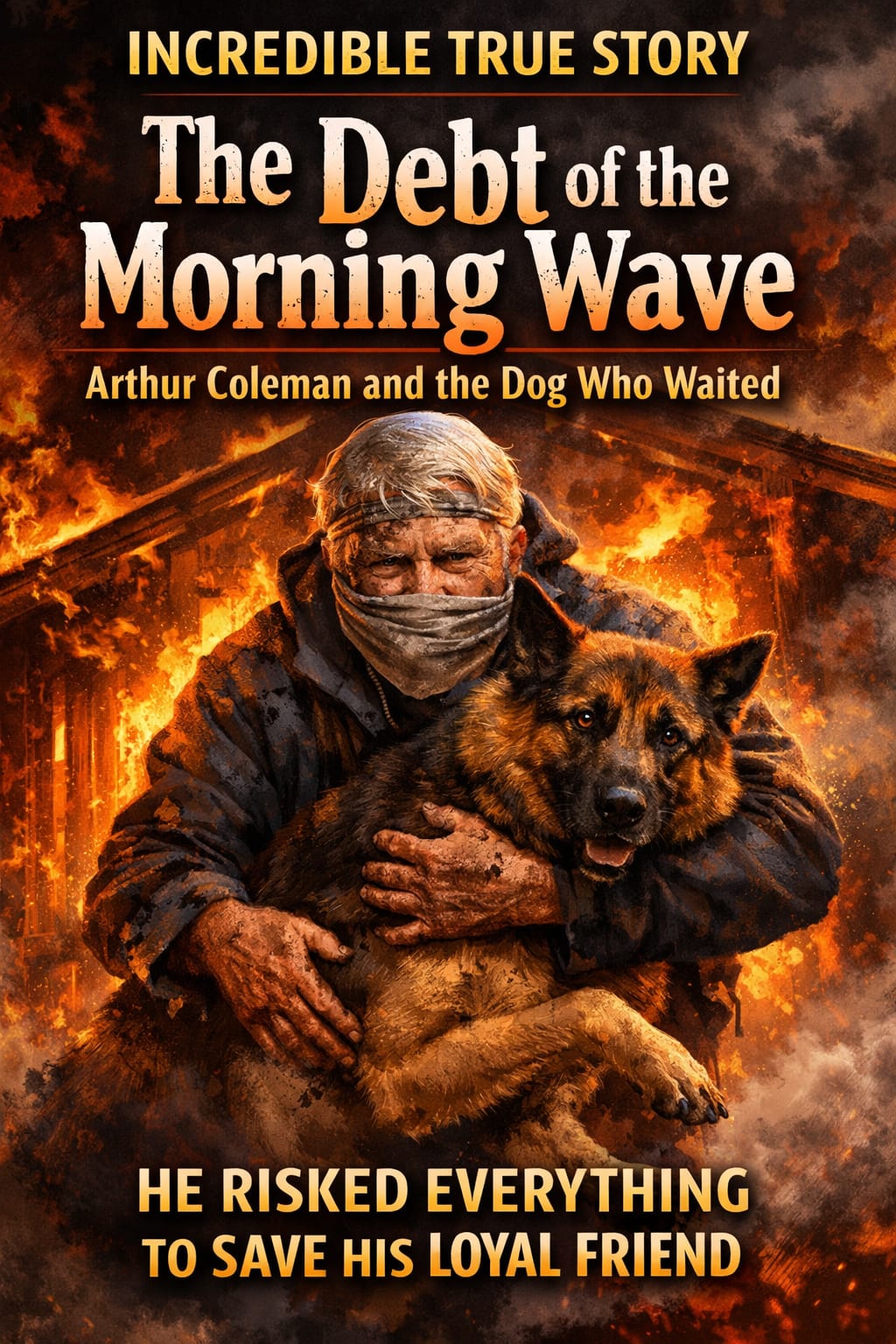
The incredible true story of Arthur Coleman, the 71-year-old man who ran into a burning building to save a trapped German Shepherd, proving that loyalty has no expiration date.
Introduction: The Invisible Contract
There is a specific kind of friendship that exists between a mailman and the dogs on his route. It is a relationship built on ritual. It is built on the sound of a truck engine, the click of a mail slot, and the exchange of a biscuit through a chain-link fence.
For thirty years, Arthur Coleman had been a mail carrier in Sacramento. He knew every dog in his zip code. He knew which ones were biters, which ones were barkers, and which ones were lonely.
He retired in 2015. His knees were shot. His lungs were wheezy from decades of city smog and secondhand smoke. He walked with a cane on bad days and a shuffle on good ones.
But old habits die hard. Even in retirement, Arthur kept tabs on the neighborhood. He was visiting his daughter in a quiet suburb on a warm night in 2019 when the routine was broken by the smell of burning pine.
It was 2:30 AM.
Arthur was awake, nursing a glass of water and his insomnia, when he saw the orange glow reflecting off the parked cars across the street.
A house was on fire.
It wasn't a candle flickering. It was a structural roar. An electrical fault in the wiring of a 1970s ranch house had ignited the insulation. The flames were eating the drywall and racing for the roof.
Neighbors were spilling out onto their lawns in pajamas, clutching cell phones, screaming. The chaos was human and loud.
But Arthur Coleman wasn't looking at the humans. He was looking at the front door of the burning house. And he was listening for a sound that only a mailman would notice.
Part I: The Survivor in the Laundry Room
The house belonged to the Millers. They were on vacation in Tahoe. The house should have been empty.
But Arthur knew it wasn't.
He knew because every morning at 10:00 AM, when he used to walk this street (and even now, when he walked for exercise), a German Shepherd named Max would be sitting in the bay window.
Max wasn't a guard dog. He was a greeter. He was a 90-pound beast with a heart made of marshmallows. He was the kind of dog that leaned his entire body weight against your leg when you petted him.
Arthur heard it over the crackle of the wood.
Scritch. Scritch. Whine.
It was the sound of claws on a hardwood floor. It was the sound of a panic attack behind a locked door.
Max was inside.
The dog sitter had left hours ago. The family was miles away.
Arthur stood on the sidewalk. He was 71 years old. He had arthritis. He had no protective gear. He was wearing slippers.
A neighbor grabbed his arm. "Arthur! Stay back! The fire trucks are coming!"
Arthur looked at the neighbor. Then he looked at the house. The smoke was billowing out of the eaves, black and oily.
"The dog," Arthur said.
"Don't be crazy," the neighbor shouted. "It's too hot! You'll die in there!"
Arthur pulled his arm away. He didn't shout back. He spoke with the quiet, stubborn resolve of a man who had delivered mail through rain, sleet, and snow for three decades.
"He waits for me every morning," Arthur said. "He won't understand why I didn't come."
Part II: The Threshold of Hell
Arthur Coleman dropped his cane. He took off his flannel shirt and wrapped it around his face, tying the sleeves behind his head.
He moved toward the house.
He didn't run like an action hero. He shambled. He moved with the stiff, painful gait of the elderly. But he moved forward.
He reached the front door. The handle was hot. Not warm—hot. He used his shirt-covered elbow to turn the knob. It was unlocked.
He kicked the door open.
A wall of heat punched him in the chest. It was physical, like a blow from a hammer. The air was thick with soot and toxic smoke.
Arthur coughed immediately. His bad lungs seized. His eyes watered so hard he was effectively blind.
Get low, he remembered from some long-forgotten PSA.
He dropped to his hands and knees. The floor was cooler, but only barely.
"Max!" he wheezed. "Max! Come here, boy!"
The roar of the fire was deafening. It sounded like a freight train was driving through the living room. The ceiling above him was popping as the joists began to fail.
He crawled.
He knew the layout of these houses. They were all the same. Living room, kitchen, laundry room, garage.
He heard a bark. High-pitched. Terrified.
It was coming from the back. The laundry room.
Part III: The Intersection
Arthur crawled past the couch, which was already smoking. He crawled past the television, whose screen was melting.
His skin felt like it was blistering. Every breath tasted like charcoal and death.
He reached the hallway. The smoke was thicker here, banking down from the ceiling. He was crawling through a gray tunnel of suffocation.
"Max!"
He felt a wet nose touch his hand.
Max was huddled in the corner of the laundry room, shaking violently. The dog had retreated as far as he could go, trapped by his own fear.
When Max felt Arthur’s hand, he didn't run. He froze. He was paralyzed.
Arthur grabbed the dog’s collar. The metal tag burned his fingers.
"Come on," Arthur rasped. "We gotta go."
Max wouldn't move. He was a 90-pound anchor.
Arthur Coleman, a man who struggled to lift a bag of groceries on a bad day, found a reserve of strength that biology cannot explain. It was the strength of desperation.
He hooked his arm around the dog’s chest. He didn't try to lift him. He pivoted.
"Move!" Arthur screamed, his voice cracking.
He pulled. The dog scrabbled on the linoleum.
Arthur turned around. The way back was brighter now. The fire had jumped from the wall to the ceiling. The living room was glowing orange.
He had to crawl back through the oven.
Part IV: The Descent
The return journey was a blur of agony.
Arthur was dragging the dog, inch by inch. His knees were raw. His lungs were screaming for oxygen that wasn't there.
He started to get dizzy. The darkness at the edges of his vision began to close in. This is how smoke kills. It convinces you to go to sleep. It convinces you that laying down on the carpet is a good idea.
Just rest, his body whispered. It’s warm here.
Arthur looked at the dog. Max was coughing, his head low, pressing against Arthur’s side.
He trusts me, Arthur thought. He thinks I know the way out.
That responsibility was the only fuel left in Arthur’s tank. He couldn't die, because if he died, he was breaking a promise.
He forced his body to move. One knee. Then the other. Drag. Pull. Cough.
He saw the rectangle of the front door. It was a portal to the night air.
He was ten feet away.
Five feet away.
The carpet under him was smoldering.
He reached the threshold. He didn't walk out. He fell out.
He tumbled onto the concrete porch, his momentum carrying him down the three steps to the lawn. He landed hard on his shoulder, rolling into the cool, wet grass.
Max tumbled on top of him, a heap of fur and smoke.
Part V: The Explosion
The neighbors screamed. Two men ran forward and grabbed Arthur by the arms, dragging him further away from the house. Another grabbed Max.
They had cleared the porch by maybe twenty feet when it happened.
BOOM.
The front windows of the house blew out. The sudden influx of oxygen from the open door had fed the fire, causing a backdraft. A tongue of flame shot out of the living room, licking the spot where Arthur had been crawling ten seconds earlier.
If he had been five seconds slower—if he had stopped to catch his breath—he would have been incinerated.
Arthur lay on the grass, gasping. He looked like a coal miner. His face was black with soot. His hair was singed. His shirt was gone.
Max was standing over him, licking the soot off his face, whining softly.
The ambulance arrived. The paramedics swarmed.
They put an oxygen mask on Arthur. They checked his vitals. His oxygen saturation was dangerously low.
As they loaded him onto the gurney, Max tried to jump in the ambulance with him. The neighbors had to hold the dog back.
Arthur pulled the mask down. "He's okay?" he wheezed.
"He's okay, Arthur," the neighbor cried. "He's fine. You saved him."
Arthur nodded. He put the mask back on. And he closed his eyes.
Part VI: The Logic of the Heart
Arthur spent two weeks in the burn unit. He had second-degree burns on his arms and back. His lungs needed serious therapy to clear the particulate matter.
The Millers came home early from their vacation. They visited him every day. They cried. They offered to pay his medical bills. They offered him money.
Arthur turned down the money.
When a local reporter came to interview him in the hospital room, she asked the question that everyone was thinking.
"Mr. Coleman," she said. "You're 71. You have health problems. Why did you run into a burning building for a dog? You could have died."
Arthur adjusted his hospital gown. He looked at the flowers on the table.
"I did the math," he said, a small smile playing on his lips.
"The math?" the reporter asked.
"I'm old," Arthur said. "I've lived a good life. I've seen my daughter grow up. I've retired."
He pointed to a picture of Max that the family had taped to the wall.
"He's young. He's got a lot of running left to do. One of us had to be brave. Might as well be the one who's lived longer."
It was a simple, brutal calculus. A life for a life.
But then he softened.
"Besides," he added. "If I had stood on that sidewalk and watched him die... I would have been dead anyway. You can't live with that kind of silence."
Part VII: The Quiet Aftermath
Arthur went home. He healed. His walk was a little slower, his breath a little shorter.
But the routine returned.
Every morning, Arthur walks down the street for his exercise. And every morning, when he reaches the Millers' rebuilt house, the door opens.
Max comes bounding out.
He doesn't jump on Arthur. He knows Arthur is fragile now.
He walks up to the old man. He leans his 90-pound body against Arthur’s leg. He puts his head under Arthur’s hand.
Arthur scratches him behind the ears.
"Good boy," Arthur whispers. "Good boy."
They stand there for a minute. The old mailman and the German Shepherd. Two survivors of the fire.
Then Arthur taps his cane, and he keeps walking. And Max goes back to the porch to watch him until he turns the corner.
Conclusion: The Definition of Loyalty
We live in a world that tries to quantify value. We ask, Is it worth the risk? Is it logical?
By any logical metric, Arthur Coleman was a fool. A human life is "worth" more than a dog's life. A burning building is a death trap for an elderly man.
But Arthur Coleman wasn't operating on logic. He was operating on Loyalty.
Loyalty is not a contract you sign. It is a debt you feel.
Arthur felt a debt to the creature that waited for him. He felt that the bond of friendship—even a friendship made of brief morning greetings—required action.
His story reminds us that courage isn't always about defeating an enemy. Sometimes, courage is simply the refusal to abandon a friend.
It forces us to ask ourselves: Who waits for us?
And more importantly: Would we go into the fire for them?
Arthur didn't ask the question. He just went in. And because he did, the world is a little less lonely, and a little more brave.
About the Creator
Frank Massey
Tech, AI, and social media writer with a passion for storytelling. I turn complex trends into engaging, relatable content. Exploring the future, one story at a time
Keep reading
More stories from Frank Massey and writers in Humans and other communities.
The Longest Night: The Construction Worker, The Ledge, and the Nine-Hour Vigil
The true story of Michael O'Rourke, a construction worker who spent nine hours on a Brooklyn rooftop talking a suicidal woman down from a ledge, proving the power of simple human presence.
By Frank Massey about 22 hours ago in Humans
Two Farmers Unearth a 17th-Century Silver Treasure While Working Their Land: A Remarkable Discovery
In a discovery that feels lifted straight from the pages of a historical novel, two farmers recently unearthed a 17th-century silver treasure while working their land. The find, consisting of coins, jewelry, and small silver artifacts, provides a fascinating glimpse into the region’s past and has ignited interest among historians, archaeologists, and the local community. Beyond the monetary value, this discovery underscores the enduring stories buried beneath the soil, waiting for chance and circumstance to reveal them.
By Salaar Jamali3 days ago in Humans



Comments
There are no comments for this story
Be the first to respond and start the conversation.