
The Man With the Walker:
What I Witnessed Shouldn’t Be Normal

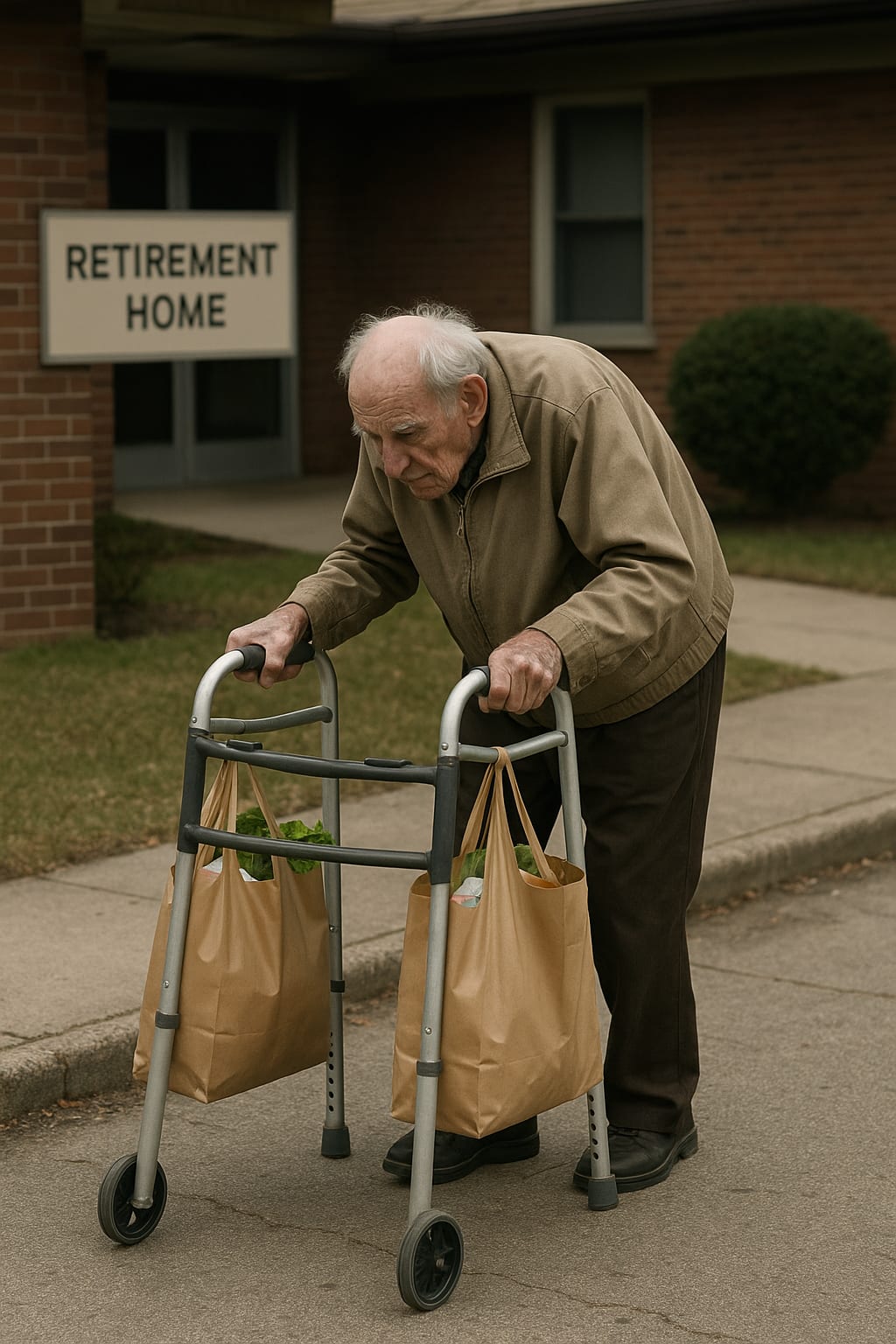
I was walking into a retirement home for routine business when I saw a man who stopped every part of my attention. His back folded into a shape the spine never willingly chooses. Every step depended on the stability of a metal walker that had already lived long years of compensating for uneven ground and vulnerable joints. Two worn grocery bags hung from each of his hands on both sides of the frame. They pulled downward in a way that made the entire structure feel compromised before he even moved. He wasn’t taking them inside the building for himself. He was working.
Moments like this never announce themselves. While I'm trying to decide, where to park, what to tell my client, and then someone appears whose presence forces the mind to stop its autopilot. Not from pity. From recognition. His posture, pacing, and quiet endurance told the whole story before he opened his mouth. He was a man who had aged out of the workforce but not out of financial demands. The bills still came. His body just couldn’t keep up with them.
From a mental health standpoint, it was all there. People carry their strain in ways they don’t consciously register. His center of gravity tilted forward, a compensatory posture often tied to chronic lumbar deterioration. His grip showed joint fatigue. His gait revealed a learned caution, the kind rooted in months or years of near-falls. The groceries were heavy enough to shift the walker’s balance. Someone half his age would feel that. At his age, it becomes a quiet but ongoing threat to stability.
He pushed through it with the steadiness of a man who no longer treats discomfort as information. Many older adults do this. They normalize pain because they learned long ago that the world around them rewards stoicism, not vulnerability. Nothing about him suggested helplessness. That was the striking part. He wasn’t fragile. He was exhausted. There is a difference. Fragility is internal. Exhaustion is earned through years of lifting more than the body can safely manage.
I kept a respectful distance at first. Dignity matters. Especially for men who spent their lives being measured by how hard they worked and how much they carried. When he reached the door, I stepped in and offered help. He wouldn’t let me touch the bags, but he accepted the offer to hold the door. That was the boundary he allowed. We spoke for a moment as he eased forward. He told me he was 81 years old, had served in the U.S. Navy. His wife, age 79, has cancer. He works now to “extend” their income. He said it plainly, without complaint, in the way people speak when survival has become routine.
In situations like this, the analytical part of my mind activates automatically. Years of trauma and forensic work train you to read strain patterns as data. If an 81-year-old veteran is delivering groceries with compromised mobility, something upstream failed.
It is not the kind of failure that fits neatly into headlines. It accumulates slowly without much of society even noticing.
Where it comes from is not mysterious:
• Healthcare costs rose faster than retirement payments
• Savings accounts earned less than the cost of basic living
• Housing markets rewarded investors over residents
• Support systems hardened into bureaucratic mazes that treat aging as a paperwork category, not a human reality
When the margin between living and falling behind becomes thin, older adults keep working until the body refuses to negotiate further.
People like to call that resilience. It isn’t. It is survival behavior, and survival behavior always has a cost.
The human body broadcasts that cost through signals:
• changes in gait speed
• forward-leaning balance
• shortened stride length
• compromised grip patterns
• hesitation at door thresholds or uneven surfaces
His body displayed all of them. He didn’t need to explain anything.
I watched him move toward the doors. For a moment, admiration and anger sat in the same space. Not directed at him. Directed at the systems that have quietly normalized outsourcing their responsibility to the very people least equipped to absorb the consequences. Older adults should not be forced into a choice between dignity and survival. They should not have to trade mobility for income or safety for another month of bills.
The retirement home advertised comfort and security. The man in front of it contradicted the promise without saying a word. Real-world evidence has always been more honest than polished reports. One man with a walker, carrying someone else's groceries, moving across a parking lot that will outlive him by decades.
That is the real state of aging now.
I let him pass through the doorway and wished him well. His nod was small, steady, and sincere. He continued toward the elevator with the careful rhythm of someone who no longer expects the world to make room for him. I carried that image into my meeting and long after I left the building. Not as an emotional punchline, but as a field reminder that if you want to understand the health of a society, you don’t study its slogans. You study who is still laboring when their bones have already paid in full. You study who is working in the quiet margins because their needs fall outside what systems consider convenient.
People age. Their bodies slow. But when the systems surrounding them start failing faster than they do, that isn’t “just life.”
That is neglect dressed up as inevitability.
Sources That Don’t Suck:
National Institute on Aging
Social Security Administration
U.S. Bureau of Labor Statistics
AARP Research
National Council on Aging
KFF (Kaiser Family Foundation)
About the Creator
Dr. Mozelle Martin
Behavioral analyst and investigative writer examining how people, institutions, and narratives behave under pressure—and what remains when systems fail.
Keep reading
More stories from Dr. Mozelle Martin and writers in Humans and other communities.
“The Secret Behind Her Parents’ Love Changed Everything She Believed.”
Emma had always believed she knew her parents better than anyone else. They were simple people who lived a quiet life in a small town. Her father, David, was a gentle man who spent most of his days repairing old furniture in his small workshop behind the house. Her mother, Sarah, worked at the town library and had a soft smile that made people feel instantly welcome.
By imtiazalamabout 16 hours ago in Humans
Early March 2026: 4 Goals Accomplished
It's early March and I've now accomplished my 4th writing goal for the year of 2026. Before diving into the behind-the-scenes of it... why not tell you up front what that accomplishment was? I was published in a 2nd publication for this year. Published in Helix Literary Magazine out of Central Connecticut State University. You can read it for free right now!
By Stephen Kramer Avitabile5 days ago in Writers



Comments
There are no comments for this story
Be the first to respond and start the conversation.