
“I Don’t Carry Diseases”:
The Prairie Dog’s Defense Against Human Ignorance


You’ve seen the meme: “I don’t ‘carry’ diseases, I don’t ruin the land, and I’m not invasive.”
A prairie dog stares straight at the camera—defiant, intelligent, misunderstood.
And yet, across the Great Plains, cities and states continue to exterminate them. From Lubbock, Texas to Boulder, Colorado, New Mexico, Oklahoma, and even Saskatchewan, Canada, the pattern repeats: prairie dogs are blamed, poisoned, or gassed under the banner of “disease control.”
It’s the same reflex that once justified wolf culls and dolphin hunts: kill what you misunderstand, then call it progress.
The Myth of the Diseased Prairie Dog
Prairie dogs are accused of “carrying plague,” a claim rooted in partial truths and old fears. The sylvatic plague bacterium (Yersinia pestis) can infect prairie dog colonies through flea bites—but outbreaks are rare and highly localized.
Modern management programs, including those by the National Park Service, already use oral vaccine baits and flea-dusting treatments to prevent infection without killing the animals. Yet municipalities often reach for the most primitive method available: suffocation and poison.
When a plague outbreak hits, prairie dogs die by the thousands naturally. There’s no need for human-driven slaughter. Eradication campaigns ignore the data, misrepresent risk, and confuse disease management with moral panic.
The truth: prairie dogs do not “carry” plague in the everyday sense—plague is carried by fleas, and those fleas infect dozens of species. Killing prairie dogs simply disrupts ecosystems without meaningfully reducing risk.
Architects of the Plains
Prairie dogs are not pests. They are the keystone engineers of the Great Plains.
- Their burrows aerate the soil, enhance groundwater infiltration, and increase nutrient cycling.
- Their grazing maintains balanced grass height, prevents shrub encroachment, and supports hundreds of plant species.
- Their colonies form living architecture—nesting habitat for burrowing owls, foraging grounds for mountain plovers, and entire micro-ecosystems that sustain swift foxes, badgers, hawks, and even the endangered black-footed ferret.
Remove them, and the land hardens. Grasses vanish. The plains fall silent. That silence is not progress—it’s decay.
Cities and States Leading the Kill
- Lubbock, Texas: in 2024, the City of Lubbock began a prairie dog eradication program in the Canyon Lakes area, citing “public health and safety.” City officials admitted to using carbon-dioxide gassing, a method that asphyxiates entire colonies underground—often killing burrowing owls in the process. Public protests followed, but the city proceeded under “disease prevention” pretexts.
- New Mexico: the state’s Cooperative Extension Service lists lethal control methods—zinc phosphide poison, fumigants, and shooting—as accepted practices. The approach is normalized, not questioned, under agricultural policy.
- Colorado: Boulder County maintains a “management plan” that allows annual lethal removal of prairie dogs from irrigated agricultural land, after permit review. Developers in Parker and Denver often bulldoze or kill colonies before construction begins.
- Oklahoma: in the Yukon area near Oklahoma City, permits have been granted for poisoning prairie dogs on development land. Officials publicly describe them as “problematic wildlife.”
- Saskatchewan, Canada: even in Canada—where the black-tailed prairie dog is federally recognized as a species of concern—provincial agencies still issue annual kill licenses near agricultural zones to prevent “colony expansion.”
Across borders, the trend is consistent: extermination is cheaper than education. Cities that call themselves sustainable still authorize mass suffocation beneath the soil.
The Psychology of Eradication
Humans do not exterminate prairie dogs because they’re dangerous. They exterminate them because they’re visible.
The mounds “look messy.” The holes “ruin the view.” The colonies remind us that the land does not belong to us.
Eradication satisfies the illusion of control—a bureaucratic reflex disguised as sanitation. And yet, the prairie dog’s intelligence rivals that of dolphins and elephants in complexity of communication.
Behavioral ecologists have recorded syntax-based alarm calls that distinguish predators by type, size, color, and direction. Prairie dogs do not just react—they describe. Their language carries meaning, not just noise.
When cities silence that language with poison, they’re not just killing rodents—they’re erasing one of the most sophisticated communication systems in the animal kingdom.
The Ripple Effect of Removal
Destroy a prairie dog colony and the consequences cascade outward.
- Burrowing owls lose nesting grounds.
- Foxes and badgers lose prey.
- Soil organisms lose oxygen flow.
- Grasslands collapse into sterile dirt plains.
These aren’t abstract losses—they’re measurable. Satellite imagery from depopulated grasslands in Texas and Colorado shows reduced vegetation diversity and lower soil fertility after eradication campaigns.
The land literally stops breathing.
The Science We Ignore
Researchers at the University of Alberta and Colorado State University have long warned that large-scale prairie dog extermination harms grassland ecosystems more than it helps agriculture.
Healthy colonies actually improve grazing conditions for cattle by maintaining fresh grass regrowth cycles. But rather than coexist, ranchers often opt for poison—out of habit, not evidence.
The U.S. Department of Agriculture (APHIS) still lists prairie dogs as “nuisance wildlife” in many states, enabling unregulated killing by landowners and local governments. It’s policy inertia built on outdated fear.
The Real Disease
The plague isn’t bacterial—it’s behavioral. It’s the chronic human allergy to coexistence.
- We poison what we find inconvenient. We call it “control.”
- We suffocate what we don’t understand. We call it “safety.”
- We sterilize the prairie, then wonder why the land dies.
Prairie dogs are healers. They do not destroy—they renew.
They have spent millennia keeping the plains alive. We have spent 100 years trying to bury them under concrete.
What Cities Could Do Instead
Real management does not require death. It requires discipline.
Vaccines, relocation, and buffer-zone landscaping already work in national parks and wildlife preserves. They could work in cities too—if governments had the will.
Prairie dog towns could be educational sanctuaries, teaching students about soil systems, predator balance, and communication intelligence. Instead, city trucks roll in with gas canisters and euphemisms.
The Behavioral Bottom Line
Prairie dogs are not carriers of plague. They are carriers of equilibrium.
Their presence signals a functioning biome; their absence, an ecological collapse in progress.
- Every poisoned burrow is an ethical wound.
- Every silenced chirp is a lesson we refuse to learn.
If we keep killing what sustains the soil, we’ll eventually learn the hard way that the only invasive species on this continent is us.
Sources That Don’t Suck:
• Lubbock Avalanche-Journal – “Lubbock’s Policy Is to Kill Unwanted Prairie Dogs” (2018)
• KCBD News – “City of Lubbock Considering Plans to Eradicate Prairie Dogs” (2024)
• Lonestar 99.5 FM – “City of Lubbock Begins Removing Prairie Dogs Around Town” (2024)
• New Mexico State University Cooperative Extension – “Prairie Dog Management Guide” (2024)
• City of Boulder Prairie Dog Conservation & Management Program (2023)
• Yukon Progress News – “Yukon-Area Prairie Dogs Could Be Relocated” (2023)
• Government of Canada – “Black-Tailed Prairie Dog Management Plan” (2023)
• U.S. Department of Agriculture, APHIS – “Prairie Dog Management Guidelines” (2024)
• National Park Service – “New Treatment to Control Plague in Wildlife Shows Promise” (2023)
• University of Alberta / ScienceDaily – “Red Squirrels Adopt Orphans When They’re Close Kin” (2010)
• Colorado State University Research Briefs – “The Ecological Role of Prairie Dogs in Grassland Function” (2022)
About the Creator
Dr. Mozelle Martin
Behavioral analyst and investigative writer examining how people, institutions, and narratives behave under pressure—and what remains when systems fail.
Keep reading
More stories from Dr. Mozelle Martin and writers in Humans and other communities.
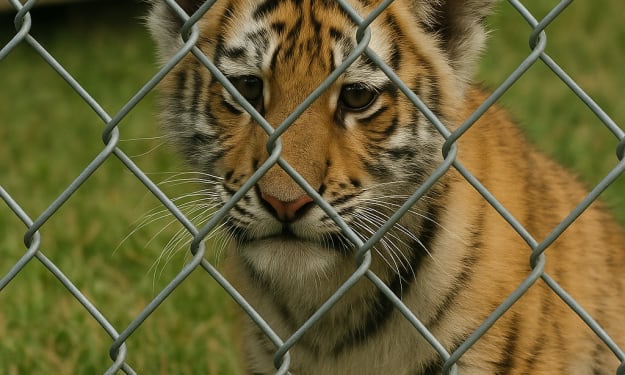
Tiger Cubs:
When a person reaches through the bars of a cage to touch a tiger cub, two nervous systems make contact: one wild, one wounded. The cub doesn’t understand commerce or cruelty—it just feels overstimulation, fear, and the absence of safety. The human on the other side, however, has learned to stop feeling entirely.
By Dr. Mozelle Martin4 months ago in Humans
The Voice in the Dark
In the history of big cities there are moments when everything turns into chaos and people don't know where to go in those moments only the people with real character and tarbiyat can lead others to safety this is the true story of Rick Rescorla who was born in a small town in England and later moved to America he was a man who had seen many wars and he knew that safety is not something you get by luck it is something you prepare for every single day
By Hazrat Umer2 days ago in Humans



Comments