
The Life and Legend of Lord Hanuman: A Divine Journey Through Bhakti, Power, and Eternal Service
Lord Hanuman a true devotee of Lord Rama


In the vast and vivid tapestry of Indian mythology, few figures shine as brightly as Lord Hanuman—the ultimate symbol of strength, selfless devotion, and eternal service. Known by countless names—Maruti, Anjaneya, Bajrangbali, Sankat Mochan, and Mahabali—Hanuman's life is not just an epic tale of heroism but a roadmap for spiritual seekers on the path of Bhakti Marg, or pure devotion.
Let us take a deep dive into the detailed journey of this awe-inspiring deity, whose name alone fills millions with strength and reverence.
The Divine Birth of Hanuman: A Cosmic Convergence
Hanuman’s origin is no ordinary tale. It begins in the celestial realms with Lord Shiva’s intense desire to serve Lord Vishnu in his incarnation as Shri Ram. Shiva, the supreme ascetic, took the Vanar form, signifying humility and servitude. To fulfill this divine mission, he incarnated as the son of Anjana, a cursed Apsara turned mortal, and Kesari, a mighty Vanar king.
The tale of Hanuman’s birth has multiple layers, all pointing toward cosmic orchestration. One version narrates that Lord Shiva entrusted Parvati with a divine child. At Shiva’s request, Parvati handed the child over to Vayudev, the wind god, who delivered him to Anjana during her penance to Shiva. Another version tells of a divine pudding (payasam) distributed to Dasharatha for the birth of Ram, a portion of which was mystically carried by a kite to Anjana’s hands, blessing her with the child.
Thus was born Maruti, named after Marut (another name for Vayudev), and destined to become Shivansh—a part of Shiva himself, manifest in the form of Hanuman.
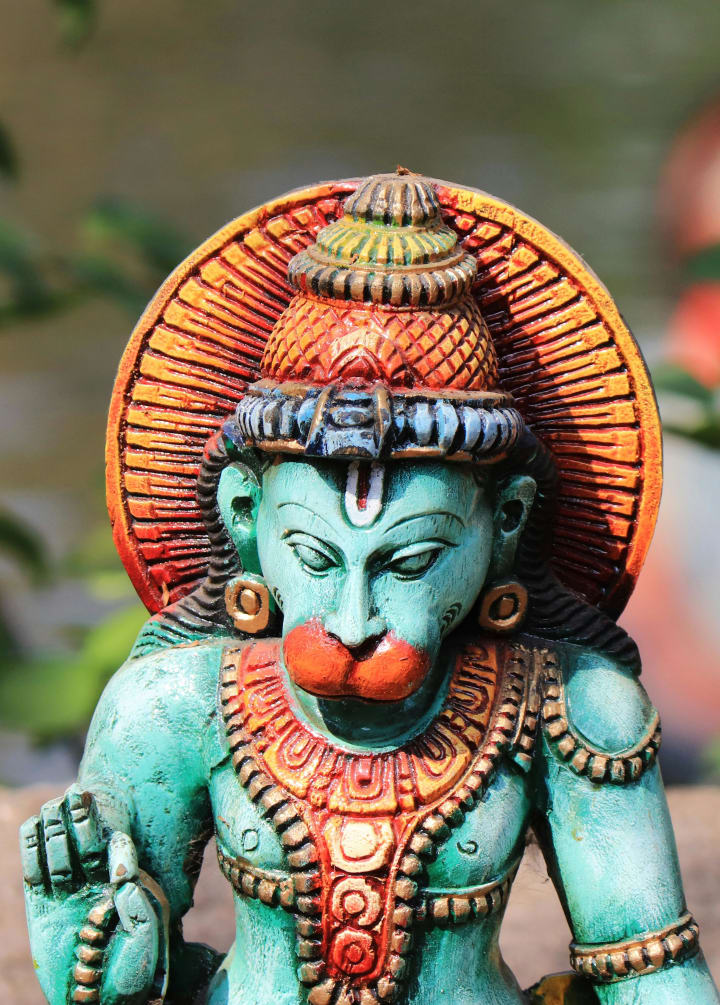
Childhood Antics and the Name Hanuman
From a young age, Hanuman exhibited divine strength and insatiable curiosity. One of the most famous stories from his childhood explains how he got the name “Hanuman.”
One morning, little Maruti saw the blazing sun through the trees and mistook it for a ripe mango. Driven by childlike innocence and divine energy, he leapt into the sky to grab the “fruit.” Alarmed, Indra struck him down with his thunderbolt (Vajra), injuring his jaw (“Hanu”). This blow earned him the name Hanuman.
This act enraged Vayudev, who withdrew air from the Earth, causing a cosmic suffocation. To pacify him, the gods showered boons upon Hanuman. Among them:
Immortality from Brahma
Shape-shifting abilities from Surya
Invincibility and strength from Indra
Wisdom and scriptural knowledge from Saraswati
Thus, Hanuman was set on the path of greatness, unknowingly harboring unimaginable power.
The Curse of Forgotten Power
Despite his boons, Hanuman’s mischievous behavior exhausted the patience of the sages. They cursed him—not out of anger, but as a blessing in disguise—that he would forget his powers until reminded at the right time. This ensured his humility and protected the balance of power.
Devotion Beyond Measure: The Meeting with Lord Rama
Fate brought Hanuman to Rishyamuk Parvat, where he served Sugriva, the exiled Vanar prince. One day, two radiant strangers—Rama and Lakshmana—arrived in search of Sita. Disguising himself as a Brahmin, Hanuman approached them.
The moment he laid eyes on Rama, his soul recognized his Ishtadev, and his voicetrembled with devotion. Dropping all pretenses, Hanuman prostrated before him and vowed eternal servitude. This meeting was not new—it was a reunion from past lifetimes, and from that moment, Hanuman became Ramdoot, the messenger of Rama.
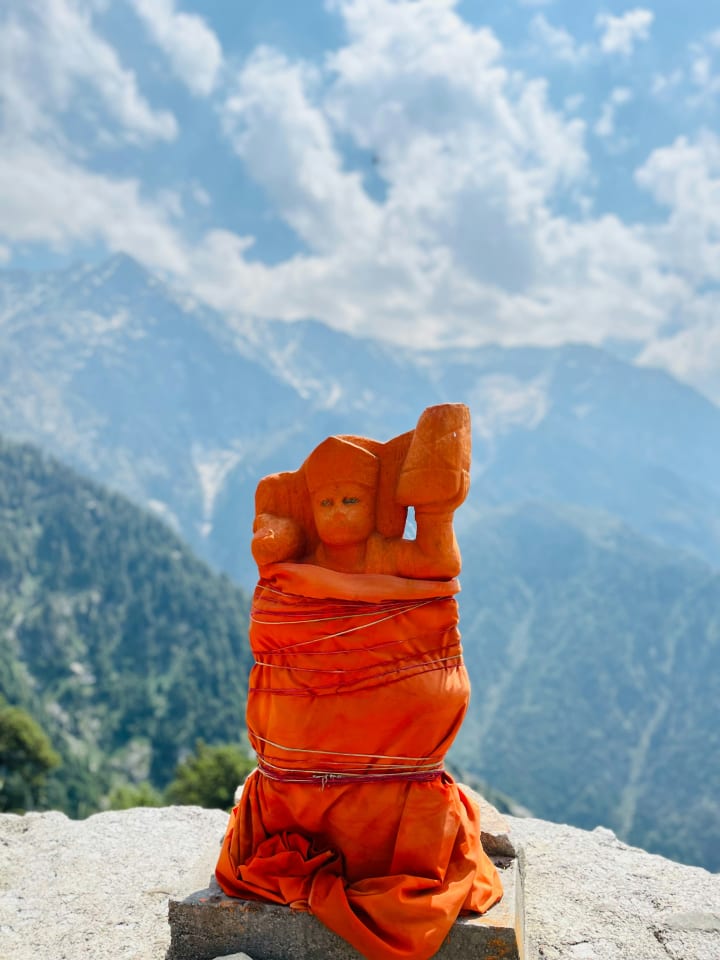
Hanuman’s Role in the Search for Sita: Awakening the Forgotten Power
When the Vanar Sena reached the southern tip of Bharat, they learned Sita was across the sea—in Lanka. None could leap the vast ocean—until Jambavan, the wise bear-king, reminded Hanuman of his dormant powers.
Awakened and radiant, Hanuman grew to gigantic proportions, bowed to Ram, and took a mighty leap over the ocean. During this journey, he:
Defeated the sea monster Surasa,
Was swallowed and escaped Simhika, the shadow-grabbing demon,
And finally landed in Lanka with fire in his eyes and Ram’s name on his lips.
The Burning of Lanka and the Roar of Devotion
After finding Sita in Ashok Vatika, Hanuman offered her Rama’s ring and message of hope. Allowing himself to be captured, he met Ravana, warned him, and when his tail was set aflame, he burned Lanka in righteous fury—honoring a curse placed by Nandi upon Ravana that an animal would bring his downfall.
This fierce episode earned him the name “Mahaveer” and “Bajrangbali” (Bajra = thunderbolt, Ang = body, Bali = strength).
The War, Panchmukhi Hanuman, and Saving Lakshmana
Hanuman played pivotal roles in the war:
Rescued Rama and Lakshmana from Ahiravana by assuming the Panchmukhi form—Hanuman (East), Narasimha (South), Garuda (West), Varaha (North), Hayagriva (Up).
Carried the Dronagiri mountain to bring the life-saving Sanjeevani herb to save Lakshmana, earning him the title Lakshman Prandatre.
Led the Vanar Sena with valor and unwavering discipline.
Symbol of Eternal Service and Brahmacharya
Hanuman is revered as the Brahmachari, the eternal celibate. His life revolved solely around Rama Bhakti, and even after Ram’s departure from the mortal world, Hanuman chose to remain on Earth as Chiranjeevi, the immortal one.
In one tale, when Hanuman asked Sita how to best please Rama, she replied, “By applying Sindoor (vermilion).” The ever-devoted Hanuman smeared his entire body with sindoor, leading to the title Bajrangbali.
Worship and Symbolism in Everyday Life
Today, Lord Hanuman is not just a divine being but a symbol of strength, protection, and devotion. His temples are found across India, where devotees:
Chant the Hanuman Chalisa for strength and clarity
Offer sindoor and laddoos for blessings
Worship him on Tuesdays and Saturdays to ward off Shani dosha
Athletes, students, soldiers, and spiritual seekers invoke him before any challenges.
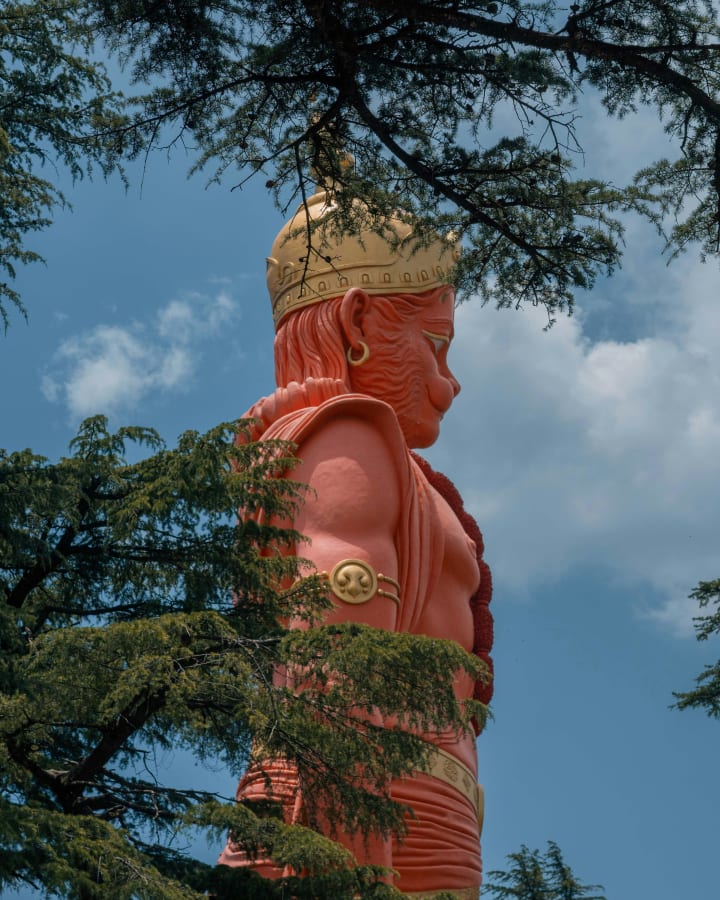
Festivals and Famous Temples
Hanuman Jayanti
Celebrated during Chaitra Purnima, it marks Hanuman’s birth. Devotees offer prayers, conduct Akhand Ramayan readings, and perform Abhishek rituals with milk, curd, and honey.
Famous Temples
Sankatmochan, Varanasi– The temple where Goswami Tulsidas prayed and wrote Hanuman chalisa. Here he was bestowed darshan by Lord Hanuman himself.
Sarangpur Hanuman Mandir, Gujarat – Famous for removing black magic and evil energies.
Hanumansetu, Lucknow – Built near the Gomti river, with grand celebrations.
Suvarchala Temple, Telangana – Recognizes the rare tale of Hanuman’s symbolic marriage to Suvarchala.
Salasar Balaji, Rajasthan – Known for its unique mustached idol and wish-fulfilling energies.
Legacy: The Living God Among Us
Lord Hanuman lives on-not just in temples but in the hearts of millions. His name is invoked in times of fear, his image adorns doorways and dashboards, and his teachings inspire those walking the path of Bhakti Marg-the path of unconditional love, loyalty, and service.
He is Sankat Mochan, the remover of all distress, the mighty Mahabali, and above all, the humble servant of Lord Rama
About the Creator
Sujeet M Sonar
An artist, teacher, and lifelong learner influenced by philosophers like J Krishnamurti & Socrates, and writers like Premchand and Kahlil Gibran. Inspired by Swami Vivekananda’s, I believe inner growth leads to outward expansion and Wisdom.
Keep reading
More stories from Sujeet M Sonar and writers in Humans and other communities.
What is Shiva Tattwa? A Beginner’s Guide to Understanding Divine Consciousness
In Hindu philosophy, the concept of Shiva Tattwa holds a profound place. It represents the essence of divine consciousness, transcendence, and ultimate reality. To understand Shiva Tattwa is to delve into the very fabric of existence beyond the physical world and into the realm of pure awareness, creation, and dissolution.
By Sujeet M Sonar10 months ago in Humans
Marc Guéhi
Marc Guéhi is a professional football player who is known for his calm defending, strong leadership, and smart decision-making on the field. He plays as a central defender and represents both club football and the England national team. Over the years, Marc Guéhi has become one of the most trusted young defenders in modern football.
By Farhan Sayed3 days ago in Humans
Silver Screen Magic with Mae West
American actress and singer Mae West became a popular film actress during the Great Depression. She started entertaining in vaudeville, then performed on Broadway, and finally went to Hollywood. She signed up with Paramount Pictures and made her debut in the 1932 film “Night After Night.” She also starred in musicals, comedies, and crime dramas. The American Film Institute named her one of the best classic Hollywood actresses.
By Rasma Raisters6 days ago in Geeks


Comments
There are no comments for this story
Be the first to respond and start the conversation.