
The Last Post at the 24-Hour Diner
In 2006, a soldier sat in a booth outside Fort Hood, paralyzed by the fear of saying goodbye. A waitress named Linda stepped in, not knowing she was orchestrating the final conversation of his life

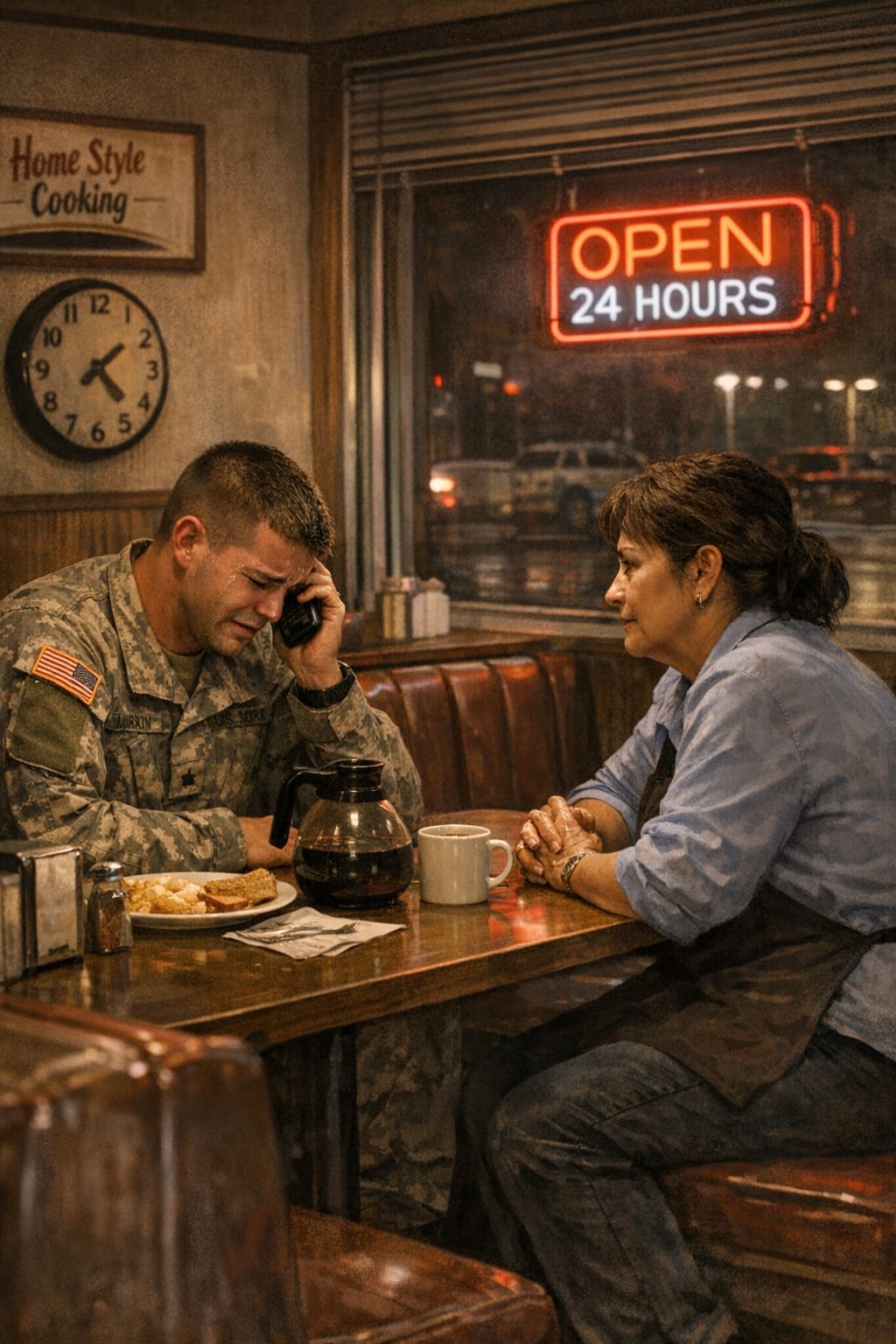
The touching true story of Linda Chavez, a Texas waitress who helped a young soldier make a difficult phone call to his mother before deploying to Iraq, unaware it would be his last.
Introduction: The Neon Purgatory
There is a specific kind of loneliness that exists only in a 24-hour diner at 3:00 AM. It is a loneliness smelling of burnt coffee, pine cleaner, and fryer grease. The fluorescent lights hum with a low-voltage anxiety, illuminating the faces of truck drivers, insomniacs, and the ghosts of people who have nowhere else to be.
In 2006, the "Star-Lite Diner" (a placeholder name for the many nondescript diners that line the highway) sat just outside the perimeter of Fort Hood, Texas.
This was the height of the Iraq War. The Surge was on the horizon. The base was a machine that inhaled young men and exhaled them into the desert. The town of Killeen vibrated with the tension of departure.
Linda Chavez was fifty-two years old. She had worked the graveyard shift for twelve years. Her uniform was pink, her apron was white, and her shoes were orthopedic. She had varicose veins and a smile that didn't reach her eyes—not because she was unkind, but because she was tired.
Linda knew the look. She saw it every night. The high-and-tight haircuts. The green duffel bags. The eyes that were looking at something five thousand miles away.
But on a Tuesday night in November, at 2:17 AM, a boy walked in who broke her heart before he even spoke.
Part I: The Soldier in the Corner
He was young. Painfully young. The kind of young where the uniform looks like a costume, even though it fits perfectly. His name tape read MORRIS.
He didn't swagger like the groups of Marines who came in for pancakes after a night at the bars. He didn't have the weary stoicism of the NCOs.
He walked in like he was walking to the gallows.
He chose the booth in the far back corner, away from the windows, away from the door. He placed a cell phone on the Formica table. It was a silver flip phone, the kind everyone had back then.
He stared at it.
Linda walked over with the pot. "Coffee, hon?"
He jumped. He looked up at her with eyes that were wide and red-rimmed.
"Yes, ma'am," he whispered. "Black, please."
She poured. He didn't drink. He just wrapped his hands around the ceramic mug, using it for warmth in the over-air-conditioned room.
Linda went back to the counter. She wiped down the pie case. She refilled the sugar dispensers. But she kept watching him.
He wasn't eating. He wasn't reading. He was just vibrating.
Every few minutes, he would pick up the phone, flip it open, stare at the green glow of the screen, and then snap it shut.
Open. Shut. Open. Shut.
It was a ritual of hesitation.
Part II: The Question
An hour passed. The diner emptied out. The drunks went home. The truckers got back on the I-35.
It was just Linda, the cook in the back, and Private First Class Daniel Morris.
Linda walked over to refill his cup. It was still full, but stone cold. She poured the hot liquid in anyway, displacing the cold.
"You okay over here?" she asked gently.
Daniel looked up. He looked at the clock on the wall. It was 3:30 AM.
"Ma'am," he said, his voice cracking. "How long can I stay here if I keep ordering?"
It was a strange question. Usually, kids wanted to leave. They wanted to go to the club, or to bed, or to their girlfriends.
Linda looked at him. She saw the duffel bag by his feet. She saw the lack of rank on his collar.
"Baby," she said, dropping the customer-service voice for her real voice. "You can stay here until the sun burns out. I ain't kicking you out."
He nodded. He took a shaky breath.
"I have to be at the assembly area at 0600," he said. "We fly out at 0800."
"Iraq?"
"Yes, ma'am."
"And you're sitting here because..."
He pointed at the phone.
"I need to call my mom," he said. "I promised I'd call her before I got on the bus."
"So call her," Linda said. "She's probably sitting by the phone right now waiting for it to ring."
Daniel looked down at his hands.
"I can't," he whispered.
Part III: The Anchor
Linda pulled out the chair opposite him and sat down. This was against policy. The manager, had he been there, would have scolded her. Fraternizing with customers.
Linda didn't care.
"Why can't you call her?" she asked.
Daniel looked out the window at the darkness of the parking lot.
"Because I'm ready," he said. "I have my gear. I have my orders. I've made my peace with going. I'm... I'm holding it together. Just barely."
He looked at Linda.
"But if I hear her voice... if I hear her cry... I'm going to break," he said. "And if I break, I won't be able to get on that plane. I'll turn around and run."
He was terrified. Not of the enemy. Not of the bullets. He was terrified of the love that was pulling him backward. He was afraid that his mother's voice was the one thing that could shatter his resolve.
Linda sat in silence. She understood.
She reached into her apron pocket and pulled out a wallet. She opened it to a picture of a young man in a Navy white crackerjack uniform.
"This is my boy, Marcus," she said. "He's on a carrier somewhere in the Gulf right now."
Daniel looked at the photo.
"When he left," Linda said, "he called me from the airport. He was crying. I was crying. It was a mess."
She leaned forward.
"But if he hadn't called me," she said, her voice turning steel-hard, "if he had just left me in the silence... I never would have forgiven him. And he never would have forgiven himself."
"It hurts too much," Daniel said.
"It's supposed to hurt," Linda said. "That's how you know you have something worth coming back to. But you can't leave her with nothing, Danny. You can't let her last memory of you be you walking out the door three days ago. You have to give her this."
She tapped the phone.
"Let her hear you breathe. Let her know you're alive right now. Not just in her prayers."
Part IV: The Call
Daniel Morris stared at the phone. He wiped his palms on his trousers.
He took a deep breath, like a diver preparing to go under.
He flipped the phone open. He dialed.
Linda started to get up to give him privacy.
"No," he said quickly. "Please. Stay."
He needed an anchor. He needed a witness to make sure he didn't hang up.
Linda stayed.
She watched him press the green button. She watched him hold the phone to his ear.
One ring.
Two rings.
"Mom?"
His voice was small. It was the voice of a six-year-old who had scraped his knee.
Linda watched the dam break.
"Yeah, Mom. It's me. No, I'm okay. I'm... I'm at a diner. Yeah."
Tears started rolling down his face. Silent, heavy tracks through the stubble on his cheeks.
"I'm leaving in a few hours. I know. I know, Mom. Please don't cry. If you cry, I'm gonna lose it."
He listened. He nodded. He closed his eyes.
"I love you too. I promise. I promise I'll keep my head down. I promise I'll wear my glasses. Yes."
He laughed, a wet, choking sound.
"Tell Dad I love him. Tell Sarah to take care of the dog. Mom... listen to me."
He sat up straighter.
"I'm going to be okay. I'm going to come back. And we're going to have that barbecue. Okay?"
He was lying. Or maybe he was hoping. It didn't matter. He was giving her the gift of reassurance, even if he didn't feel it himself.
"I have to go, Mom. I love you. Bye."
He snapped the phone shut.
He put it on the table.
And then he put his head in his hands and sobbed.
He didn't cry like a soldier. He cried like a boy who had just cut the umbilical cord.
Linda reached across the table and took his hand. Her hand was rough, calloused from years of scrubbing dishes. His hand was smooth, shaking.
She didn't say anything. She just held on until the shaking stopped.
Part V: The Transaction
Ten minutes later, Daniel wiped his face with a paper napkin. He composed himself. He put the mask of the soldier back on.
"Thank you, ma'am," he said. "You were right. I needed to do that."
"I know," Linda said.
He reached for his wallet. "How much for the coffee? I had three cups."
Linda snatched the check from the table.
"Put that away," she said.
"Ma'am, I can pay," he said. "I got my deployment bonus."
"I don't care what you got," Linda said. "Tonight is on me."
"I can't let you do that."
"You aren't letting me," Linda said. "I'm telling you. My son is out there. And I hope to God that somewhere, in some diner in Bahrain or wherever he is, there is a waitress buying him a cup of coffee and sitting with him so he isn't lonely."
She stood up.
"You pay it forward, Danny. That's the deal."
Daniel Morris stood up. He grabbed his duffel bag. He looked at Linda Chavez, a woman he had known for two hours.
He stepped forward and hugged her.
It was a fierce, desperate hug. It smelled of starch and fear.
"Thank you, Linda," he said.
"Keep your head down, baby," she whispered.
He turned and walked out the door. The bell chimed. Ding.
He walked into the dark parking lot, got into a cab, and vanished into the war.
Part VI: The Silence of the Map
For the next few months, Linda watched the news differently.
Every time the TV mentioned Baghdad, or Fallujah, or an IED attack, she froze. She looked for a face.
She wondered about Danny. She wondered if he had called his mom again. She wondered if he was safe.
Life in the diner went on. The eggs fried. The coffee brewed. New soldiers came in.
But Linda kept glancing at the corner booth. To her, it was still occupied by the ghost of the boy with the flip phone.
Part VII: The Envelope
Three months later, on a rainy Tuesday morning, the mailman dropped a bundle of letters on the counter.
Bills. Flyers. Coupons.
And one thick, white envelope.
It was addressed to "The Waitress Linda - The Star-Lite Diner." There was no return address, just a postmark from Ohio.
Linda felt a cold chill go down her spine. Her hands trembled as she picked it up. She knew. Before she even opened it, she knew.
She walked to the back of the diner, near the break room. She tore open the flap.
Inside was a handwritten letter and a photograph.
The photograph was of Daniel Morris. He was standing in front of a Humvee, dusty, tanned, holding a bottle of water. He was smiling—a real smile this time. He looked older. Harder.
Linda unfolded the letter.
Dear Ms. Linda,
I don't know if you remember my son. His name was Daniel Morris. He told me about you. He told me about the night he left.
He told me that he was sitting in your diner, terrified to call me. He told me that you sat with him. That you held his hand. That you gave him the courage to say goodbye.
Linda had to stop reading. She leaned against the wall, sliding down until she was sitting on a crate of soda.
Danny was killed two weeks ago. His convoy was hit by an IED outside of Baghdad. He didn't suffer.
I want you to know something. That phone call? That was the last time I ever heard his voice. We wrote letters, but we never spoke again. The reception was too bad.
If you hadn't pushed him... if you hadn't been there... I would have last spoken to him three days before he left, when we were fighting about him packing his socks. I would have been left with that.
Instead, I have "I love you." I have "I promise."
You gave me that. You gave me his goodbye.
Thank you for not letting him be alone.
Sincerely,
Martha Morris
Linda reached into the envelope again. There was something else inside.
It was a twenty-dollar bill.
On the back of the bill, written in black Sharpie, were the words:
For the coffee I never paid for. Love, Danny.
Conclusion: The Altar
Linda Chavez sat in the back of the diner and wept. She wept for Danny. She wept for Martha. She wept for her own son, praying he was safe.
She never spent the twenty dollars.
She bought a small frame. She put Danny’s picture in it, with the twenty-dollar bill tucked behind the photo.
She placed it on the shelf behind the counter, next to the cash register.
Customers would ask, "Who's the soldier?"
And Linda would say, "That's Danny. He's a friend of mine."
She never told them the whole story. She never told them about the tears at 3:00 AM. That belonged to her and Danny.
The war in Iraq ended. The soldiers came home, or they didn't. The diner eventually closed down and became a strip mall.
But the story remains.
It is a story that reminds us that history is not just made by generals in situation rooms. It is made in the quiet moments between strangers.
It is made by a waitress who decides to be a mother for ten minutes.
It is made by the courage to make a phone call.
And it is made by the realization that sometimes, a cup of coffee is not just a beverage. It is a sacrament. It is the last communion before the darkness.
Danny Morris didn't come home. But because of Linda, he didn't leave this world without saying I love you. And in the grand, tragic calculus of war, that small victory means everything.
About the Creator
Frank Massey
Tech, AI, and social media writer with a passion for storytelling. I turn complex trends into engaging, relatable content. Exploring the future, one story at a time
Keep reading
More stories from Frank Massey and writers in Humans and other communities.
The CEO of Everything
They say "jack of all trades, master of none," but they forgot to mention the part where the jack of all trades is also the camera woman, the makeup artist, and the person currently yelling at a tangled Wii microphone cable in a her own bathroom while recording herself singing and trying to make it look realistic and professional. (As professional as you can make it with nothing but a cell phone camera and a mic that doesn't work)
By Sara Wilson7 days ago in Humans
Neptune Turns Twin Flame Love Dreamy and Disorienting.
Neptune plays a powerful role in twin flame connections. This planet rules dreams, intuition, fantasy, and spiritual longing. When Neptune touches a twin flame bond, love feels magical. You feel connected beyond words. You sense destiny. You feel unity without effort.
By Wilson Igbasi2 days ago in Humans
Affection and Healing for Yourself
During the night of the last quarter moon, I gathered my ritual supplies. I carefully handled the chunk of black tourmaline that would protect me from your overall negative and narcissistic energy. I carefully walked the house with my stick of selenite in hand, asking the universe to cleanse our working space.
By Alisha Wilkins ✒️🦋🖋️5 days ago in Fiction


Comments
There are no comments for this story
Be the first to respond and start the conversation.