
The Voice in the Flood: Angela Morris and the Birth of the Storm
In August 2017, Hurricane Harvey turned Houston into an ocean. In the chaos, a 911 dispatcher found herself the only lifeline for a woman giving birth in a sinking trailer. There were no doctors. There were no ambulances. There was only a voice in a headset

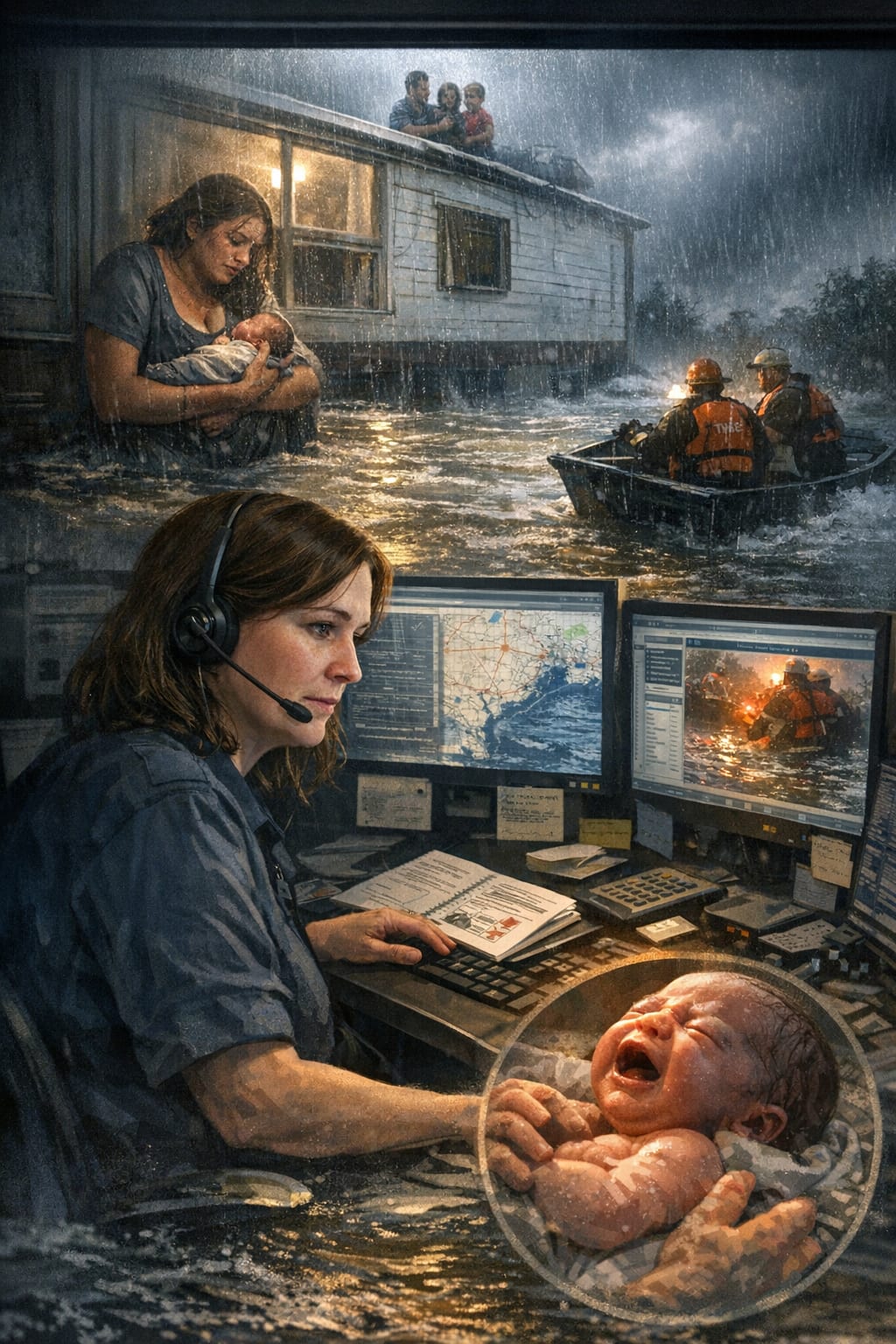
The harrowing true story of Angela Morris, the Harris County 911 dispatcher who guided a woman through childbirth in a flooded trailer during the height of Hurricane Harvey.
Introduction: The Bunker and the Deluge
To understand the isolation of a 911 dispatcher, you have to understand the room. It is usually windowless. It is kept at a constant, frigid temperature to protect the servers. It is lit by the blue glow of monitors.
Inside the Greater Harris County 911 Emergency Network, the world is reduced to data points. A blinking light is a car crash. A red line is a heart attack.
But in late August 2017, the data points were screaming.
Hurricane Harvey had stalled over southeast Texas. It wasn't just a storm; it was a hydrological event that defied history. Fifty inches of rain were falling. The bayous had burst. The highways were rivers. The city of Houston was drowning.
Inside the center, Angela Morris was sitting at her console. She had been working for hours. Her coffee was cold. Her eyes were burning.
The board was lit up like a Christmas tree, but every light was a tragedy.
Trapped in attic.
Water at chest level.
Diabetic emergency, no access.
The first responders were overwhelmed. Fire trucks were swamped. The "Cajun Navy"—civilian volunteers in bass boats—were launching into the streets, but there were too many victims and not enough hulls.
At 2:46 AM, a new call blinked onto Angela’s screen.
The location was a trailer park in a low-lying area. The connection was fuzzy, battered by the interference of the storm.
Angela clicked her mouse. She took a breath. "911, what is your emergency?"
A scream tore through the headset.
It wasn't a scream of fear. It was a scream of biology.
Part I: The Impossible Geography
The voice on the other end belonged to a woman we will call Isabel. She was young. She was terrified. And she was in the active stages of labor.
"My water broke!" Isabel screamed. "The baby is coming! Please, I need an ambulance!"
Angela looked at her map. The trailer park was in a red zone. The roads leading to it were under six feet of water.
"Ma'am, take a deep breath," Angela said, her voice dropping into the professional, rhythmic cadence of a veteran dispatcher. "I need you to tell me exactly what is happening."
"The water is in the house," Isabel sobbed. "It's up to my knees. My husband... he had to put the other kids on the roof. He's trying to flag down a boat. I'm alone in here."
Angela Morris froze for a microsecond.
The scenario was a nightmare algorithm.
A woman in labor.
Alone.
In rising floodwaters.
With no medical transport available.
Angela typed a query to dispatch. The response came back instantly: UNITS UNABLE TO RESPOND. HIGH WATER.
She looked at the screen. She looked at the rain lashing against the cameras outside.
She realized, with a heavy, cold weight in her stomach, that she was not going to be able to send help. Not in time.
She was the help.
Part II: The Truth
"Isabel," Angela said. She didn't use the title 'Ma'am' anymore. She needed intimacy. She needed trust. "Listen to me very carefully. The ambulances cannot get to you right now. The water is too high."
"No, no, no!" Isabel hyperventilated. "I can't do this! I don't know how!"
"You can," Angela said. She made her voice harder, stronger. An anchor in the wind. "You are going to do this. And I am going to help you. I'm not going to hang up. I'm right here."
"I feel pressure," Isabel groaned. "It hurts!"
"Okay," Angela said. She pulled up the Emergency Medical Dispatch (EMD) cards on her screen—the script for childbirth. But the script assumed a dry floor. It assumed towels. It assumed safety.
Angela had to improvise.
"Isabel, I need you to find the highest, driest place in that room. Is there a bed? A table?"
"The bed is wet," Isabel cried. "The water is coming up fast."
"Get on the bed anyway," Angela commanded. "Get out of the water. Do you have towels? Sheets?"
"Everything is wet!"
"That's okay," Angela lied. It wasn't okay. Hypothermia for a newborn is deadly. "Just get comfortable. Lie on your back. Knees up."
Part III: The Blind Midwife
For the next twenty minutes, Angela Morris became a midwife by proxy.
She had to visualize a room she couldn't see, miles away in the dark. She had to interpret the sounds coming through the headset.
She heard the relentless drumming of rain on the metal roof of the trailer. She heard the slosh of water as Isabel moved. She heard the distant shouting of the husband on the roof, yelling for help into the void.
"Contraction!" Isabel screamed.
"Breathe with me," Angela said. "In through your nose. Out through your mouth. One, two, three, four."
Angela breathed with her. In the quiet call center, her colleagues glanced over. They saw Angela hunching forward, eyes closed, hand pressed to her headset, breathing in rhythm with a ghost.
"I feel the head!" Isabel yelled. "I feel it!"
"Okay, listen to me," Angela said. "On the next contraction, I want you to push. But don't push hard. Just steady pressure. Put your hands down. Support the head. Don't pull on it."
"I'm scared," Isabel whimpered. "What if I drop him in the water?"
"You won't," Angela said. "I won't let you."
Part IV: The Arrival
The physics of birth do not stop for hurricanes.
"Push!" Angela said.
Isabel screamed. It was a primal sound that cut through the static.
"It's coming! It's coming!"
"Support the head," Angela guided. "Once the head is out, wait. The shoulders will be next. Don't force it."
In the trailer, Isabel was fighting two battles. She was fighting her body, and she was fighting the rising tide. The water was lapping at the mattress. If the baby fell...
"He's out!" Isabel gasped. "He's out!"
"Grab him!" Angela shouted, breaking protocol, her voice jumping an octave. "Put him on your chest! Skin to skin!"
There was a splashing sound. Then a rustle of wet fabric.
"I have him," Isabel panted. "I have him."
Angela waited.
She waited for the sound that every dispatcher, every doctor, every mother knows is the signal of life.
She waited for the cry.
But there was only the sound of rain.
Part V: The Silence
"Isabel?" Angela asked. "Is he crying?"
"No," Isabel whispered. Her voice trembled with a new kind of terror—worse than the storm. "He's blue. He's not moving. Why isn't he crying?"
Angela’s heart hammered against her ribs. A silent baby. A flooded house. No oxygen.
"Okay, we need to work," Angela said. "He needs help to start. Do you have a shoelace? A string? Anything to tie the cord?"
"No! I can't move!"
"Forget the cord," Angela said. "Leave him attached. Rub his back. Vigorously. Like you're drying him off with a towel, even if you don't have one. Use your hand. Rub him hard."
"Come on, baby," Isabel was sobbing. "Please. Please."
Angela could hear the friction—the wet slapping sound of the mother rubbing the infant's back.
"Turn him over," Angela said. "Clear his mouth. Use your pinky finger. Scoop out any fluid. He might have swallowed water."
"I did it," Isabel said. "He's still quiet."
"Flick the soles of his feet," Angela instructed. "Hard. Make him mad."
Seconds ticked by. Five seconds. Ten seconds.
In the call center, time distorted. It stretched into an eternity. Angela stared at the timer on her screen.
Breathe, little one, she thought. Just breathe.
"Come on!" Isabel screamed at the baby. "Wake up!"
And then, a sound.
It started as a gurgle. Then a cough. Then, a thin, wavering wail.
Waaaaah.
It was the most beautiful sound Angela Morris had ever heard. It was the sound of air filling lungs that had never known oxygen. It was a protest against the storm.
"He's crying!" Isabel laughed and sobbed at the same time. "He's pinking up! He's crying!"
Angela slumped back in her chair. Tears ran down her face. She wiped them away quickly. She couldn't break. Not yet.
Part VI: The Rescue
"Okay," Angela said, her voice shaking slightly. "Keep him on your chest. Your body heat will keep him warm. Cover his head with your shirt if you can."
"The water is almost to the mattress," Isabel said.
"Help is coming," Angela promised. "We have a newborn. That moves you to the top of the list."
She updated the CAD (Computer Aided Dispatch) notes: NEWBORN ON SCENE. FLOOD WATERS RISING.
Fifteen minutes later, Isabel’s voice changed.
"I see lights!" she shouted. "There's a boat!"
It wasn't a Coast Guard cutter. It wasn't a police boat. It was a civilian boat—a flat-bottomed skiff piloted by neighbors who were patrolling the darkness.
"They're here!" Isabel yelled. "They're coming to the window!"
Angela heard the muffled voices of men shouting. She heard the window smash. She heard the splash of boots in water.
"Ma'am, we got you," a male voice said in the background. "Hand me the baby."
"Angela?" Isabel came back to the phone one last time.
"I'm here," Angela said.
"Thank you," Isabel whispered. "I... I don't know your name."
"My name is Angela."
"Thank you, Angela. You saved us."
"Go," Angela said. "Get on the boat."
The line clicked. The connection broke.
Part VII: The Unseen Hero
Angela Morris sat in the silence of the disconnect.
Her hands were shaking. Her adrenaline was dumping, leaving her cold and exhausted.
She looked around the room. The phones were still ringing. The board was still red. The storm was still raging outside.
She took a sip of her cold coffee. She adjusted her headset.
She didn't get a break. She didn't get to go home and process the miracle she had just engineered.
Another light blinked on her screen.
Cardiac Arrest. Chest pains. Flood water blocking entry.
Angela clicked the mouse.
"911, what is your emergency?"
Conclusion: The Architecture of Hope
We often think of infrastructure as concrete, steel, and power lines. When a hurricane hits, we mourn the loss of bridges and roads.
But the most critical infrastructure in America is not made of concrete. It is made of people like Angela Morris.
It is made of the invisible web of voices that hold the world together when the physical world falls apart.
Angela never held that baby. She never saw his face. She never got a birth announcement. To this day, she might walk past that mother in a grocery store and neither would know the other.
But in the darkest hour of the storm, when the lights went out and the water rose, Angela Morris became the bridge.
Her story is a reminder that heroism isn't always about physical strength. It isn't always about running into the fire.
Sometimes, heroism is the ability to sit in a chair, staring at a screen, and project enough calm, enough love, and enough expertise across a telephone line to convince a terrified stranger that they can survive.
Angela Morris didn't just dispatch an ambulance that night. She dispatched hope. And in a flooded trailer in Texas, that was enough to bring a new life into the world.
About the Creator
Frank Massey
Tech, AI, and social media writer with a passion for storytelling. I turn complex trends into engaging, relatable content. Exploring the future, one story at a time
Keep reading
More stories from Frank Massey and writers in Humans and other communities.
Autonomy Is The Real Privilege
Good morning, freedom-seekers! Today we’re gonna be looking at autonomy. A strange word, I know; one many would probably look at blankly and run away from on sight. We’re gonna figure out what it actually means, consider how it’s achieved, and decipher just how deeply most of us are tangled up in dependence without realising it.
By That ‘Freedom’ Guyabout 7 hours ago in Humans
Overkill
Love, love, love. We love everything. We love our dogs, our cats, our homes. We love our cars, our new snowboard, this new book. Love. The word used to mean something. One did not use that word for mundane things. It was revered and used in beautify longing poetic verse. Some of the most prolific writers, wrote sonnets, lyrics, odes, to the emotion of love, once saved and cherished for a one and only. Now it’s used like the word like, but a little stronger.
By Alexandra Grant6 days ago in Humans



Comments
There are no comments for this story
Be the first to respond and start the conversation.