
The Importance of Community
How strangers kept my story alive when I couldn't

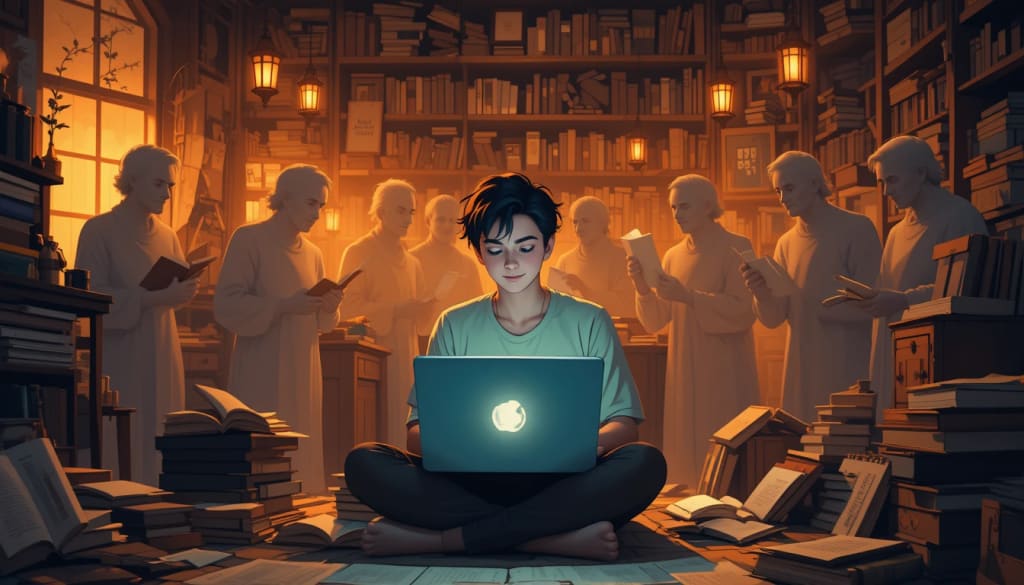
What kind of writer starts a series, writes two volumes, and then abandons it for two years?
Me.
I did.
And it wasn’t intentional. There was no dramatic quitting, no rejection letter that pushed me over the edge, no flaming laptop hurled out a window during a stormy night. It was quieter than that. It was the slow burn of life—unforeseen responsibilities, a draining job, a pandemic hangover, family needs, mental fatigue. The things that fill the spaces where creativity used to live.
At first, I told myself it was just a break. I even kept the notebooks out. The characters’ names scribbled in the margins. The plot arcs neatly mapped. But days passed, then weeks, then seasons. The story waited. And I did not return.
But someone else did.
One day, while ignoring yet another email and trying not to feel the guilt of another writing-less afternoon, I opened a comment on Volume Two. I hadn’t checked that platform in ages. It was from someone I didn’t know.
“When is Volume 3 coming? I’ve read the first two twice now.”
Istared at the words for a full minute. My first thought was: They’re still reading it?
Another comment came the next week.
“This story made me feel less alone. Please keep going.”
The one after that was a message.
“Your story reminded me of my sister. She passed, but she would’ve loved this. Thank you.”
Something in me cracked open.
Because when I had stepped away, I thought the silence would swallow it. I assumed no one would notice. It was just a little story on a little site. But it wasn’t gone. It had kept living—inside readers I had never met. And they wanted more.
That’s when I remembered: I didn’t start writing just for me.
Community.
It’s a word we throw around. A concept we often reduce to sidewalks and street names, people we wave at on Tuesday trash days.
But real community? It’s deeper than proximity. It’s the quiet power of being witnessed, encouraged, held up when your own arms are tired.
And mine were very, very tired.
These readers—these strangers with usernames and time zones I couldn’t place—they had become part of my story in a way I didn’t anticipate. They weren’t just an audience. They were the echo in the canyon, reminding me my voice mattered. Even when I forgot.
So I did something small, something that felt like scaling Everest: I opened the document again.
Volume Three.
I reread my old words like someone else had written them. I didn’t hate them. In fact, I was surprised by how much I missed that world. The characters had aged with me. I could feel it. Their decisions, once simple, were more layered now. Like mine.
I started writing again—slowly, awkwardly, like learning how to walk after an injury. Some days, it was only one paragraph. Some days, just a sentence. But the dam had broken.
And still, they waited.
Every time I posted an update, comments trickled in.
“Take your time. We’re not going anywhere.”
“This chapter was worth the wait.”
“I don’t know you, but I’m rooting for you.”
Imagine that. In a world wired for speed, a community willing to wait. Not demand. Not pressure. Just support.
We think of writing as solitary. And in a way, it is. You alone face the page. You alone wrestle the words. But that’s only part of the truth.
The other part? The people who read it. The ones who tell you: This matters. Keep going.
They are part of the process, too.
They are the community.
Now, Volume Three is done.
It’s not perfect. But it’s real. And that’s enough.
I could’ve given up—and almost did. But the story kept living in others, and that gave it life in me again.
And now, when I write, I don’t imagine myself alone at a desk.
I imagine the woman in Seattle who reads before work.
The college student in Nigeria who writes fan theories in the comments.
The man in Montreal who says my character helped him grieve.
I write for them.
And I write for the me who once forgot why I started.
Because here’s the truth:
We all abandon things—dreams, hobbies, stories, parts of ourselves.
And sometimes, we need someone else to keep the light on.
To tell us it’s okay to come home.
That our unfinished work is still waiting, still needed.
That we are still needed.
To every person who ever left a kind comment—this is your story, too.
You reminded me that words matter. That stories don’t disappear just because we get lost. That community isn’t just people who clap the loudest—but the ones who stay the longest.
Thank you for staying.
About the Creator
Shohel Rana
As a professional article writer for Vocal Media, I craft engaging, high-quality content tailored to diverse audiences. My expertise ensures well-researched, compelling articles that inform, inspire, and captivate readers effectively.
Keep reading
More stories from Shohel Rana and writers in Humans and other communities.
Learning to Leave Quietly
There is no thunderclap when a heart decides to leave. Sometimes, the loudest decision is made in silence, folded neatly like worn clothes into a small suitcase. That’s how I left—not with slamming doors or broken dishes, but with a soft zipper sliding shut and the quiet padding of footsteps at dawn.
By Shohel Rana8 months ago in Humans
Trying to seem cool
Yes the Taylor Swift called Eldest Daughter inspired me to write this piece. I may not be an Eldest Daughter but damn that song hits hard especially the line i have been afflicted by a terminal uniqueness i've been dying just from trying to seem cool. In case you haven't read my previous pieces I am a bit of a unique soul! I am not complaining at all!
By Amanda Nicole5 days ago in Humans
The Devil's Cut
“Comrade, finally you’re awake.” The voice was smooth, sensual. A flickering incandescent bar was all that lit the white, sterile room. All Vladimir remembered was everything going black. He tried to move his arms and found them strapped to the gurney.
By Matthew J. Fromm4 days ago in Fiction


Comments (1)
Nice