
The Guardian of Maple Street: The Bus Driver Who Trusted the Silence
In 2014, a school bus driver in Oklahoma was told to stay home. He defied orders because of a feeling he couldn't explain. That decision didn't just save a route—it stopped a tragedy that would have erased an entire city block.

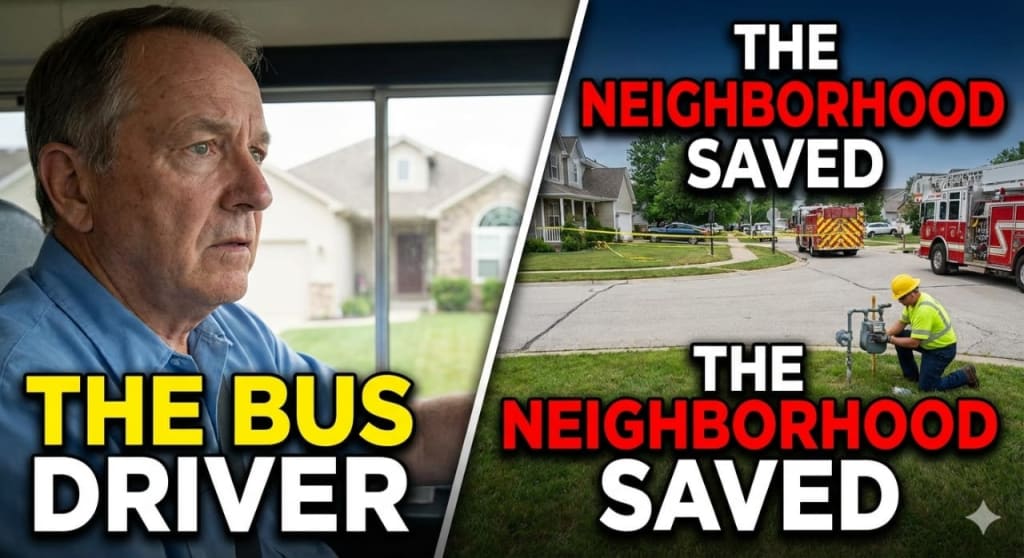
The incredible true story of Harold Jennings, the school bus driver whose attention to detail and refusal to take a day off saved an elderly couple and 27 children from a catastrophic gas explosion.
Introduction: The Invisible Clockwork of a Small Town
There is a specific rhythm to a small town in Oklahoma. It is a clockwork mechanism made of habits, routines, and quiet understandings. The sun comes up, the coffee pots gurgle, the porch lights flicker off, and the yellow buses roll out of the depot like clockwork soldiers.
In the town of Broken Arrow, just outside of Tulsa, this rhythm was maintained by people like Harold Jennings.
Harold was 62 years old. He had the worn-out knees of a man who had spent forty years working on his feet and the soft, watchful eyes of a man who had spent the last eighteen of them looking into a rearview mirror.
He was a school bus driver. To most people, that means he was a chauffeur for children—a background character in the movie of their lives. He opened the door, he closed the door, he said "sit down."
But to Harold, driving the bus wasn't just transportation. It was stewardship.
He didn't just know the route. He knew the ecosystem of the route. He knew that the Johnson dog barked at the mailman but not at the garbage truck. He knew that Mrs. Gable on 4th Street always watered her petunias at 7:15 AM in her pink robe. He knew which cars left for work early and which ones left late.
He was the neighborhood watch on wheels.
On a Tuesday in November 2014, the rhythm broke. And Harold Jennings was the only person in the world who noticed.
Part I: The Mandatory Day Off
The morning started with a bureaucratic hiccup. Harold had accumulated too many hours. The district policy was strict about overtime and fatigue. His supervisor had told him the day before: "Take Tuesday off, Harold. We have a sub covering Route 42. Rest your knees."
Harold agreed. He needed the rest. His arthritis was flaring up in the damp Oklahoma chill.
But when Tuesday morning came, Harold woke up at 4:30 AM anyway. His internal clock was louder than his alarm. He made his coffee. He looked out the window at the gray predawn light.
He felt a nagging anxiety. It wasn't logical. It was visceral.
Route 42 was tricky. There were tight turns on Maple Street. There was that blind spot near the creek where the fog settled. He thought about the substitute driver—a young kid, new to the district. Would he know to wait for little Timmy, who was always running thirty seconds late? Would he know to pull wide on the corner of Elm?
Harold paced his kitchen. He drank his coffee.
Then, he put on his uniform.
He drove to the depot. When he walked in, the dispatcher looked up, surprised.
"Harold? You're off the board today."
"I know," Harold said, grabbing his keys. "I'll take the run. Send the kid to Route 19. I just... I want to drive my route."
The dispatcher shrugged. In the hierarchy of problems, a veteran driver wanting to work was low on the list. "Alright, Harold. It's your knees."
Harold climbed into Bus #42. He checked the mirrors. He checked the brakes. He eased the big diesel engine into gear.
He drove out into the morning, telling himself he was just being a control freak. He didn't know he was driving toward a bomb.
Part II: The House on Maple Street
The route began like any other. The sun breached the horizon. The first few kids climbed on, sleepy and silent, clutching backpacks.
Harold greeted them by name. "Morning, Sarah. Morning, Billy. Jacket zipped up?"
He turned onto Maple Street. This was the heart of the neighborhood—a street of 1950s ranch houses, big oak trees, and manicured lawns.
Harold scanned the street. He wasn't just looking for kids; he was scanning the pattern.
Porch light off at the Millers? Check.
Mr. Henderson's truck gone? Check.
The blue sedan in the driveway at 304? Check.
Then his eyes drifted to 312 Maple.
It was a tidy white house with green shutters. It belonged to the Gibsons, an elderly couple in their 80s. Arthur and Martha. They were fixtures of the neighborhood.
Every morning for eighteen years, Arthur Gibson was on the porch at 7:20 AM picking up the Tulsa World newspaper. Every morning, the blinds in the front window were open.
Today, the porch was empty.
The blinds were drawn tight.
And there, sitting on the concrete step, was yesterday's newspaper. And the day before's. A yellowing pile of three papers.
Harold slowed the bus.
Maybe they're on vacation, he thought.
No. Arthur told me last week he was too old to travel.
Maybe they're sick.
Maybe.
But something else was wrong. The trash cans. It was Tuesday. Trash day. Every single house on Maple Street had their bins at the curb.
Except 312.
Harold stopped the bus at the corner stop. He opened the door for the kids waiting there. As they climbed on, he looked back at the house. It looked dead. It looked abandoned.
Most people would have kept driving. A bus driver has a schedule. You are timed to the minute. If you stop to check on a neighbor, you make thirty parents late for work.
Harold put the bus in neutral. He set the parking brake.
"Sit tight, kids," he said. "I'll be right back."
Part III: The Invisible Fog
Harold stepped off the bus. The air was crisp. He walked up the driveway of 312 Maple.
He didn't want to be a busybody. He expected Arthur to open the door, annoyed, in his pajamas.
He walked up the steps. He rang the bell. No answer.
He knocked on the storm door. Bang, bang, bang.
"Arthur! Martha! It's Harold!"
Silence.
He leaned in close to the door to look through the glass.
That's when it hit him.
It wasn't a sound. It was a smell.
Even through the sealed weather stripping, a faint, sickly-sweet odor was seeping out. It smelled like rotten eggs.
Natural gas.
And it was strong. If he could smell it outside, the inside must be saturated.
Harold’s heart hammered against his ribs. He knew instantly what was happening. A pilot light had gone out. A line had ruptured. The house was filling up.
He grabbed the doorknob. Locked.
He ran around to the side window. He peered in through a crack in the blinds.
He saw feet.
Someone was lying on the living room floor.
Part IV: The Protocol Paradox
Harold stood in the yard, his mind racing.
Protocol said: Call dispatch. Call 911. Stay with the vehicle.
But Harold looked at the bus. It was idling fifty feet away. There were twenty-seven children inside.
He looked at the house. It was a wooden structure, filled with gas.
If the furnace cycled on—if the thermostat clicked and sent a spark to ignite the burner—or if the refrigerator compressor kicked on...
The house wouldn't just burn. It would detonate.
A gas explosion in a confined space creates a shockwave that can level neighboring structures. The blast radius would easily engulf the street. It would engulf the bus.
Harold realized he was standing in the middle of a blast zone.
He ran back to the bus. He didn't panic. He didn't scream. He channeled the calm authority of a man who had broken up a thousand fights on the playground.
"Everybody off," he commanded. "Leave your bags. Move. Now."
The kids, confused by the urgency in his voice, obeyed. They filed out.
"Go across the street," Harold pointed. "Go behind the brick wall at the park. Run."
He watched them scatter. He made sure they were clear.
Then, he did something that went against every instinct of self-preservation.
He ran back to the house.
Part V: The Breaching
Harold Jennings was 62. He had bad knees. He was not a firefighter.
But he knew that waiting for the fire department might be too long. Every second the gas built up, the mixture became more volatile.
He went to the back of the house. He found a patio door. Locked.
He picked up a heavy concrete garden gnome from the flowerbed. He smashed the glass.
Crash.
The smell that poured out was staggering. It made his eyes water instantly. It made him gag.
He held his breath. He stepped through the broken glass.
He found Martha Gibson in the kitchen. She was slumped over the table, unconscious. Her skin was a terrifying cherry-red color—the sign of carbon monoxide poisoning, which often accompanies gas leaks.
He found Arthur in the hallway. He had collapsed trying to reach the phone.
Harold grabbed Arthur by the shoulders. The man was dead weight. Harold gritted his teeth, ignoring the fire in his arthritic knees, and dragged him toward the broken door.
He got him to the patio. He took a breath of fresh air, filling his lungs, and dove back in.
He grabbed Martha. She was lighter, but Harold was dizzy now. The fumes were getting to him. His head swam.
He dragged her out.
He laid them both on the grass in the backyard, far away from the house.
Then, he ran to the gas meter on the side of the house. He didn't have a wrench. He grabbed the shut-off valve with his bare hands and twisted. It was rusted stuck. He strained, the metal biting into his skin, until finally—creak—it turned.
The hiss stopped.
Part VI: The Aftermath
Minutes later, the sirens wailed. The fire trucks arrived. The paramedics swarmed the backyard.
They put oxygen masks on Arthur and Martha.
Harold sat on the bumper of the ambulance, coughing. A paramedic checked him out.
"You're lucky, buddy," the medic said. "Another few minutes in there and you wouldn't have woken up."
The fire captain came over. He was holding a gas detector. He looked pale.
"What was the reading?" Harold asked.
"It was explosive," the captain said. "The mixture was perfect. If the furnace had kicked on... or if you had rung the doorbell and it created a spark..."
He looked at the bus, still parked down the street. He looked at the shattered remains of the back door.
"You didn't just save them," the captain said quietly. "You saved the block."
Arthur and Martha Gibson survived. They spent a week in the hospital in hyperbaric chambers, but they lived.
The twenty-seven children went to school late. They had a story to tell about how Mr. Harold smashed a window.
Harold finished his route.
Part VII: The Quiet Heroism of Memory
There was no parade for Harold Jennings.
The school board gave him a plaque: For Outstanding Service. They gave him a $50 gift card to a steakhouse.
He hung the plaque in his garage, next to his tools.
But the real reward wasn't the plaque.
A few weeks later, Harold was driving Route 42. He turned onto Maple Street.
He looked at 312.
The blinds were open.
The trash cans were at the curb.
And standing on the porch, leaning on a cane, was Arthur Gibson.
As the bus rolled by, Arthur didn't wave. He just lifted his hand and held it over his heart. He nodded.
Harold nodded back. He kept driving.
Conclusion: The Superpower of Noticing
We live in a world that worships disruption. We love the innovators, the game-changers, the people who break the rules.
But civilization relies on the maintainers. It relies on the people who keep the routine.
Harold Jennings saved a neighborhood not because he was a superhero with X-ray vision. He saved it because he noticed a newspaper on a porch.
He saved it because he knew his world so intimately that a deviation from the pattern triggered an alarm in his soul.
It forces us to ask ourselves: How much do we notice?
Do we know our neighbors well enough to know when their lights are wrong?
Do we know our coworkers well enough to know when their silence is heavy?
Do we look up from our phones long enough to see the glitch in the matrix?
Most tragedies are preceded by whispers. Small signs. A smell. A missed appointment. A pile of mail.
We ignore them because we are busy. We ignore them because we don't want to intrude. We ignore them because we assume someone else will handle it.
Harold Jennings teaches us that "someone else" is a myth.
There is only us. There is only the person who is there, in the moment, with the choice to keep driving or to stop the bus.
Harold stopped the bus.
And because he did, twenty-seven children grew up. Two grandparents lived to see another Christmas. And a neighborhood on Maple Street remained a neighborhood, instead of becoming a crater.
That is the power of attention. It is the quietest form of love, and the most effective form of protection.
About the Creator
Frank Massey
Tech, AI, and social media writer with a passion for storytelling. I turn complex trends into engaging, relatable content. Exploring the future, one story at a time
Keep reading
More stories from Frank Massey and writers in Humans and other communities.
The Key Without a Lock: The Librarian, the Lifer, and the Alphabet of Redemption
The moving true story of Elaine Thompson, a prison librarian at San Quentin, who taught illiterate inmate Raymond Cortez to read at age 43, transforming a violent life through the power of literacy.
By Frank Massey 6 days ago in Humans
Silver Screen Magic with Mae West
American actress and singer Mae West became a popular film actress during the Great Depression. She started entertaining in vaudeville, then performed on Broadway, and finally went to Hollywood. She signed up with Paramount Pictures and made her debut in the 1932 film “Night After Night.” She also starred in musicals, comedies, and crime dramas. The American Film Institute named her one of the best classic Hollywood actresses.
By Rasma Raisters6 days ago in Geeks



Comments
There are no comments for this story
Be the first to respond and start the conversation.