
The Garden Where My Mother Waits
A tale of love grown in silence, pruned by time, and hidden in the mystery of memory

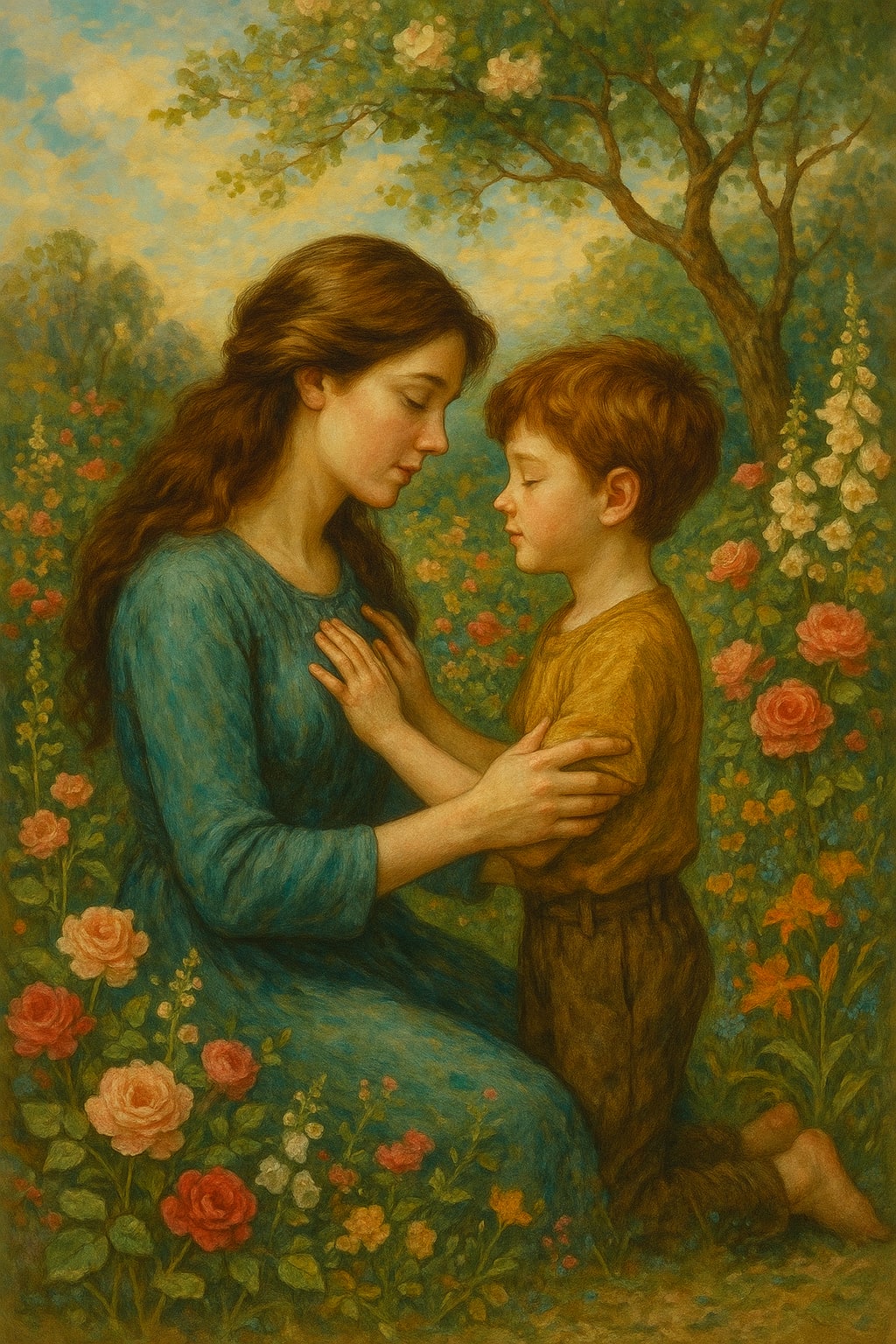
There was a garden at the edge of time. Neither in the past nor the future, it grew in the breath between dreams and waking. I have not seen it in years, yet every blade of grass whispers her name.
My mother.
She was not simply the woman who bore me, nor the one who taught me to tie my shoes or carry my grief in my back pocket. She was the house of my first thoughts, the moon of my tides, the breath behind every lullaby that ever held my name in its cradle.
I was her son, yes, but more than that—I was her echo.
She named me Eli. Short, sweet, like the humming of a bird just before dawn. She said it meant “ascend,” as if I were meant to rise, always rise, even when the world wished to bury me. She would press her warm palms to my cheeks and say, “You are light caught in skin, my son. You belong to the stars, but I begged the heavens and they lent you to me.”
We lived on the edge of the forest, in a crooked wooden house that smelled of thyme and burnt toast. The walls whispered in the wind, and the floorboards creaked like they were trying to remember something. But the garden—oh, the garden—it remembered everything.
It bloomed with colors that didn’t exist elsewhere: roses the color of promises, vines like the veins of forgotten gods, tulips that bowed in prayer at sunset. That garden was hers. She tended it like one tends a child. She spoke to it more than she spoke to anyone else.
Some say that flowers do not understand. But my mother knew better.
I remember the day I turned ten. She baked me a cake shaped like the sun and placed it in the center of the garden. “You are its twin,” she whispered, her eyes moist like early dew. “But even the sun sets.”
I did not understand.
That night, a storm came—not of rain, but of memory. I woke to her standing outside, barefoot, drenched, speaking to the garden in a tongue I could not name. Her voice trembled like a violin string plucked by grief. She said, “Don’t take him. Not yet.”
She never told me who she was speaking to.
Years passed. The house aged, as did I. My limbs stretched like saplings trying to touch the clouds. I read books. I asked questions. I grew hungry for truths—about the world, about her, about myself.
She remained silent on certain things.
Every time I’d ask about my father, her eyes would fog over like windows in winter. “He loved you,” she would say, but her voice cracked like a dying candle. “That’s all that matters.”
I wanted to believe her. But silence has a way of fermenting into suspicion.
One evening, as twilight painted the world in shadows, I found an old photograph hidden beneath the loose floorboard of her room. It showed her—young, radiant, wearing a white dress and standing beside a man whose face had been scratched out.
On the back, a note: Forgive me. I had no choice.
The next morning, I confronted her. My voice shook. “Who was he?”
She looked at me as if I had slapped her with the sky. Her hands trembled, not with fear but fatigue. “You were never meant to see that,” she said.
“But why?” I asked. “Why hide everything from me?”
She turned away. “Because the truth is a knife, Eli. And even love bleeds when it’s too sharp.”
I left the house that night. I needed air, distance, answers. I wandered the city, studied at a university far away. I learned philosophy, literature, theology—anything that would give shape to the questions my mother refused to name.
Years passed. I grew tall, like the dreams she had sewn into my bones. But something hollow followed me wherever I went, like a shadow that didn't belong to me.
And then, the letter came.
It was short.
Eli. The garden is dying. So am I. Come home.
Love, Mother.
I returned to the house, older, wearier, a stranger in the place that once named me. She was thinner now. Her hair, once a cascade of summer, was a ghost of winter. But her smile still held the same light.
She held my hand for a long time before speaking.
“There’s something I must tell you,” she said. “And it won’t be easy.”
She took me to the garden. The flowers drooped like they had forgotten how to hope.
She pointed to a small patch of earth beneath the willow tree. “This,” she whispered, “is your father's grave.”
My knees gave out.
She continued, voice like wind through broken glass. “He was a cruel man, Eli. I ran from him. Hid you. Hid myself. Changed names, cities, lives. This garden was my sanctuary. But he found us, once. He hurt me. Then… I ended it.”
She wept. Not the tears of guilt, but of relief. Of years hidden under silence finally allowed to breathe.
“I buried him here. And the garden grew from that truth. From that pain. Every flower bloomed because I confessed to the earth what I could never confess to the world.”
I did not know what to say. My mother—my gentle, luminous, lullaby-mother—had killed a man. My father.
But love is not a binary. It does not live in black or white.
Love is the color of her holding my fevered body for nights without sleep. Love is the way she taught me not to lie, even when her whole life was a lie. Love is the garden she grew from grief, the poetry she wove from pain.
I sat beside her beneath the willow. The air was thick with forgiveness.
That night, she passed.
She died with her hand in mine, her face turned toward the garden. The moon shone like a mother's eye through the window. And I—wept like a child learning silence.
I buried her next to him. Planted a seed between them. I do not know what will grow.
But something will.
It always does.
Years have passed since then.
Now, I tend the garden. I speak to the flowers. I sleep in the house where the walls remember. Sometimes, I think I hear her singing in the wind.
I teach my own children not just how to read and write, but how to feel. How to forgive.
How to hold truth without letting it cut too deep.
Every spring, a new flower blooms in that sacred patch of earth. One I do not plant.
Perhaps it's her. Perhaps it’s him. Perhaps it’s the love that grew despite the ache.
All I know is that at the edge of time, there is still a garden.
And that’s where my mother waits.
About the Creator
Muhammad Abdullah
Crafting stories that ignite minds, stir souls, and challenge the ordinary. From timeless morals to chilling horror—every word has a purpose. Follow for tales that stay with you long after the last line.
Keep reading
More stories from Muhammad Abdullah and writers in Humans and other communities.
Where the Wind Hums Love
In a village not marked on maps, but etched into the memory of winds and rivers, there lived a man named James—kind not merely in manner, but in marrow. He was the kind of man whose voice could quiet storms, whose eyes never spoke lies, and whose hands, weathered by both time and tenderness, held his world gently.
By Muhammad Abdullah9 months ago in Humans
Why Didn't Anyone Tell Us
Men, move along. This is not for you. This is for the women. I was forty-five when I began menopause. It is pretty young for that to be going on in a woman’s life, but I had undiagnosed PCOS, my entire life. Thank you to all the gynecologists I had seen my entire life. That in itself should encourage women to keep seeking second opinions, especially when you are not getting correct answers or any at all.
By Alexandra Grant2 days ago in Humans
The Beauty of Being Broken
There is a specific, metallic taste to failure. It’s the flavor of a cold coffee at 4:00 AM, the bitterness of a bank account that mocks your ambition, and the salt of tears you swore you wouldn’t shed. We are raised in a culture that worships the "Architects of Success," those polished individuals who seem to have built their lives with surgical precision. But let me tell you a secret that the editors of glossy magazines won't: The most beautiful people I know are not architects. They are ruins.
By Alex Sterling a day ago in Humans


Comments
There are no comments for this story
Be the first to respond and start the conversation.