
Where the Wind Hums Love
A timeless tale of a love that sees through shadows, sings in silence, and blooms in the soul’s deepest garden.

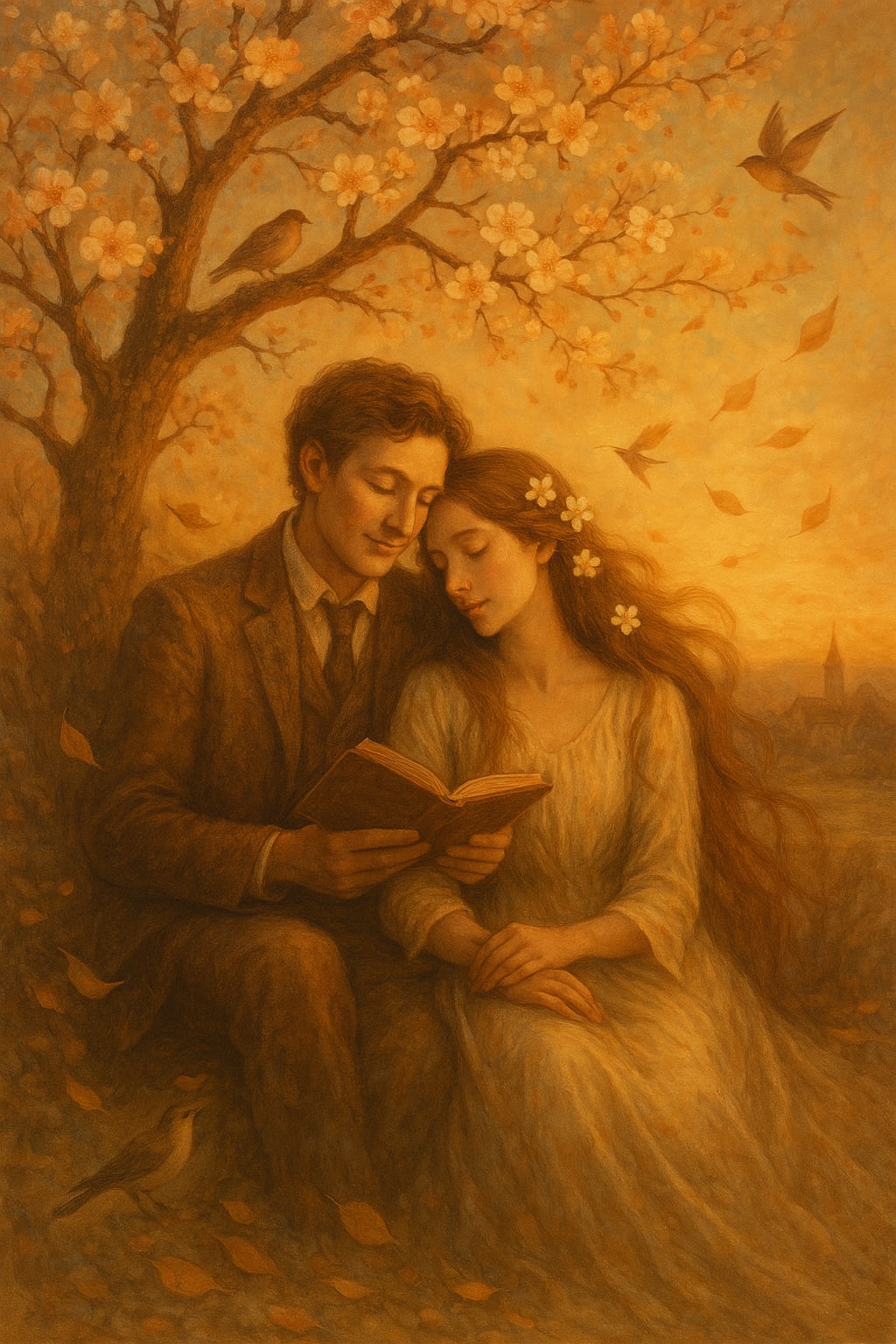
In a village not marked on maps, but etched into the memory of winds and rivers, there lived a man named James—kind not merely in manner, but in marrow. He was the kind of man whose voice could quiet storms, whose eyes never spoke lies, and whose hands, weathered by both time and tenderness, held his world gently.
And Clara—ah, Clara. She was beauty not only seen but breathed. Her laughter was an instrument of spring, her silence the spell of moonlight on snow. To say she was beautiful would be to describe the ocean as “wet”—a criminal reduction. Clara was not a woman you looked at; she was a woman you felt through the pulse of poetry, the hush of hymns, the scent of petals after rain.
They met where time pauses and fate stirs its tea. The old bridge by the swaying willows bore witness. Clara was watching the water sketch its secrets, and James, on his usual route of solitude, found something in her stillness that broke his own. Not love at first sight—but love at first silence.
It is a strange truth: the most profound connections are often born not from what is said, but from what is allowed to remain unsaid.
What followed was not a whirlwind of romance, no grand declarations or stolen kisses under clichéd stars. No. Their love was a garden that grew slow and deep, with roots that tangled under the soil of each day. They taught each other the language of glances, the music of shared breath, the miracle of ordinary moments.
And yet—does love not demand its trials?
There is a phase in every human story where joy becomes almost unbearable, as though hearts know that ecstasy, like summer, cannot last forever. The world, ever the jealous voyeur, seeks to test what it cannot taste.
Clara, radiant in her affections, began to feel the weight of whispers. Beauty, as history has shown, is often both a gift and a gamble. When others saw her walking hand-in-hand with James, their eyes narrowed with suspicion—"Why him?" they whispered, "What spell did he cast?"
But love, true love, does not bargain. It chooses. And Clara had chosen James not because he matched her shine, but because he reflected her soul.
Still, the poison of doubt has a way of seeping into even the clearest waters.
James, too good and too gentle, began to retreat into himself—not out of anger, but out of reverence. He loved Clara so immensely, so wholly, that he feared becoming the chain to her wings. Was it selfish to hold such beauty to himself?
One evening, when the moon was so full it looked like it might weep, they sat in silence under the apricot tree in their yard. Clara’s hair was braided with jasmine, her hands stained with ink from poems she had tried to write but couldn’t finish. James, always the reader of her silences, placed his hand over hers.
"Are we still who we were?" he asked.
Clara looked into his eyes, those wells of warmth, and smiled—not with lips but with the entire history of her affection. "We are," she said. "But we must water who we will be."
That night, they began again—not out of necessity, but out of reverence. Sometimes, the greatest proof of love is the willingness to love again the same soul, as though you’ve just met them.
Time, however, is not always kind to lovers.
A storm came. Not of weather—but of whispers. A traveler, passing through the village, claimed to have known Clara before. He spoke of a past where her name was not Clara, where love was not so clean, where she had run from something.
James, ever the believer, listened not to the words, but to the wound they tried to inflict.
He did not confront Clara—not out of fear, but out of dignity. If truth had a voice, it would arrive when ready.
And it did.
One morning, Clara handed James a box. Inside it were letters—not to lovers, but to herself. Words she had written long ago, confessions of a life once marred by sorrow, of trust once betrayed, of a name she shed to begin again.
"I am not what they say," she said, her voice a fragile thread. "But I am not only what you know, either."
James read each letter as though decoding sacred scripture. When he finished, he placed them back in the box and kissed her palm.
"You are all the names you've ever had," he said. "And you are still the one I love."
Ah, reader—are we not all built of half-truths and whole hearts?
In time, the village forgot the whispers. What they remembered was the image of James and Clara—dancing barefoot in the rain, arguing over poetry lines, growing old not like fading stars but like deepening rivers.
When Clara fell ill—gently, like a leaf in autumn—James remained beside her with unwavering devotion. He would read her the letters she once feared would end them. And she, with tears of grace, whispered, “You loved me not in spite of my past—but because you saw through it.”
On the day she passed, the skies did not thunder. The earth did not shake. The world, in its strange wisdom, chose silence.
James buried her under the apricot tree, the one where love had once questioned itself only to find new faith.
He visits still, every dusk, with a book in hand. He reads aloud, not to remember her, but to continue speaking the language they had built—a tongue of glances, of unspoken loyalty, of metaphor and miracle.
And when he, too, finally lay beneath that tree, the villagers say the wind changed. It began to hum—not a song of sorrow, but of deep, echoing joy.
For love, when true, is not a moment. It is a rhythm. And James and Clara were its everlasting hymn.
About the Creator
Muhammad Abdullah
Crafting stories that ignite minds, stir souls, and challenge the ordinary. From timeless morals to chilling horror—every word has a purpose. Follow for tales that stay with you long after the last line.
Keep reading
More stories from Muhammad Abdullah and writers in Humans and other communities.
Juneteenth: The Liberty We Celebrate, The Chains We Keep
I. They say freedom rang on June 19, 1865. Two and a half years late, but freedom—like most things in America—took the scenic route through oppression, confusion, and polite delay. General Granger arrived in Galveston, Texas, with news that the enslaved were—imagine this—already free. The chains had been outlawed. And so the broken were told they were no longer broken, the owned were told they had never truly been owned, and the dying were told to get up and live.
By Muhammad Abdullah9 months ago in Humans
What Are the Top Things to Do in Puerto Plata Dominican Republic
The first time I arrived in Puerto Plata, I was immediately struck by the combination of golden beaches, vibrant culture, and lush mountains. It’s one of those destinations where every corner offers something memorable, and you quickly realize that planning ahead can make your trip even more special.
By Amanda Glena day ago in Humans



Comments
There are no comments for this story
Be the first to respond and start the conversation.