
The Longest Night: The Construction Worker, The Ledge, and the Nine-Hour Vigil
In 2016, a man went to a Brooklyn roof to smoke a cigarette and found himself in a life-or-death negotiation with a stranger. He didn't use a megaphone. He didn't use force. He used the only tool he had: his time

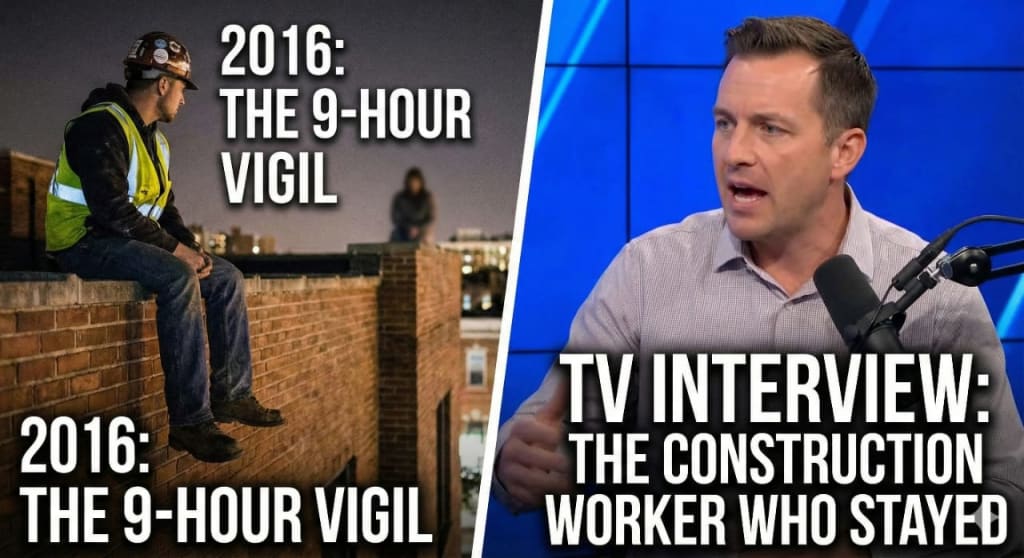
The true story of Michael O'Rourke, a construction worker who spent nine hours on a Brooklyn rooftop talking a suicidal woman down from a ledge, proving the power of simple human presence.
Introduction: The Sanctuary Above the Concrete
In New York City, the roof is not just a part of the building. It is a sanctuary. It is the only place in the vertical claustrophobia of the city where you can see the horizon, breathe air that moves, and feel alone.
For Michael O’Rourke, a 27-year-old construction worker, the roof of his Brooklyn apartment building was his decompression chamber.
It was a Tuesday in 2016. Michael had just finished a ten-hour shift. His body ached. His boots were heavy with dust. His ears were ringing from the sound of jackhammers and shouting foremen.
He climbed the fire escape stairs, pushed open the heavy metal door, and stepped out onto the gravel surface. He lit a cigarette. He leaned against the parapet, looking out at the skyline.
The city was humming—that low-frequency vibration of millions of people moving, eating, and living.
He looked across the alleyway to the adjacent building. The gap between them was about twenty feet. A lethal drop to the concrete alley below.
On the ledge of that building, sat a woman.
She wasn't looking at the view. She wasn't taking a selfie.
She was sitting with her legs dangling over the abyss. Her hands were folded neatly in her lap.
And next to her, placed with terrifying precision, were her shoes and her phone.
Michael froze. He worked in construction. He spent his life on scaffolding. He knew what "relaxed" looked like, and he knew what "resigned" looked like.
The placement of the phone was the detail that hit him in the gut. You don't put your phone down neatly if you plan to pick it up again. You put it down like that when you are leaving it behind.
Part I: The Geometry of Silence
Michael’s first instinct was the one we all have: Panic. Call 911. Shout at her. Do something.
But something stopped him.
The air between them was fragile. If he shouted, if he startled her, she might slip. Or she might jump just to stop the noise.
She looked entirely alone in the universe. She was enclosed in a bubble of silence that the city noise couldn't penetrate.
Michael took a drag of his cigarette. He exhaled slowly.
He decided not to be a hero. He decided to just be a guy.
"Hey," he said.
His voice wasn't loud. It carried across the gap like a paper airplane.
She didn't move. She didn't look up. She stared at her socks, dangling over the void.
Michael waited. The construction worker knows that patience is part of the job. You wait for the cement to cure. You wait for the inspector. You wait.
"You okay over there?" he asked.
Silence.
He didn't pull out his phone. He didn't leave. He just stood there, leaning on the wall, witnessing her.
Ten minutes passed. In the timeline of a crisis, ten minutes is an eternity.
Finally, without turning her head, she spoke. Her voice was flat, devoid of affect.
"I'm just tired."
Part II: The Dangerous Word
In the lexicon of mental health, "tired" is often the most dangerous word there is.
It doesn't mean sleepy. It doesn't mean "I need a nap."
It means existential exhaustion. It means the effort required to draw another breath feels heavier than the gravity pulling you down. It means the soul has run out of fuel.
Michael didn't know the clinical psychology of suicide. But he knew human beings.
He knew that if he argued with her—if he said "No, you're not, life is beautiful"—he would lose her. Because to her, life wasn't beautiful. It was heavy. And arguing with her reality would only prove that he didn't understand.
So he validated her.
"Yeah," Michael said. "I feel that. It's been a long week."
He sat down on the gravel of his own roof. He sat cross-legged, mirroring her posture, but safely back from the edge.
He made himself a permanent fixture.
"My name's Mike," he said. "I pour concrete."
She didn't respond.
"It's loud down there," he said, gesturing to the street. "Nice and quiet up here though."
He began to talk. Not at her. With her. Even when she didn't answer. He created a low-level hum of connection. He built a bridge of words across the twenty-foot gap.
Part III: The Vigil
Time in a crisis usually moves fast. Adrenaline makes minutes feel like seconds.
But on that roof, time stretched out.
The sun began to set. The orange glow faded into the purple bruise of a city twilight. Then came the darkness, broken only by the grid of windows lighting up around them.
Two hours passed.
Michael’s legs were cramping. He was thirsty. He wanted to go downstairs, eat dinner, and go to sleep.
But he knew the rule: If I leave, she jumps.
He was the tether. As long as he was there, she was observed. And as long as she was observed, the social contract of "not doing something horrible in front of a witness" held her in place.
He kept talking.
"What kind of music do you like?" he asked.
A pause. "I like Bowie," she whispered.
"Bowie's good," Michael said. "Starman. That's a classic."
They talked about music. They talked about the humidity. They talked about how expensive rent was in Brooklyn.
It was the most mundane conversation in the world, taking place on the edge of a cliff.
Every now and then, she would go silent for twenty minutes. Michael would watch her shoulders. If they tensed, he would speak again.
"You from the city?"
"No," she said. "Ohio."
"Ohio," Michael said. "I've never been. Is it flat?"
"It's green," she said. "Greener than this."
Part IV: The Unraveling
Around hour four, the dam broke.
It wasn't a sudden explosion. It was a slow leak.
She started to talk about why she was on the ledge.
She had lost her job a month ago.
Her father had passed away from cancer earlier in the year.
Her boyfriend, the person she moved to New York with, had walked out on her.
She described her life as a room that was shrinking.
"I feel like I'm taking up space that doesn't belong to me," she said. "I just want the noise to stop."
Michael listened. He didn't offer platitudes. He didn't say "Everything happens for a reason," because that is a cruel thing to say to someone in pain. He didn't say "You have so much to live for," because she clearly couldn't see it.
He simply acknowledged the weight.
"That sucks," he said. "That really, really sucks. I'm sorry you're carrying all that."
He validated her pain without validating her solution.
"You know," he said gently, "you don't have to decide anything tonight. The ledge will be there tomorrow. The street will be there. You don't have to clock out right now."
He was buying time. He knew that the impulse to suicide is often a wave. It crests, it crashes, and then it recedes. If he could just get her to ride out the wave, she might survive the night.
Part V: The Midnight Crisis
Midnight came and went. The city quieted down.
Michael had been on the roof for six hours. He was exhausted.
Then, the shift happened.
The woman stopped talking. She stiffened. She placed her hands on the ledge.
And she stood up.
She turned her back to Michael, facing the drop. Her toes were over the edge.
Michael’s heart hammered against his ribs. This was it. The wave was cresting.
He stood up too.
He desperately wanted to run to the edge of his roof and reach out, but the gap was too wide. If he lunged, he might startle her.
He had one card left to play.
He had spent six hours building a relationship. He had six hours of equity with her. He had to spend it all in one sentence.
He didn't shout "Don't jump!"
He spoke to her like a friend.
"Hey," he said. His voice cracked slightly. "Listen to me."
She didn't turn around. She was leaning forward.
"If you jump," Michael said, "I am the one who has to watch it."
She froze.
"I'm the one who has to call your mom," he continued. "And I'm going to spend the rest of my life wondering why I couldn't say the right thing to make you stay. I’m going to spend the rest of my life wishing I had been better."
He took a breath.
"So don't do it for you. Do it for me. Just... give me one more minute. Let's just talk for one more minute."
It was a guilt trip. It was a selfish plea. And it was brilliant.
He pulled her out of her own head and forced her to look at him. He forced her to acknowledge that her death was not a solitary act—it was a transaction that would destroy him too.
She hesitated.
The wind blew her hair. She looked down at the street. Then she looked back at Michael.
He was standing there, a dusty construction worker with dark circles under his eyes, looking at her with total, desperate sincerity.
She sat back down.
And then, she broke.
She pulled her knees to her chest and began to sob. It was a guttural, ugly, beautiful sound. It was the sound of the wave crashing.
Part VI: The Long Descent
The crisis had peaked, but it wasn't over.
Michael stayed.
He sat back down. "Let it out," he said. "I'm right here. I'm not going anywhere."
He stayed for another two hours while she cried. He stayed until she was dry-heaving from exhaustion. He stayed until the adrenaline had left her body and was replaced by the cold reality of the night.
At 2:41 AM, nine hours after Michael had climbed onto the roof, she spoke.
"I'm cold," she said.
"Yeah," Michael said. "It's freezing. You want to go inside?"
"I think so," she whispered.
"Okay," Michael said. "Do you want me to call someone to help you down?"
"Okay."
Michael called the police. He told them specifically: No sirens. No lights. Just come help her.
Because it was New York, the police arrived quickly. They came up to the roof. They were gentle. They wrapped a blanket around her. They helped her put her shoes back on.
She looked across the gap at Michael one last time.
She didn't say thank you. She didn't have the energy. She just nodded.
Michael nodded back.
They took her to the hospital.
Part VII: The Aftermath
Michael watched them leave.
He was alone on the roof again. The sun was starting to hint at the horizon. The birds were starting to sing.
He looked at the ledge where she had sat. It was just a piece of concrete now. The shoes were gone. The phone was gone.
He realized he hadn't eaten in twelve hours. He realized his back was in spasms.
He climbed down the fire escape. He went into his apartment. He drank a glass of water.
He lay down on his bed and stared at the ceiling.
He went to work the next day. He poured concrete. He shouted over the jackhammers.
He never saw the woman again. He didn't know her name. He didn't know if she got better. He didn't know if she moved back to Ohio.
There was no news crew. There was no viral video. In a city of eight million people, this entire drama had played out in complete secrecy.
Conclusion: The Ministry of Presence
We live in a culture that worships the "intervention." We love stories where the hero tackles the villain, or the doctor performs the miracle surgery, or the fireman kicks down the door.
But Michael O’Rourke’s story teaches us a quieter, heavier truth.
Sometimes, saving a life looks like doing nothing.
It looks like sitting still. It looks like listening to boring answers. It looks like enduring the discomfort of silence.
Michael saved that woman not because he was a psychologist, or a negotiator, or a priest. He saved her because he was there.
He refused to let her be alone. He refused to let the darkness have total ownership of the night.
The woman on the ledge wanted to die because she felt disconnected from humanity. By sitting there for nine hours, Michael reconnected the wire. He proved to her that a stranger cared enough to lose a night of sleep.
And sometimes, that singular data point—someone is staying—is enough to tip the scale from death to life.
If you ever find yourself on that rooftop, figurative or literal, remember Michael. You don't need the perfect words. You don't need to be wise.
You just need to stay.
"Just give me one more minute."
Sometimes, a minute is all it takes for the sun to come up.
About the Creator
Frank Massey
Tech, AI, and social media writer with a passion for storytelling. I turn complex trends into engaging, relatable content. Exploring the future, one story at a time
Keep reading
More stories from Frank Massey and writers in Humans and other communities.
The Man Who Heard the Steel Scream: Tom Alvarez and the Paper Shield
The untold story of Tom Alvarez, the construction foreman who documented the structural instability of the I-35W bridge weeks before its 2007 collapse, challenging the official engineering reports.
By Frank Massey 2 months ago in Humans
The Voice in the Dark
In the history of big cities there are moments when everything turns into chaos and people don't know where to go in those moments only the people with real character and tarbiyat can lead others to safety this is the true story of Rick Rescorla who was born in a small town in England and later moved to America he was a man who had seen many wars and he knew that safety is not something you get by luck it is something you prepare for every single day
By Hazrat Umer7 days ago in Humans


Comments
There are no comments for this story
Be the first to respond and start the conversation.