
China stands firm in Trump’s tariff war what comes next?
Beijing vows to fight back as new U.S. tariffs loom, global markets brace for impact.

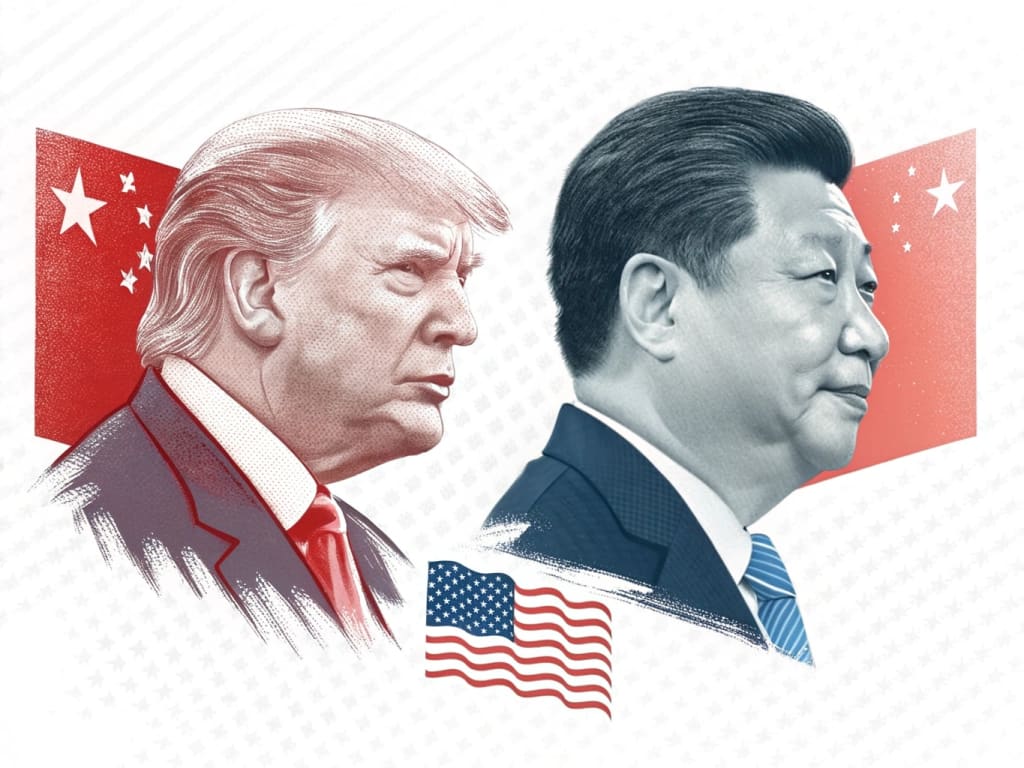
The trade war between the world’s two largest economies China and the United States shows no signs of abating, with tensions reaching new heights and the economic consequences rippling across the globe. The dispute, which has been unfolding for years, escalated once again after U.S. President Donald Trump announced plans to nearly double existing tariffs on Chinese imports. In response, Beijing swiftly vowed to “fight to the end,” making it clear that it will not yield to American pressure. This hardline stance sets the stage for a potentially prolonged and damaging standoff that could reshape global trade dynamics for years to come.
If the new U.S. tariffs are enforced, the impact would be severe. Nearly all Chinese imports could face a staggering 104% tax a sharp escalation from the already high rates in place. Such an increase would place tremendous pressure on Chinese exporters and U.S. importers alike, with the effects likely to be felt throughout global supply chains. Key categories of Chinese exports, including smartphones, computers, lithium-ion batteries, toys, and video game consoles, would be particularly affected. These products are deeply embedded in the daily lives of American consumers and the operations of many U.S. companies, making the stakes even higher.
However, it is not just high-tech items that would be caught in the crossfire. A vast array of smaller but essential goods from household screws to industrial boilers are also on the list of targeted imports. The breadth of the products involved highlights how deeply intertwined the U.S. and Chinese economies are, and how disruptive this trade conflict could become if it continues unchecked.
The Trump administration has set a deadline for implementing the new tariffs, with Wednesday marked as the day additional duties could go into effect. The move is widely viewed as an attempt to force China back to the negotiating table under Washington's terms. But with both sides digging in, the prospect of a resolution seems increasingly distant. Observers around the world are now watching with bated breath to see who will blink first in this high-stakes geopolitical game.
Alfredo Montufar Helu, a senior advisor at The Conference Board’s China Center, believes that China is unlikely to back down unilaterally. "It would be a mistake to think that China will back off and remove tariffs unilaterally," he said. "Not only would it make China look weak, but it would also give leverage to the U.S. to ask for more. We've now reached an impasse that will likely lead to long-term economic pain."
This impasse is already being felt in financial markets. Global stocks have tumbled since the latest round of tariffs was announced. In Asia, stock markets suffered one of their steepest declines in decades on Monday, as investors reacted to the Trump administration’s aggressive stance. Although there was a slight recovery on Tuesday, the overall mood remains one of caution and anxiety.
China, for its part, has not sat idly by. In response to the U.S. measures, Beijing has imposed its own retaliatory tariffs of 34%, targeting key American exports. These include agricultural products, machinery, and automobiles industries that are politically sensitive in the United States and strategically chosen by Beijing to maximize pressure on Washington. But President Trump has already warned that if China does not back down, he is prepared to respond with an additional 50% tariff increase, signaling a readiness to take the conflict even further.
The growing tit-for-tat measures are creating significant uncertainty for businesses and investors around the world. More tariffs, some exceeding 40%, are expected to take effect on Wednesday, compounding the volatility. And it’s not just China that is being targeted. Other Asian economies, such as Vietnam and Cambodia, are also in the crosshairs. Tariffs on imports from Vietnam are set to rise to 46%, while those from Cambodia could reach 49%. These countries, which have seen a recent boom as alternative manufacturing hubs to China, now face the prospect of being dragged into the broader trade conflict.
Experts are raising alarms about the speed at which events are unfolding. Unlike past trade disputes that evolved over months or years, this latest escalation has taken place in a matter of days. The rapid pace leaves little room for diplomacy or compromise, and even less time for governments, companies, and investors to prepare. As a result, many are now scrambling to adapt to what could become a fundamentally different global economic environment.
Economists warn that prolonged trade tensions between the U.S. and China could have far-reaching consequences. Higher tariffs could increase costs for businesses, reduce consumer spending, and ultimately slow economic growth. Supply chains that have taken decades to build could be disrupted or dismantled entirely, forcing companies to invest in new infrastructure and relationships an expensive and time-consuming process. For developing nations, particularly in Asia, the uncertainty may deter foreign investment and stall economic progress.
There is also a broader geopolitical dimension to the trade war. For the United States, the tariffs are part of a larger strategy to counter China's rising influence and force Beijing to make structural changes to its economy, such as reducing state subsidies and improving intellectual property protections. For China, standing firm is not just about economics, but also about national pride and sovereignty. Any perception of capitulation could weaken the government’s domestic support and embolden foreign rivals.
As the deadline looms, the world waits to see how the next chapter in this escalating conflict will unfold. Will either side offer a compromise to de-escalate tensions, or will the situation spiral further out of control? For now, the outlook remains grim, with both Washington and Beijing appearing more committed than ever to winning the battle regardless of the cost.
In the end, it may not be a matter of who wins or loses, but how much damage the global economy can endure before a truce is finally reached.
About the Creator
G.M. Rayhan
I'm G.M. Rayhan, a Journalist and content writer covering trending news from around the world. I deliver timely, engaging, and reliable stories that inform and inspire readers to stay connected with global events and viral topics.
Keep reading
More stories from G.M. Rayhan and writers in Humans and other communities.
If Humans Are the Most Intelligent, Why Do They Create Destruction?
Humanity has long been regarded as the most intelligent species on Earth. With our advanced technology, ability to communicate through complex languages, and unparalleled problem-solving skills, it’s easy to see why humans are often considered the most intellectually advanced creatures. However, when we look at the darker side of human history, particularly the creation of destructive weapons like the atomic bomb and the perpetuation of war, a troubling question arises: If humans are so intelligent, why have they made the atom bomb and continued to wage war?
By G.M. Rayhan10 months ago in Humans
The Power of Daily Discipline
In a crowded city where ambition filled the air like dust, lived a man named Elias. He was not poor, yet never comfortable. Not unsuccessful, yet far from fulfilled. Like many others, Elias carried dreams quietly inside him—dreams of becoming skilled, respected, and at peace with himself. But his daily life told a different story. His mornings began late, his nights ended later, and his days slipped away in distractions that offered comfort but no progress.
By The best writer 6 days ago in Humans
Wild Card Weekend Recap: What Happens Now?
I think I figured out why I love Wild Card Weekend so much. It's because it's the first playoff anything of the calendar year. The NFL season starts in the fall, and once upon a time, the champion was crowned either on or slightly before New Year's. The evolution of the NFL schedule has resulted in the playoffs starting just into the New Year, and currently, the final week of the season falls on the first weekend of the New Year, with Wild Card Weekend coming a week after that. So yes, chronologically, the NFL's Wild Card Weekend serves as the first playoff anything of the calendar year.
By Clyde E. Dawkins7 days ago in Unbalanced



Comments
There are no comments for this story
Be the first to respond and start the conversation.