science
The Science Behind Relationships; Humans Media explores the basis of our attraction, contempt, why we do what we do and to whom we do it.
The Essence of Spirituality: A Journey of Self-Discovery
Spirituality is an age-old concept that transcends cultural boundaries and has evolved through millennia. It encompasses the search for meaning, purpose, and connection with something greater than oneself. While spirituality is often associated with religious beliefs, it can exist independently, embracing a broader spectrum of human experiences. In this essay, we will explore the essence of spirituality, its significance in modern society, and the profound impact it can have on individuals' lives.
By Nathan Davis3 years ago in Humans
Human Gene Editing – Good or Bad?
Once upon a time, in a not-so-distant future, the world stood on the cusp of a scientific revolution that could reshape humanity forever. The advent of human gene editing brought with it both wonder and concern, as the boundaries of medical possibilities expanded beyond imagination. This tale revolves around the debate of whether this groundbreaking technology is a boon or bane for humankind.
By Zeeshan May3 years ago in Humans
The Science of Muscle Growth: How Your Body Builds Strength
Introduction Our bodies house a complex network of over 600 muscles, constituting a significant portion of our body weight. These muscles, along with connective tissue, are responsible for supporting our structure, enabling movement, and maintaining posture. Whether you are an avid bodybuilder or not, understanding how muscles grow and the factors that influence their development is crucial to maximizing their strength and functionality. In this article, we delve into the fascinating process of muscle growth, shedding light on the role of the nervous system, cellular changes, nutrition, hormones, and rest in fostering robust muscle development.
By Aniket Chalke3 years ago in Humans
Scientists Discover Hidden Weakness of Deadly Brain Cancer
Glioblastoma multiforme, an aggressive and deadly form of brain cancer, has long posed a significant challenge to medical researchers and oncologists. Despite advances in cancer treatment, the survival rate for patients with glioblastoma remains low. However, recent groundbreaking research has shed light on a hidden weakness in this formidable disease, offering new hope for improved treatment strategies.
By R Bijaya Kumar3 years ago in Humans
Nanotechnology and the Future Lifestyle: Balancing Needs, Wants, and Sustainability
Introduction: As the world hurtles into the future, our lifestyle choices and consumption patterns are undergoing a profound transformation. The pursuit of a sustainable and fulfilling life demands a careful balance between fulfilling our needs and managing our wants responsibly. In this pursuit, nanotechnology emerges as a game-changer, promising to revolutionize various aspects of our daily lives. By harnessing the power of nanotechnology, we have the potential to address our essential needs more efficiently while simultaneously reevaluating and curbing our wants to create a more sustainable future lifestyle.
By kolitha lokubalasuriya3 years ago in Humans
Beyond the Veil: The Extraordinary Odyssey of Near-Death Experiences
Introduction Near-death experiences (NDEs) have long been a subject of fascination and intrigue. These extraordinary encounters occur when an individual, on the brink of death, undergoes a life-altering experience. Contrary to what one might expect, NDEs are not the dreary encounters with darkness but rather awe-inspiring journeys filled with vivid images and sensations. While some may dismiss these accounts as hallucinations or dreams, a growing body of evidence and personal testimonies suggests that there is more to life than meets the eye. In this article, we delve into the documented NDEs, exploring the common themes and remarkable stories of individuals who have ventured to the precipice of existence and returned forever changed.
By WanderLUST3 years ago in Humans
Do You Often Wake Up Between 2-4 AM?
Sleep disruptions can significantly impact our overall well-being, affecting approximately 35% of people on a regular basis. Many individuals find themselves waking up between two and four in the morning, wondering why they are unable to experience uninterrupted rest. While external factors like environmental disturbances can contribute to sleep issues, a substantial portion of the population experiences these awakenings independently. Understanding the complexities of a healthy sleep cycle is crucial in addressing this common concern and improving overall sleep quality. In this article, we will delve into the factors influencing sleep patterns, and circadian rhythms, and explore effective strategies to overcome nighttime awakenings.
By Daham Navodya3 years ago in Humans
The Role of Olive Oil in Brain Health and Reducing Dementia Risk
Olive oil has long been recognized for its numerous health benefits, particularly its positive effects on heart health. However, recent research suggests that olive oil may also play a crucial role in supporting brain health and reducing the risk of dementia. This article explores the chemical composition of olive oil, its potential benefits for brain health, the role of oleic acid in this context, and how it compares to other commonly used oils in Indian households. Additionally, we'll discuss the appropriate daily intake of olive oil and its potential benefits for children's health.
By satish Kumar3 years ago in Humans
BLOW YOUR MIND
BLOW YOUR MIND This is Earth this is where you live and this is where you live in your neighbourhood the solar system [Applause] here's the distance between the Earth and the moon doesn't look too far does it think again at their farthest point the earth and the moon are two hundred and fifty two thousand eighty eight miles away inside that distance you could fit every planet in our entire solar system but let's talk about planets the Great Red Spot on Jupiter that's about two times as big as Earth and Saturn is about nine times wider than Earth Saturn's rings are so large that a few of the fragments within them are as large as mountains but that's nothing compared to our Sun just remember this is Earth and this is Earth from the moon this is Earth from Mars here's Earth from just behind Saturn's rings and here's Earth from just beyond Neptune four billion miles away but a billion is a big number so let's put that in perspective one million seconds equals about eleven and a half days whereas 1 billion seconds equals over 31 years let's step back a bit here's the size of Earth compared with the size of our Sun terrifying right and here's that exact same Sun from the surface of Mars as Carl Sagan once mused the total number of stars in the universe is larger than all the grains of sand on all the beaches of the planet Earth and there are some stars out there that are much bigger than our little wimpy Sun the biggest star we know of V Y Canis Majoris is about 2,000 times the diameter of our Sun but none of those compares to the size of a galaxy in fact if you shrink the size of our solar system down to the size of a quarter and trans the Milky Way galaxy down using the same scale the diameter of the Milky Way will be roughly the size of the United States that's because the Milky Way galaxy is huge it's diameters about 100,000 light-years wide which when converted to miles is about 621 quadrillion 371 trillion 192 billion 237 million three hundred thirty three thousand eight hundred ninety miles inside of all that is you live in this tiny portion of the Milky Way but even still our galaxy is a little runt compared with some others NGC 674 for a spiral galaxy similar to our own is twice as wide as the Milky Way stretching over two hundred thousand light-years across it is a massive but let's think bigger in this picture alone taken by the Hubble telescope there are thousands and thousands of galaxies each containing millions or billions of stars with their own planets some of the objects seen here may have formed as many as 11 billion years ago just three billion years after the Big Bang [Music] this period of time is considered one of the busiest star-forming periods and just keep this in mind that's a picture of a very small part of the universe so if you ever feeling upset about your favourite show being cancelled or the fact that they play Christmas music way too early just remember this is your home earth
By hellen wanjiru3 years ago in Humans
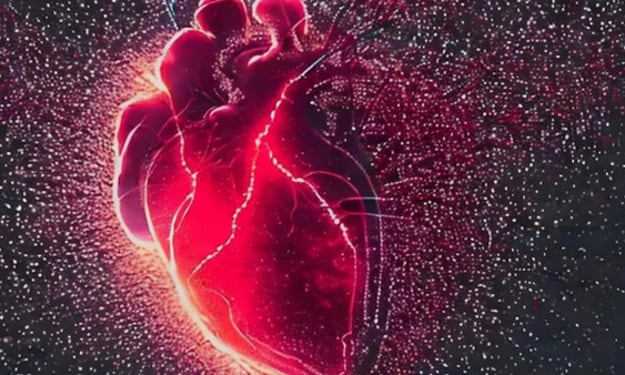
Pioneering Hearts in Space: 3D-Printed Organs on ISS Could Revolutionize Deep Space Travel
Introduction As humanity sets its sights on deep space exploration, the challenges posed by extended space travel become increasingly evident. Among the most critical concerns is the health and well-being of astronauts during prolonged missions. In an unprecedented breakthrough, the International Space Station (ISS) is spearheading an innovative initiative to produce 3D-printed hearts in microgravity. This revolutionary approach has the potential to transform astronaut health and pave the way for successful long-duration missions to distant celestial bodies.
By Anthony Gatimu3 years ago in Humans