humanity
For better or for worse, relationships reveal the core of the human condition.
RAIN BEAU
Arriving at the restaurant, my Lyft (™) driver pulled up to the front door. The rain was pouring down, I rushed so I would not be soaked. Les Chat Noir (The Black Cat) is a modern french restaurant in downtown Detroit. My friends picked this place. I got an email invitation for “the gang” meaning my 3 other girlfriends and I to spend some quality time together. This was arranged for a late Sunday afternoon. I arrived on time as always. I knew I would be waiting for the others. Their version of “on time was 30 minutes late.
By Cara Arildsen5 years ago in Humans
Needs
Over the years I've spent many hours in thrift stores for various reasons. I've gone there out of necessity as well as being environmentally conscious and trying to make less of a footprint on our earth. In my mind there are many things you can buy used and still get what you need from them. One of the other reasons I have gone also is just being social with my friends. It seems funny but friends go out shopping together and so there's no difference I feel in shopping at a thrift store aka the treasure store.
By Yvette McDermott5 years ago in Humans
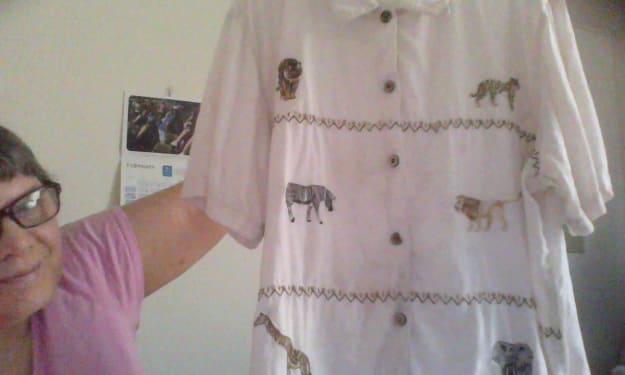
A $50 Cruiser Bicycle, a Green Jean Jacket, a Linen Blouse with Animal Embroidery, and Other Treasures
In my opinion, buying things second hand definitely practices good stewardship of the planet as well as my wallet. Aside from those very important goals, I think people often seek a connection with the past or ideal self in their thrift shop purchases...that book signed by a famous author, the classic Labyrinth T-shirt with the silk-screen of David Bowie as the Elf King, my own love of Victorian and art deco costume jewelry that harkens back to sorting through my grandmother's things after her death in the early 70's. However, I wonder if another push-back idea against consumerism comes into play here. Many now prefer to give experiences instead of goods as gifts. Perhaps, in a very thoughtful, reflective sense, some of my favorite, no-regrets thrift store purchases and second-hand items have tied me into future human connections and experiences.
By Julia Schulz5 years ago in Humans
Storytelling-Imagination Shapes Who We Are As Humans
We as a human race have been telling stories since the beginning of time. Small, hidden caverns still hold pictures from the first known storytellers, thousands of years ago. We love sharing and hearing stories; it is one of the things that makes us human. Before humans ever learned to read and write, we are told stories that can capture family or cultural values, glorify a historical event or capture the imagination.
By Suzanna Slack5 years ago in Humans
Occupational Health
Christine was sunny and bright. She smiled at strangers. One teenaged summer holiday, she volunteered for a project that provided respite for families with disabled children. Against her adolescent instinct, she would wake early and make her way to the local primary school. Christine and the project coordinator worked in a small, windowless room with school desks, low chairs and brightly coloured art supplies. Children usually stayed with the project for half a day, but Paul and Angela were booked in for a full week. Christine had read their files and looked up the syndrome in the coordinator’s hand book. They had a progressive condition so that before their brains had matured, they began a physical decline and developed dementia. Paul and Angela’s bodies and brains were collapsing. There was no cure. The cause was a rare genetic disorder. Christine had already outlived their life expectancy.
By Rachel Robbins5 years ago in Humans
The Crush
The bunkhouse was in the French style, painted white under a black slated roof, upon which sat a rusting iron cockerel who used to tell which way the wind blew. The floorboards creaked under Harrison as he crept out. Dawn chased shadows across the Pyrenees, bringing the last day of the crush.
By Will Russell5 years ago in Humans
Strangers
Anna awoke with the yellow Labrador, Bree, laying on her legs and realized her feet were asleep. Her husband, Peter, had already gotten up to make coffee and get his routine started for the day. So she decided to just relax and enjoy the peaceful morning.
By Rosalee Beach-Pelkey5 years ago in Humans
My life behind broken eyes
This is byte number two in my journey with a condition known as optic atrophy. The full name of my eye condition is congenital optic atrophy myopia. And for those who don't know, the myopia part is short-sightedness just thrown in for good measure. I was in primary school and it was not until grade two or seven years of age when my condition was first discovered. I touched on it in the first bite. The way they discovered I had an eye condition was the teachers, quite clearly noticed I was extremely distracted, and more so when the teacher would write on the chalkboard. I just couldn't see it. At the tender age of seven, the teacher moved me to the front of the class. But alas, it was still a blurry mess of lines that just ran into each other. This would be a very good time for me to explain or try and put it into layman's terms what it would be like for a sighted person to have my condition. I think the best way I can describe it would have to be in two parts. Part one: It's like looking through a set of binoculars that are just quite out of focus. Everything is quite blurry. That's part one. Part two: The optic nerve which connects to the back of your eye, where the pictures travel in the front of your eye through the optic nerve and through to the brain to be turned into pictures. Well, that optic nerve at the back of the eye is covered in nerve endings and for some unknown reason a lot of those nerve endings have died. This leaves the result of blind spots in my vision. So when I look straight ahead with my right eye. I cannot see anything in the middle. Right in the center of my eye, a large portion of my central vision is gone in my left eye. I have two major parts where I have no vision at all, and try to explain that is not as easy. Needless to say, Well, probably not, needless to say, I do all of my looking out of my left eye, and only the corner of it. I only have very limited vision. Now back in school, I was sent off to the primary school nurse who did an eye examination on me. You know the one where they get you to read off the chart on the wall. When they realized that I could not read more than around three lines, and that's including the largest letter on the chart, that's when things started to change for young, Phillip Ogden. Oh, by the way, my birth name is Ogden, Phillip, Ogden. However, when I found my calling is to be a radio announcer the name Ogden just didn't work for me. But that's another story. I'll tell that one in another story. From this time on things changed in a big way. For a seven-year-old boy who was now moved to a different school around 45 minutes away from home in a suburb of Perth, called Lathlain. Lathlain primary school was a regular primary school, but two of the classes spatialized teaching children with low vision. One class was Junior and had students from grades one through to five I do believe. And the second class had grades, five, six, and seven. I quite enjoyed my time at Lathlain primary. There unlike regular school, we had visual aids, such as handheld magnifying glasses to read books and small print items. We had monoculars, or what we termed as mini scopes, which were single lens binoculars, so we could read from the chalkboards. They also taught us how to type. And I think the idea behind this was if you can't see you can't have neat handwriting. So it made life a little easier for us and for people who had to read our work,. That's certainly what I'm guessing because they never really told us. Other things that were a little different for us are we had a lot of text photocopied into larger print, so it was easier to read. We also had one of the first closed-circuit TVs. These days most people relate CCTV with security cameras. And these were well not for security, they were mounted onto a board, which sat on a table. Around three feet above the table. And you could put your books on the table under the camera. And there was a television screen attached, like a small portable TV. And the text could be easily enlarged the colors could also be inverted, which I do prefer. Depending on the type of eye condition you have some people find it hard to read, black text on a white background. I find this very stressful on my eye, very bright, in fact too bright. So I prefer to invert my colors to a black background and white text, or light-colored text makes it a lot easier. The idea behind the two classrooms was to help visually impaired children adjust to what a regular school would be like in our older years. As a rule, students were returned to a regular school in year 7 to prepare them for returning to high school. This was a very hard time for me. This was to be just the start of quite a few tumultuous years.
By Phil P K Kennedy5 years ago in Humans