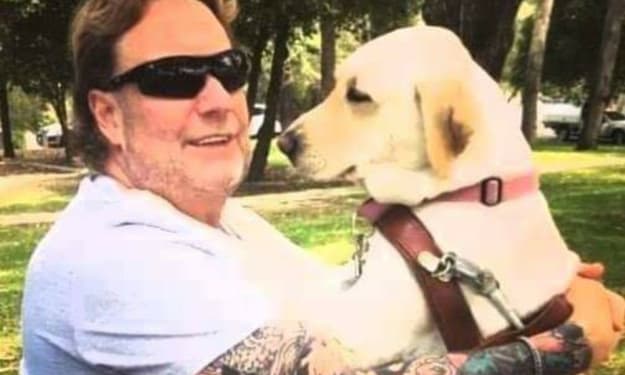
Phil P K Kennedy
Bio
Stories (2)
Filter by community
My life behind broken eyes
This is byte number two in my journey with a condition known as optic atrophy. The full name of my eye condition is congenital optic atrophy myopia. And for those who don't know, the myopia part is short-sightedness just thrown in for good measure. I was in primary school and it was not until grade two or seven years of age when my condition was first discovered. I touched on it in the first bite. The way they discovered I had an eye condition was the teachers, quite clearly noticed I was extremely distracted, and more so when the teacher would write on the chalkboard. I just couldn't see it. At the tender age of seven, the teacher moved me to the front of the class. But alas, it was still a blurry mess of lines that just ran into each other. This would be a very good time for me to explain or try and put it into layman's terms what it would be like for a sighted person to have my condition. I think the best way I can describe it would have to be in two parts. Part one: It's like looking through a set of binoculars that are just quite out of focus. Everything is quite blurry. That's part one. Part two: The optic nerve which connects to the back of your eye, where the pictures travel in the front of your eye through the optic nerve and through to the brain to be turned into pictures. Well, that optic nerve at the back of the eye is covered in nerve endings and for some unknown reason a lot of those nerve endings have died. This leaves the result of blind spots in my vision. So when I look straight ahead with my right eye. I cannot see anything in the middle. Right in the center of my eye, a large portion of my central vision is gone in my left eye. I have two major parts where I have no vision at all, and try to explain that is not as easy. Needless to say, Well, probably not, needless to say, I do all of my looking out of my left eye, and only the corner of it. I only have very limited vision. Now back in school, I was sent off to the primary school nurse who did an eye examination on me. You know the one where they get you to read off the chart on the wall. When they realized that I could not read more than around three lines, and that's including the largest letter on the chart, that's when things started to change for young, Phillip Ogden. Oh, by the way, my birth name is Ogden, Phillip, Ogden. However, when I found my calling is to be a radio announcer the name Ogden just didn't work for me. But that's another story. I'll tell that one in another story. From this time on things changed in a big way. For a seven-year-old boy who was now moved to a different school around 45 minutes away from home in a suburb of Perth, called Lathlain. Lathlain primary school was a regular primary school, but two of the classes spatialized teaching children with low vision. One class was Junior and had students from grades one through to five I do believe. And the second class had grades, five, six, and seven. I quite enjoyed my time at Lathlain primary. There unlike regular school, we had visual aids, such as handheld magnifying glasses to read books and small print items. We had monoculars, or what we termed as mini scopes, which were single lens binoculars, so we could read from the chalkboards. They also taught us how to type. And I think the idea behind this was if you can't see you can't have neat handwriting. So it made life a little easier for us and for people who had to read our work,. That's certainly what I'm guessing because they never really told us. Other things that were a little different for us are we had a lot of text photocopied into larger print, so it was easier to read. We also had one of the first closed-circuit TVs. These days most people relate CCTV with security cameras. And these were well not for security, they were mounted onto a board, which sat on a table. Around three feet above the table. And you could put your books on the table under the camera. And there was a television screen attached, like a small portable TV. And the text could be easily enlarged the colors could also be inverted, which I do prefer. Depending on the type of eye condition you have some people find it hard to read, black text on a white background. I find this very stressful on my eye, very bright, in fact too bright. So I prefer to invert my colors to a black background and white text, or light-colored text makes it a lot easier. The idea behind the two classrooms was to help visually impaired children adjust to what a regular school would be like in our older years. As a rule, students were returned to a regular school in year 7 to prepare them for returning to high school. This was a very hard time for me. This was to be just the start of quite a few tumultuous years.
By Phil P K Kennedy5 years ago in Humans
My life behind broken eyes
Finally I've made it, and still it's hard to think, I have made it to half a century, with very little eye sight, despite I don't know how many close calls like crossing the road at the most inappropriate times, like when a car is practically on top of you. Like, going for a dip at the beach, and realizing you can't see the shore (even though you are only a few meters from it) oh and can't feel the bottom "GULP". Or the time as a kid I was with cousins climbing paper bark trees at the trailer park in August Western Australia when I decided to jump down onto what I thought looked like the ground but was in fact a swamp with very deep water and lots of debris under the surface. And that is not even the tip of the iceberg of things that have nearly killed me. I guess now would be a good time to explain why I can't see real good. I have a condition that is call Congenital Optic Atrophy with Myopia, which is just a fancy schmanzy way of say short sighted as well. To keep it simple and not bore you to complete tears, the optic nerve behind both eyes are covered in nerve ending and for some unknown reason a great majority have died. So I can see a little and I mean a very little in my right eye (less than 5 percent vision) and just a little more in my left eye (Just under 10 percent). One of the questions I get asked is how old were you when your eyesight was discovered. I was in first grade at the tender age of 6 when the teacher noticed I wouldn't do any work, in particular when she write things on the chalk board. The school nurse was called to asses my eye sight and arranged an eye test which was closely followed by a meeting with my parents to inform them that I simply couldn't see very much at all. This is when everything changed for a young lad. I was moved from a regular primary school and now sent to another school, Lathlain Primary school funnily enough in Lathlain, a suburb just South of Perth. The reason for the move was that Lathlain has two classes especially set up to cater for children in lower and upper primary with sight loss. So the scene is set, you now know a little about what happened when I started this journey. So join me in the next installment of my story My life behind broken eyes, and hey thanks reading. In the meantime as I say everyday on my radio show, take it easy but do take it ok....
By Phil P K Kennedy5 years ago in Humans