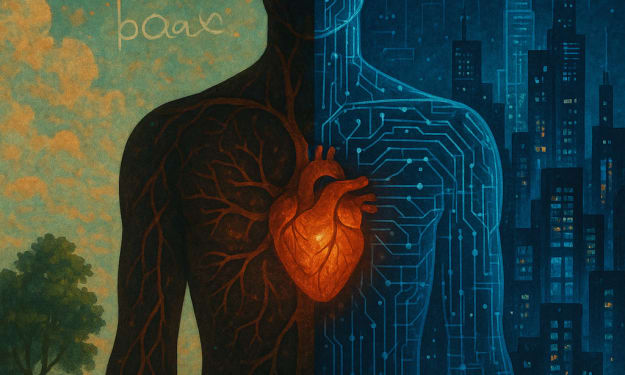
book reviews
Reviews of books by relationship gurus, dating experts, and cautionary tale-tellers.
Things We Never Got Over
Things We Never Got Over by Lucy Score is an emotionally charged, heartwarming romantic novel that will keep you hooked from the very first page. A perfect blend of humor, deep emotions, and romance, this book will take you on a journey of love, healing, and personal growth. With a storyline that’s both captivating and thought provoking, Lucy Score has created a rich narrative filled with compelling characters and heartfelt moments.
By Muhammad Hayat9 months ago in Humans
Silence of the Minds
In the year 2147, humanity achieved the zenith of technological progress, a period characterized by the seamless integration of Artificial Intelligence and robotics into all aspects of daily life. This transformation unfolded gradually, commencing several decades prior with the introduction of basic smartphones and culminating in sophisticated AI systems that oversaw everything from individual affairs to global governance. The advent of the Neurolink, a groundbreaking innovation facilitating direct communication between humans and machines, represented a pivotal moment. With merely a thought, individuals could retrieve information, transmit messages, and manipulate their surroundings. As the Neurolink gained widespread acceptance, it emerged as a beacon of advancement, celebrated as the quintessential instrument for human connectivity. Paradoxically, it would also herald the onset of decline.
By Imon Mridha9 months ago in Humans
"The Pulse of Humanity in a Digital Age"
Exploring the Emotional, Ethical, and Existential Questions of Being Human in an Ever-Connected World We live in a time when technology is advancing faster than ever before—when artificial intelligence can compose music, diagnose illness, write essays, and simulate human conversation. Social media has turned strangers into communities and thoughts into metrics. In this whirlwind of constant innovation, we are left to face a profound and unavoidable question: What does it mean to be human in the digital age?
By Muhammad Faizullah9 months ago in Humans
Wuthering Heights
Wuthering Heights is a powerful and dramatic novel written by Emily Brontë and first published in 1847. It's the only novel she ever wrote, but it became one of the most well known and unique love stories in English literature. This is not your typical romantic tale it’s dark, emotional, intense, and filled with passion, revenge, and haunting memories.
By Muhammad Hayat9 months ago in Humans
The weight of an only son.
I’ve always believed that if you’re born male into a humble Nigerian home — especially as the only son — life hands you a load that’s invisible but heavy. It’s not just tradition. It’s not just expectation. It’s something deeper. Something you feel in your chest long before you understand it.
By Nathaniel NART9 months ago in Humans
The Cases of Breakthrough Measles Infections, Why Do They Happen?
However, these breakthrough measles infections—measles infection in a vaccinated person—are rare but nevertheless laudable occurrences. The MMR vaccine is well-proven, but no vaccine gives 100% protection. With outbreaks of measles still emerging in countries around the world, particularly in those communities where vaccination rates are subsiding, it has been important to establish what the factor is for these breakthrough cases to occur, in order to facilitate public health awareness and landscape response [1].
By Asif Faysal9 months ago in Humans
“The Hollow Hunger”. Content Warning.
Jason sat at the edge of the bed, the silence of the early morning pressing against his ears. The city hadn’t yet woken up. A woman lay behind him, breathing softly, a name he couldn’t remember even if he tried. He stared at the floor, shirtless, with fingers nervously pulling at the hem of the sheets.
By Sabiha Sums9 months ago in Humans
'New Colour' No One Has Seen Before. Content Warning.
Researchers at the University of California, Berkeley have discovered a previously unknown color they have dubbed "olo" in a ground-breaking study. This discovery, which was published in Science Advances, challenges our understanding of how humans perceive color and opens up new research opportunities in visual studies and neuroscience. The Finding of "Olo" Dr., a neuroscientist, is in charge of the research team. A novel method was used to stimulate the human retina by Michael Lee. They used a device called "Oz" to focus on M-cones, which are cells in the retina that are responsible for detecting medium wavelengths of light, which are typically associated with green hues. The S-cones and L-cones, which detect short wavelengths and long wavelengths, were omitted by this precise stimulation. The end result was the perception of a brand-new color called olo that has no known wavelength. Olo was described by participants as a unique, highly saturated blue-green color. The three-cone model of human color vision is challenged by this phenomenon, which suggests that olo exists outside of the standard color gamut. Understanding Color Vision in Humans The trichromatic theory, which asserts that the retina contains three types of cones that are sensitive to short (blue), medium (green), and long (red) wavelengths of light, serves as the foundation for human color vision. In order to produce the perception of color, the brain processes the input from these cones. However, the discovery of olo, which appears to be a singular experience that is not attributable to the stimulation of the existing cone types, has cast doubt on this model. The trichromatic model's limitations and the possibility of additional, previously unknown mechanisms in human color vision are intriguingly questioned by the perception of olo. Implications for Visual and Neuroscience Research The field of neuroscience will be significantly affected by the discovery of olo. It gives researchers a new tool for understanding how the brain processes sensory information and how complex visual processing is. Researchers can gain insight into the neural pathways involved in color perception and the brain's construction of our visual reality by comprehending how olo is perceived. Additionally, the capacity to create a brand-new color experience may be useful in the treatment of visual disorders. The method used to make Olo may provide therapeutic options for people who are color blind or have other visual impairments by helping to retrain the brain to process visual stimuli. The Debate Regarding "Newness" Even though the Berkeley team says that olo is a new color, some experts still don't believe it. Dr. According to vision scientist John Barbur of the University of London, olo might not be a new color but rather a more intense version of an existing color. He suggests that the brain may perceive olo as a distinct color experience because of the extreme saturation of a blue-green hue. This debate demonstrates the difficulty of defining what constitutes a "new" color and the complexity of color perception. Additionally, it emphasizes the need for additional research to determine whether olo is a variation of existing color stimuli or a truly novel perceptual experience. The Study of Color Perception's Future The discovery of olo opens the door to additional research into the limits of human color perception. The possibility of stimulating various combinations of retinal cells to elicit additional new colors is currently being investigated by researchers. Understanding the full spectrum of human color perception could have an impact on art and design, virtual reality, and user interface development, among other fields. These kinds of discoveries also have ramifications that go beyond the confines of the laboratory. In conclusion, our fundamental understanding of color and perception is challenged by the discovery of olo. It opens up exciting possibilities for future neuroscience research and applications, whether it is a brand-new color or an enhanced version of an existing one. Who knows what other unseen colors might be waiting to be discovered as scientists continue to investigate the limits of human perception.
By rasong nokrek9 months ago in Humans
The Metamorphosis of the Mind
The Metamorphosis of the Mind Eliot Greaves lived a life boxed neatly in spreadsheets and meetings, where the only transformation he embraced was from coffee to code. An unremarkable man in a gray suit, he worked as a systems analyst in a firm that prized logic over feeling and structure over spontaneity. His days ticked by with mechanical precision—wake, work, sleep, repeat—until one morning, he awoke with a curious itch behind his eyes.
By Mohammed Mamunar Rahamn9 months ago in Humans