

In a quiet village nestled between green hills and flowing streams, life moved slowly. The people were hardworking and honest, but something was missing—unity.
Each family stayed to themselves. The blacksmith hammered in silence. The baker made bread without sharing his warmth. Farmers grew crops, but never shared seeds or tools. They lived close together, but their hearts were far apart. The village looked whole from a distance, yet it was like a jar of sand—together in space but separate in spirit.
At the center of the village stood a great tree. Its wide branches stretched out like welcoming arms, and its roots were buried deep in the earth. It had watched over the village for more than a hundred years. The elders remembered playing under its shade. But now, most people passed it without a glance, too busy with their own struggles.
Then one year, the sky stopped crying. Rain didn’t fall. The river that once flowed with song became silent and dry. Crops shriveled. Wells became hollow. The earth cracked like broken skin. The villagers panicked.
“We must save water,” the headman said.
“We must think of our children,” said the teacher.
“We must survive,” said the farmers.
But even then, no one wanted to work together. Fear made their walls higher. Everyone blamed someone else.
One night, a terrible windstorm shook the village. Thunder roared in the sky like angry drums. The villagers stayed inside their homes, praying for the storm to pass.
By morning, the storm had calmed, but something had changed.
The old tree had split in half. Its trunk had cracked down the middle, and its strongest branch lay broken on the ground.
Children cried. Elders stared in silence. For the first time in many years, the villagers gathered around the tree. They stood not as strangers, but as people with shared pain.
A small boy named Bilal looked up and asked, “Why did the tree fall?”
An old woman, once a village teacher, touched the fallen bark and replied, “It stood alone for too long. Even the strongest break when left unsupported.”
Her words echoed in every heart.
That evening, as the sun set in golden light, a young woman named Amina stood in the village square. She said softly but clearly, “We have been like this tree. Proud, tall, but standing alone. Now we must grow roots together.”
For a moment, silence wrapped the village. Then something shifted.
The next day, the blacksmith offered to fix the broken tools of the farmers. The carpenter shared wood for repairs. The baker gave out bread to those without food. The teacher reopened her home to teach children again.
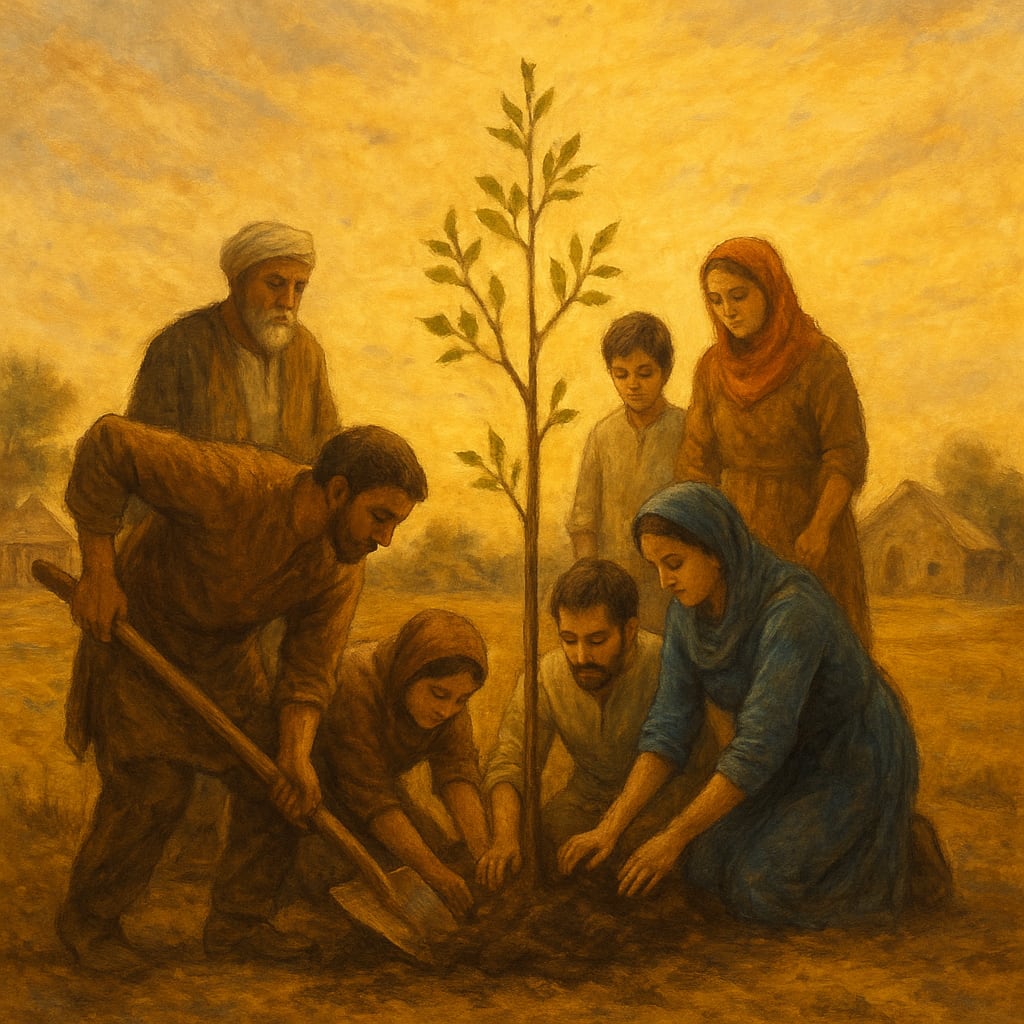
Together, the villagers decided to dig a new well. The ground was dry and hard, but they didn’t stop. Men and women worked side by side. Children brought small stones in buckets. The elderly carried water from a distant spring.
For days they labored, sweating under the sun, laughing through the struggle. And finally—water. Clear, cold water rose from the earth. They had found life again—not just in water, but in each other.
Where the old tree had once stood, they planted a young sapling. This time, they made a promise—not just to the tree, but to themselves.
“We will never stand alone again.”
Seasons passed. The village changed.
People helped without being asked. Families shared harvests. When someone fell ill, others cared for them. At weddings, the whole village danced. At funerals, they cried as one. They were no longer just neighbors. They were a family.
The young sapling grew into a strong tree. Its leaves whispered of unity, of struggle and rebirth. Children climbed its branches. Lovers carved their names into its bark. Elders sat under it and remembered.
One day, a traveler visited the village and asked, “What made this place so full of peace?”
A little girl pointed to the tree and smiled. “That tree is our heart. Long ago, we learned to grow like its roots—stronger together.”
---
Moral of the Story:
Even the mightiest fall when left alone, but when we unite, we become unbreakable.
Unity is not just living side by side—it’s growing together, struggling together, and rising together.
About the Creator
Raza Ullah
Raza Ullah writes heartfelt stories about family, education, history, and human values. His work reflects real-life struggles, love, and culture—aiming to inspire, teach, and connect people through meaningful storytelling.
Keep reading
More stories from Raza Ullah and writers in Humans and other communities.
Together We Rise
In a small town nestled between green hills and busy roads, there stood a school known not for its grandeur, but for its heart. Central Valley High had average classrooms, old desks, and faded walls — but it was home to students with big dreams. Among them was a group of six students who barely knew each other, until a challenge forced them to become a team.
By Raza Ullah7 months ago in Humans
Autonomy Is The Real Privilege
Good morning, freedom-seekers! Today we’re gonna be looking at autonomy. A strange word, I know; one many would probably look at blankly and run away from on sight. We’re gonna figure out what it actually means, consider how it’s achieved, and decipher just how deeply most of us are tangled up in dependence without realising it.
By That ‘Freedom’ Guyabout 14 hours ago in Humans
Today, Tomorrow
I had a moment recently where I contemplated what is even genuine anymore in the digital space. Humans were bound to be predictable in our unethical use of AI, I cannot think of any popular user generated platform online that has not been exploited or oversaturated in one way or another. Money, power and dominance are the pillars of society, so it is no surprise the rapid development of AI coincides with the human condition.
By Malachai Hough3 days ago in Humans




Comments (1)
Unity power.