

Eid al-Adha & Qurbani: Compassion in Tradition
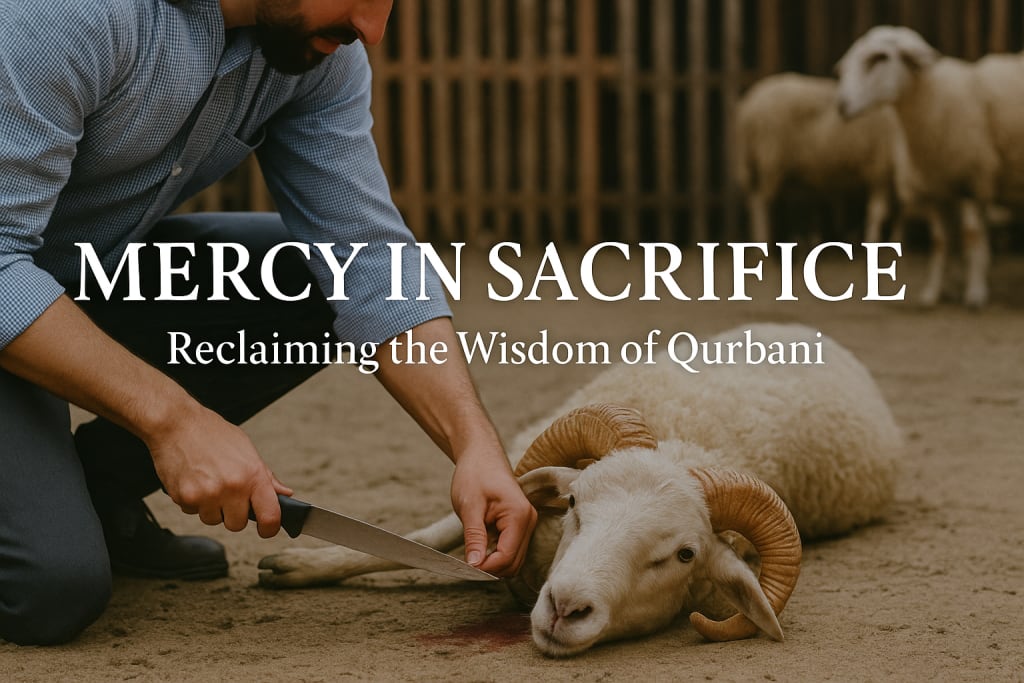
I know the idea of animal sacrifice can feel unsettling. Those feelings come from empathy – and Islam respects that empathy. Eid al-Adha commemorates Prophet Abraham’s devotion: according to the Qur’an, God provided a ram so Abraham’s son was spared. Qurbani (sacrifice) is done in gratitude for that mercy. We should remember that this act is meant as a profound ritual of faith and charity, not mindless violence. Islam actually calls on us to be kind to animals: “animals represent God’s wisdom and wonder, and humans are obliged to attend to their health and living conditions”. In other words, compassion is built into Qurbani, not ignored.
Abrahamic Traditions of Sacrifice
• Islam (Qurbani) honors Abraham’s test of faith. Eid al-Adha “honors the willingness and devotion of father and son… as ultimate obedience to God’s command. God then ordained an animal sacrifice instead of the son.
• Judaism had a similar practice: the Torah required a korban (sacrificial offering) of livestock (e.g. the Passover lamb). While mainstream Jews no longer perform temple sacrifices, the story lives on in rituals (eating matzo and lamb at Passover, sharing blessings).
• Christianity regards Jesus as the “Lamb of God” whose own sacrifice replaces animal offerings. Christians remember His sacrifice in Communion (the Eucharist) – a rite that uses bread and wine in place of an animal. (Historically, early Christian feasts often featured lamb at Easter, recalling the Passover lamb symbolism.)
All three faiths used animal sacrifice as a way to give thanks and serve others. In Islam today, the meat of Qurbani is traditionally divided: about one third for the donor, one third for family, and one third for the poor. This ensures the act is both worship and community care – a tangible charity on a holy day.
Ethical Practice in Qurbani
Islam lays out strict, humane rules for Qurbani (just as modern halal standards do):
Animal care before slaughter: The animal must be healthy, well-fed, and rested before sacrifice. (Studies note that Islamic law actually requires animals to be “well fed and well looked after” at slaughter time.)
Sacred intent: Every Qurbani is done “in the name of God”, acknowledging the animal’s life is a sacred trust. This spiritual framing reminds the butcher and witnesses that the sacrifice is an act of worship, not cruelty.
Quick, painless method: Islam requires a very sharp knife and one swift cut to the animal’s throat, severing the carotid artery, jugular vein, trachea and esophagus simultaneously. This technique causes rapid loss of consciousness, minimizing suffering – in fact, minimizing pain is central to halal slaughter. The aim is exactly what modern animal welfare science seeks: an animal rendered insensible instantly, so it feels as little as possible.
No torment or waste: An animal that is sick, wounded or otherwise unfit cannot be used for Qurbani. Wounded meat is haram (forbidden) in Islam, so believers ensure they select only healthy animals. Animals are fed and handled gently right up to the moment of sacrifice. Nothing of the animal is wasted – skin, bones and organs are used, and every part serves people in some way.
All these rules show that respect for the animal is built into Qurbani.
• The Prophet Muhammad taught mercy at every step: feed the animal, don’t taunt it, and one hadith even says the blood will testify on behalf of a kind butcher on Judgment Day. In short, the ritual is as humane as possible by intention and design.
Giving Meat , Not Just Money
Some ask: “Why not just give money to the poor instead of sacrificing an animal?” Islam encourages all forms of charity, so giving money is good. But Qurbani has its own special purpose: it’s a prescribed act of worship and charity combined. Consider these points:
Direct nourishment: Meat is protein-rich and often scarce for the needy. By giving meat, you ensure hungry families get a highly nutritious meal. As one Islamic scholar notes, “meat is a basic requirement for all… offering a sacrifice… fulfills the needs of the poor and needy”. For someone who has little, a share of fresh meat can be far more immediately beneficial than cash, which might be used for rent or fuel instead.
Community impact: Qurbani supports local economies and communities. Farmers, butchers and aid groups work together to distribute the meat. It can empower villages where food is needed most. This communal aspect is part of the blessing.
Spiritual meaning: The act of sacrifice is a powerful reminder of gratitude and humility. It’s not just a donation; it’s doing what Abraham did, trusting God and sharing from one’s own sustenance. The Prophet’s companion Ali (رضي الله عنه) famously sacrificed two rams each Eid – one for himself and one on behalf of the Prophet – and explained: “He [the Prophet] commanded me to do so”. The faith fully approves giving money to the poor, but it also preserves this ritual as a meaningful Sunnah.
In balance, Islam teaches:
If you have the means to perform Qurbani, you should (it’s a sunnah for non-obligatory sacrifice). If you truly cannot, donating money to feed the needy is allowed at any time of year. The key is intention: we want to help the poor and honor God. Many Muslim aid organizations actually turn cash donations into Qurbani meat for exactly these reasons – they see both actions as valuable.
Compassion vs. Double Standards
It’s important to compare Qurbani with everyday practices. Millions of people eat meat daily without a second thought: cows, pigs, chickens are raised and slaughtered in huge numbers. Those animals often live cramped, stressful lives on factory farms, and are slaughtered by machines or assembly lines. Few question this because it’s “normal.” So if one is concerned about animal welfare, we should apply the same standard universally. Ironically, Islamic teachings already do apply rigorous welfare standards. For example, modern halal guidelines require animals have pre-slaughter rest and good conditions. The ritual includes saying “Bismillah” (in God’s name) and being mindful. This level of care is more than what many industrial systems mandate. One researcher observes that people often assume secular slaughter is automatically kinder, but that’s a shifting assumption. In truth, both Muslim scholars and veterinarians have worked for decades to align slaughter with animal welfare science.
So yes, an animal does die in Qurbani, but it’s done consciously and carefully. The alternative – ignoring that reality – can lead to more suffering. By slaughtering in a ritual way, Muslims at least ensure the animal lived a decent life and was killed quickly. We should admit it: billions of animals worldwide are killed in less mindful ways. A single Eid sheep raised on a family farm often has a gentler life than an industrial pig or chicken. Let’s not forget that halal (permissible) slaughter requires minimizing suffering , just as secular ethicists say we should. In fact, some studies show animals in halal slaughterhouses can experience lower stress at the moment of death than those in poorly managed factories.
Shared Values and Understanding
At its heart, Qurbani is about serving God and serving people. It’s a festival, a sacrifice, and a sharing of blessings all at once. Criticism can help us refine practices, but we must do it with understanding. Eid teaches submission and gratitude: the sacrifice reminds us that everything we have is ultimately a gift, and that we owe kindness to others. All of us – Muslim or not – value mercy. If you love animals, know that Islam loves them too. The felt discomfort when seeing an animal die is a sign of a good heart. We channel that heart by insisting on compassion in every part of Qurbani. We pray over the animal, treat it gently, cut as swiftly as possible, and then feed the hungry with the meat. In this way, the sacrifice becomes an act of mercy. Let us focus on common ground: feeding the hungry, respecting life, and encouraging ethical treatment of animals everywhere. Islam’s teachings on Qurbani encourage just that – limiting pain and maximizing benefit.
In The Last:
This Eid al-Adha, may our conversations be guided by knowledge and empathy, building bridges of understanding rather than walls of misunderstanding.
About the Creator
Fahad Iqbal
I’m Fahad Iqbal, a passionate writer with a flair for exploring the truth behind systems we follow blindly. I write to challenge minds, spark thought, and inspire change. Join me on a journey of awareness, growth, and bold ideas.
Keep reading
More stories from Fahad Iqbal and writers in Humans and other communities.
7 Science-Backed Ways To Rewire Your Brain for Positivity
Introduction In an increasingly fast-paced world, it’s easy to fall into negative thought patterns — worrying about past mistakes, fearing future outcomes, or simply dwelling on everyday frustrations. Fortunately, neuroscience shows that our brains are remarkably adaptable. Through consistent practice of targeted exercises, we can “rewire” neural pathways, making positivity our default mode. Below are seven science-backed strategies you can start using today to cultivate a more optimistic mind.
By Fahad Iqbal8 months ago in Humans
The CEO of Everything
They say "jack of all trades, master of none," but they forgot to mention the part where the jack of all trades is also the camera woman, the makeup artist, and the person currently yelling at a tangled Wii microphone cable in a her own bathroom while recording herself singing and trying to make it look realistic and professional. (As professional as you can make it with nothing but a cell phone camera and a mic that doesn't work)
By Sara Wilson4 days ago in Humans
Neptune Turns Twin Flame Love Dreamy and Disorienting.
Neptune plays a powerful role in twin flame connections. This planet rules dreams, intuition, fantasy, and spiritual longing. When Neptune touches a twin flame bond, love feels magical. You feel connected beyond words. You sense destiny. You feel unity without effort.
By Wilson Igbasiabout an hour ago in Humans
Affection and Healing for Yourself
During the night of the last quarter moon, I gathered my ritual supplies. I carefully handled the chunk of black tourmaline that would protect me from your overall negative and narcissistic energy. I carefully walked the house with my stick of selenite in hand, asking the universe to cleanse our working space.
By Alisha Wilkins ✒️🦋🖋️2 days ago in Fiction


Comments
There are no comments for this story
Be the first to respond and start the conversation.