
Making friends with authenticity
Looking for belonging and knowing each other better


Everyone has something to say about authenticity, especially when it comes to Asian fusion food. But I’m not sure if every immigrant grandparent’s dream was ever about being “authentic.” For some, just getting by is enough. And there’s nothing more authentic than making a living so you can have a future.
That means you may get mediocre Kung Pao chicken or bland Mapo Tofu at a Chinese restaurant. Or you may end up in a catch-all situation, where Korean and Japanese food all sit together on the menu.
You also might end up on the other side - Asian food with a fine dining twist. Tapas, appetizers the size of an earring (see tiny taco from Soy Cowboy), and whimsical desserts.

If you’re lucky, you’ll find a spot that gives you that Ratatouille moment, where you’re brought back to your childhood from your first bite.
But, that’s life. To think that immigrant business owners only try to give you what’s most authentic is naive. We’re given what sells, and we tell the world how much we care about what’s authentic. Sometimes, it turns out people care very little, and occasionally care too much.
A sense of belonging
Many young Asian Americans tend to overanalyze what’s most culturally authentic in the US. They actually seem to analyze authenticity more than an immigrant parent or international student ever would. My hunch is that for most Asian Americans, one of their biggest fears is never really being seen as “authentic” within their culture (and thus, never feeling authentic themselves). It certainly was one of mine.
They argue over which cities have the most Asians and the best restaurants, would they rather eat Chinese food in New York or LA, and would they even bother to live in the midwest if there’s no Asian food nearby (my favorite pastime now is finding great food in the places you least expect to). But really, I think they’re just arguing over places where they feel like they most easily belong.
From my experience, you can truly find Asian restaurant gems in any corner in the US. And going a step further, I’d argue you can feel like yourself in any corner in the US if you give it a shot. Could you imagine your immigrant grandparents deciding not to move overseas to the US, just because there might not be enough Asian food when they get there?
I get it, though - food and language feels like home. They bring you home. And for younger Asian Americans who might feel displaced, the idea that you yourself can define where you belong may be hard to believe.
This is partly because many of us grow up around others with the same universal struggle story. And the media tends to paint pretty one-note Asian American stories: growing up in southern California, navigating cultural gaps with immigrant parents, never living up to their expectations, and receiving invisible apologies from them through cut-up fruit.
But, I’d like to raise my own hand and ask: what about the other stories we haven’t heard before?
A different story

My mom and dad are both Chinese American.
My dad and his five siblings all grew up in Arizona. His relatives came from Guangdong in China, so they could speak Cantonese; but his direct family all spoke English. His great grandpa owned a grocery store; his dad owned a shoe business at one point; and his mom was a teacher, plus an active member in their local Asian American community.
He grew up camping and playing baseball. He studied graphic design and architecture. When I was little, I’d ask him to draw my favorite animal (horses, at the time) so that I could sketch alongside him, trying to imitate every curve and line.
My mom grew up in southern California, but she was born in Taiwan. When she was little, they moved to Argentina, before settling in Los Angeles. She’s not fluent in Chinese, but she grew up with it; and she and my grandma share a fluent back-and-forth of Ching-lish.

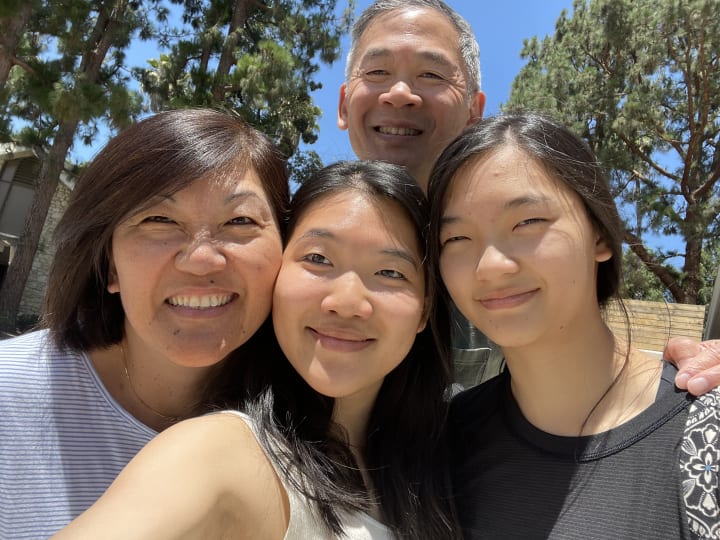
My mom roomed with my dad’s sister at UCLA. It was only a matter of time until they met. Eventually, my parents got to know each other through a skiing trip with friends and regularly played volleyball together every weekend in California (I always say my dad was “courting” my mom on the court.) There’s more to their story, of course - but the fast version is they eventually married, moved to Texas, and had me and my sister.
We grew up in Texas and spent our Thanksgivings at my aunt’s house in Houston. Novembers meant juicy turkey (sometimes seasoned with soy sauce and other Asian flavors), cranberry sauce, corn casserole, stuffing, and several pumpkin or apple pies.
During Christmas, we visited my mom’s family in California. All the cousins and aunts and uncles would sleep over at my grandparents’ house in Palmdale. My grandma would make 13-dish meals every Christmas Eve, and we’d all open presents together under the tree. My parents would keep a list of the gifts we received so that could write thank-you letters to the family later.

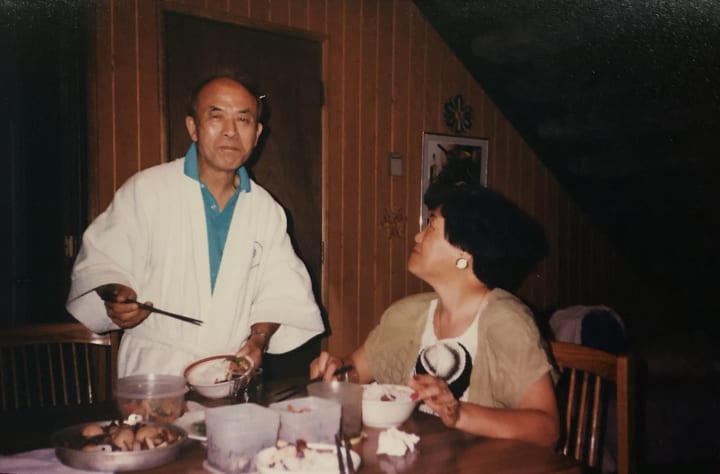
Everyone in my mom’s family wears their hearts on their sleeves. My late grandpa didn’t reserve his stories like some grandparents do - in fact, he shared them over and over; and before he passed, he wrote his stories down. They’re ironically a bit more direct and expressive than my dad’s family, who all grew up in the US. Everyone in my mom’s family can express “I love you,” with or without cut-up fruit (though that wasn’t always the case).
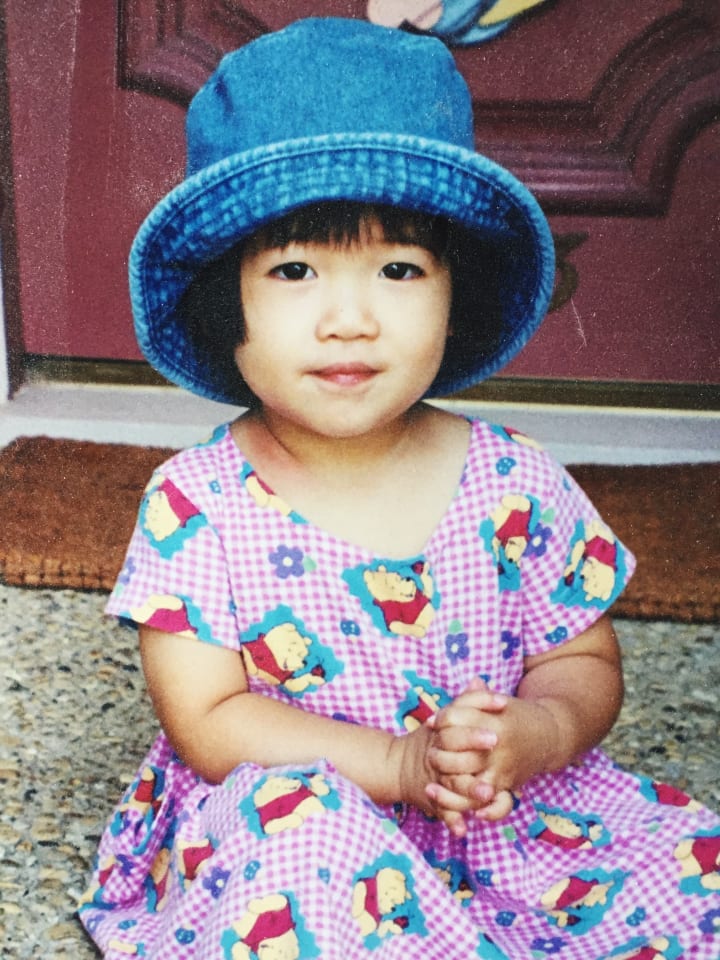
I was born and raised in Texas. I went from dreaming of having blonde hair like Barbie in the horse games I played when I was little on my dad’s computer, to making it a life goal to go back to my late Chinese grandpa’s hometown in China. I started from zero and learned enough Chinese through university classes, and then on my own through italki and HelloTalk, to read and digitally remediate my late grandpa’s handwritten Chinese autobiography. I also made a recipe-turned-biography book for my grandma.
These were all very far places for me to get to after growing up wishing I wasn’t Chinese. Now, I wouldn’t want to be anything else.
A new mold
Because my family has fit into but also broken the mold in many ways, I can’t help but long for more exposure to different Asian American stories we don’t typically hear about, like my own.
While I’ve always spent time to honor and understand the stories about struggle and sacrifice (including the handwritten stories left behind by my own late Chinese grandpa) - it’s almost as if the Asian American community doesn’t know how to push past them.
You can say “I love you” if you try. You can have difficult conversations, even if they seem impossible and painful. Because of this growth mindset that my family has worn all these years - although it’s taken time and pressure, I can now talk to my family like they’re my best friends; and I know that we never had to be friends, but I’m so glad we chose to be.
It would be cool if we considered more colors of the Asian American narrative alongside the stereotypical narratives we’re fed. Maybe it could be a story about those who live with deep southern accents, or even the Japanese community in Michigan. Asian American culture is diverse, and we shouldn’t forget that.
Growing authentically
There’s always been something authentic about evolving alongside my parents, and my grandparents. As I grow older, I’ve learned that being authentic is just learning how to understand myself better, consider what makes every experience valid and unique, and create my own sense of belonging.
Instead of looking for myself in the next best bowl of noodles at a restaurant, I’ve learned to find myself by: being curious about my family history; making an effort to learn how to actually think, read, and feel in another language; and visiting places where I come from, and those where I don’t.
We all belong to our history. And for the Asian American community, if our history is truly everywhere - no one place is truly better than the other.
I’m unofficially declaring that we can stop searching for authenticity, wherever and whatever it is, and get to know each other as we already are. We can take time to understand what already makes us unique.
Life will become more clear to us, and any food we eat anywhere will taste more authentic because of it.
About the Creator
Lindsay Sing
Writing a collection of snack-sized reflections on life, culture, relationships, and growing up. Come for homemade observations, and stay for new perspectives and stories. There's a seat for everyone at the table.
Keep reading
More stories from Lindsay Sing and writers in Humans and other communities.
The CEO of Everything
They say "jack of all trades, master of none," but they forgot to mention the part where the jack of all trades is also the camera woman, the makeup artist, and the person currently yelling at a tangled Wii microphone cable in a her own bathroom while recording herself singing and trying to make it look realistic and professional. (As professional as you can make it with nothing but a cell phone camera and a mic that doesn't work)
By Sara Wilson4 days ago in Humans
I am not alone.
Billu Bhai’s Realization Category: Human Interest / Life Lessons His real name was Bilal, but everyone in the village called him Billu Bhai. He was the eldest child in a large family, with parents, siblings, and relatives all living together. Growing up, Bilal had been quite weak, both physically and mentally. His childhood was marked by illness, which affected his ability to concentrate in school. Learning was a constant struggle, and he barely managed to complete his education up to the tenth grade. Now, at twenty-five, Bilal was hardworking, reliable, and always willing to help others. His father had given him a rickshaw, which became his source of daily income.
By Sudais Zakwan7 days ago in Humans


Comments
There are no comments for this story
Be the first to respond and start the conversation.