

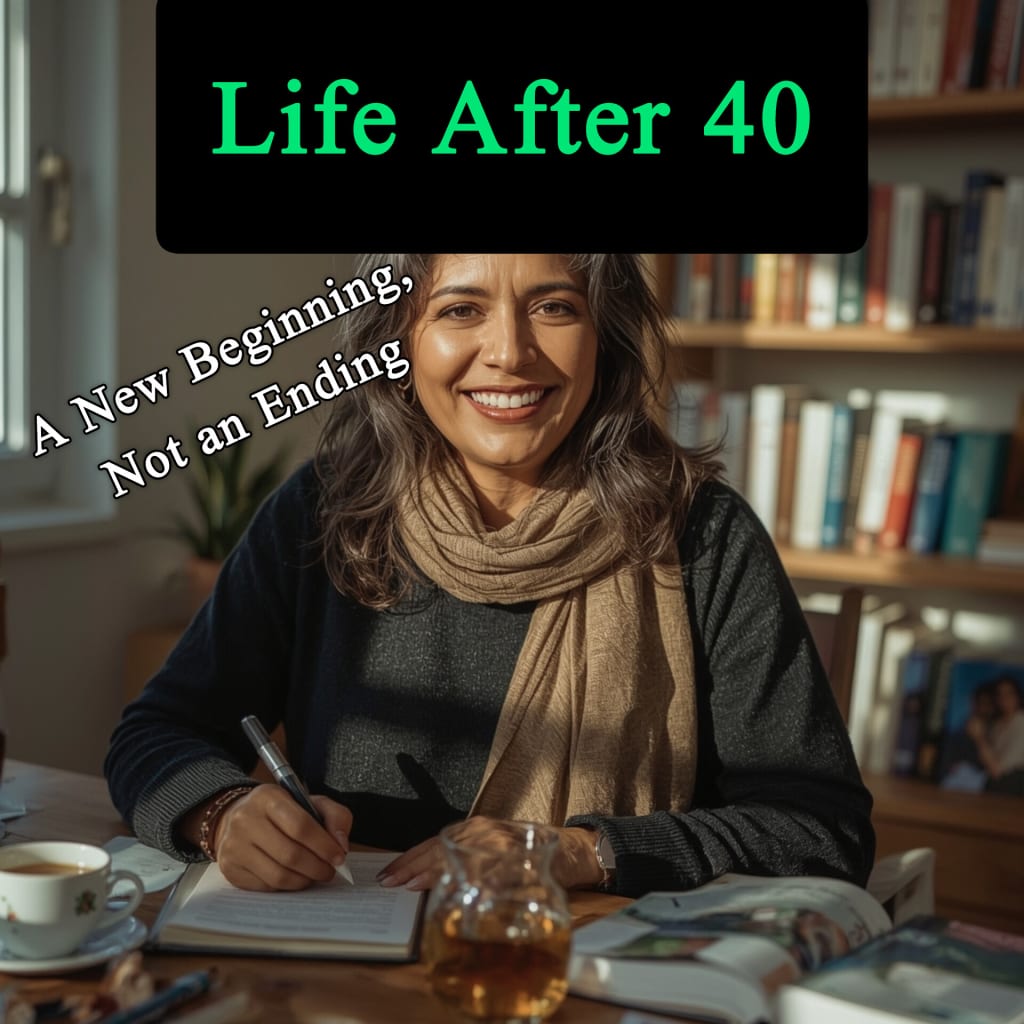
When the clock struck midnight on her 40th birthday, Zara sat alone in her living room, a small slice of cake before her and a quiet sense of both relief and uncertainty in her heart. Her two teenage children were fast asleep, her husband was out on a work trip, and the phone buzzed only a few times with polite birthday wishes. It wasn’t a grand celebration, but for the first time in years, she didn’t mind.
Turning 40 had once sounded frightening to Zara. In her twenties, it felt like an invisible deadline—where youth faded, dreams settled, and the rest of life would just be routine. But now that she was here, standing on the other side of that number, she felt something strange. A soft tug of excitement. A question: What now?
Zara had spent most of her adult life as a mother and a wife, her dreams packed away neatly in a box labeled “someday.” She had once wanted to be a writer, her notebooks filled with poems and short stories in her college days. But life had its own rhythm. The kids came, bills piled up, and priorities shifted. She didn’t regret any of it, but now, with the kids becoming independent and the house quieter, she began to feel a spark of forgotten ambition light up again.
One morning, a week after her birthday, she pulled out an old journal from the attic. Dust clung to its spine like time itself had sealed it shut. Flipping through the pages, she saw her 21-year-old self in ink—hopeful, wild, and unafraid. She laughed, and then she cried. “Maybe it’s not too late,” she whispered to the walls.
She started small. Waking up an hour earlier than usual, she began writing again. At first, it was clumsy. The words came slowly. But soon, like an old song she still remembered the lyrics to, her voice returned. It wasn’t the same as before—it was wiser, deeper, more grounded. And somehow, better.
Zara wasn’t the only one going through a transformation. Her best friend, Shazia, had just opened a small café after leaving a 20-year-long job at a bank. “I was scared out of my mind,” Shazia confessed over coffee one day, “but I’ve never felt more alive.” They both laughed, realizing that life after 40 was not about slowing down. It was about waking up.
Their children no longer needed them in the same way. They didn’t have to chase approval from society. There was freedom in this stage—a kind that they had never tasted before.
But freedom came with its shadows too.
Some nights, Zara would stare into the mirror, noticing the silver threads in her hair, the soft lines on her face. Society still whispered that youth was beauty and that aging women should quietly fade into the background. But she chose not to listen.
Instead, she bought herself a bright red lipstick—the same shade she wore in college. She joined a local writing group, sharing her stories with strangers who soon became friends. She even started a blog titled "After Forty: The Real Story" where she wrote about motherhood, aging, love, and rediscovering oneself.
To her surprise, women from all over the world began reading and responding. “You put into words what I’ve been feeling for years,” one comment read. Another said, “I thought I was the only one who felt invisible after 40. Thank you for reminding me I’m not done yet.”
Her relationship with her husband also began to change. They were no longer just parents and partners—they were two people trying to remember each other again. They started taking long evening walks, discussing books instead of bills, and slowly rekindling a romance that had once been buried under the weight of routine.
One evening, as they sat under the open sky on their rooftop, he turned to her and said, “You’ve changed, Zara. You shine differently now.” She smiled, her eyes reflecting both joy and strength. “I haven’t changed,” she replied. “I’ve just come back to myself.”
Life after 40, Zara realized, wasn’t a downhill path. It was a second act—a chance to rewrite the script. There were still challenges: aging parents, health checks, hormonal changes, and the bittersweet ache of watching her children prepare to leave the nest. But there was also growth. Grace. A quieter kind of confidence.
She stopped measuring her worth by external success. She began living more intentionally—savoring her tea instead of gulping it down, calling old friends, saying no without guilt, and yes without fear.
She wasn’t trying to prove anything anymore. She was simply living—fully, honestly, and with open arms to the unknown.
On her 41st birthday, surrounded by friends, family, and the laughter of her teenage children, Zara raised a glass and toasted not to the past, but to everything that was still ahead.
“Here’s to life,” she said, “the real kind that begins after 40.”
And in that moment, she wasn’t just a mother, a wife, or a writer. She was a woman reborn.
About the Creator
Ikhtisham Hayat
Writer of quiet truths and untold stories.
Keep reading
More stories from Ikhtisham Hayat and writers in Humans and other communities.
From a Single Cell: The Journey of Life
In the soft silence of a warm womb, where no light reaches and no sound disturbs, a miracle begins quietly. It starts with a single cell — a zygote. The moment of union between a mother’s egg and a father’s sperm sparks an extraordinary journey. From this tiny beginning, smaller than a grain of sand, a new life will slowly form — full of thoughts, dreams, and laughter yet to come.
By Ikhtisham Hayat7 months ago in Humans
Autonomy Is The Real Privilege
Good morning, freedom-seekers! Today we’re gonna be looking at autonomy. A strange word, I know; one many would probably look at blankly and run away from on sight. We’re gonna figure out what it actually means, consider how it’s achieved, and decipher just how deeply most of us are tangled up in dependence without realising it.
By That ‘Freedom’ Guy5 days ago in Humans
A Short Love Story That Still Can’t Be Forgotten
How one brief moment changed my life forever Sometimes, the most unforgettable love stories aren’t the ones that last years. Sometimes, they’re the ones that last just long enough to leave a mark on your soul.
By Ahmed aldeabellaabout 6 hours ago in Humans
The Path to Salvation
The late autumn evening air filled the monk's lungs, but it wasn't the season that chilled his bones. The heavy-handed presence of evil he had sensed upon entering the woods surrounding this mountain village had not bothered to conceal itself from him.
By Made in DNA4 days ago in Fiction




Comments
There are no comments for this story
Be the first to respond and start the conversation.