
From a Single Cell: The Journey of Life
The Incredible Journey of Life — From a Single Cell to a Living, Breathing Human

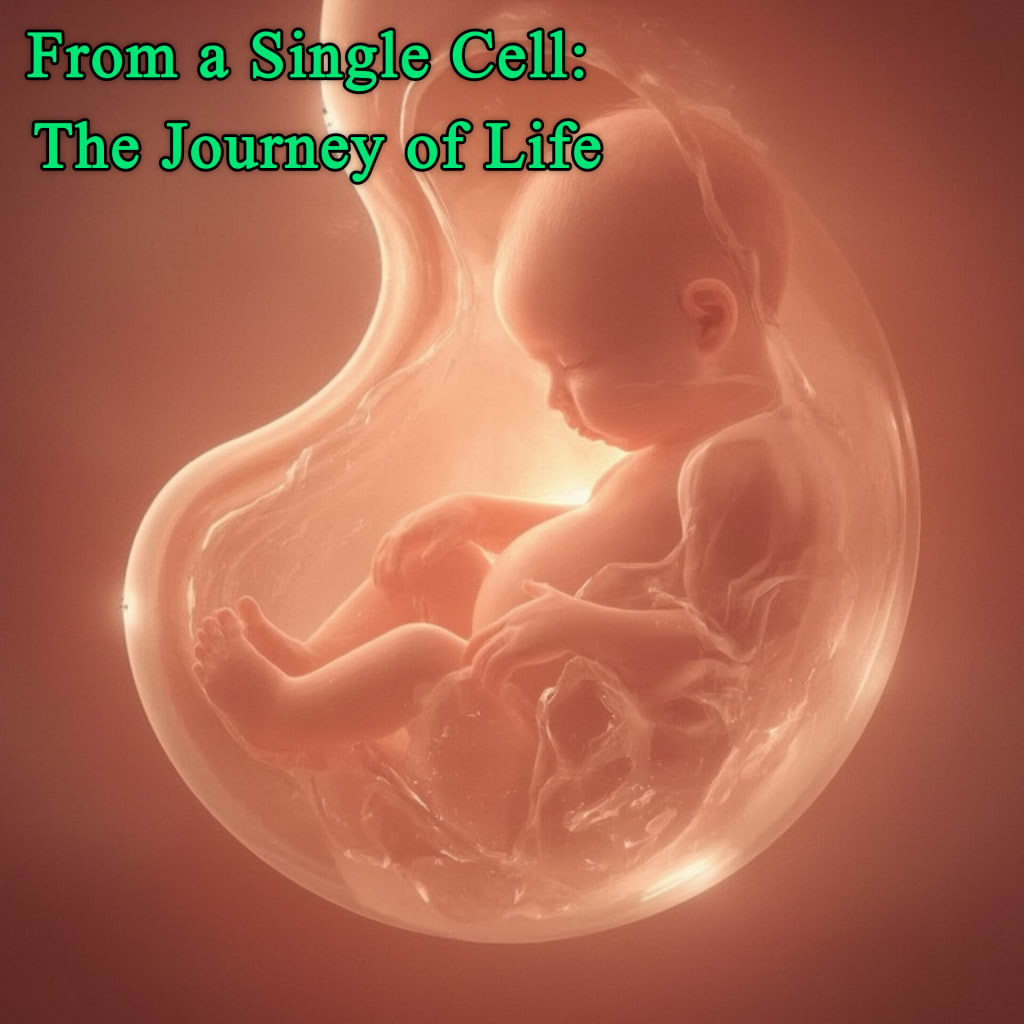
In the soft silence of a warm womb, where no light reaches and no sound disturbs, a miracle begins quietly. It starts with a single cell — a zygote. The moment of union between a mother’s egg and a father’s sperm sparks an extraordinary journey. From this tiny beginning, smaller than a grain of sand, a new life will slowly form — full of thoughts, dreams, and laughter yet to come.
The story of the zygote starts at conception. Deep within the fallopian tube, the sperm meets the egg, each carrying half the genetic instructions of a human being. In a blink of biological brilliance, they merge — forming the zygote, a complete cell with 46 chromosomes. The blueprint of life is now ready. The zygote knows its task: to divide, grow, and become someone unique.
Only a few hours later, the zygote begins its first division, becoming two cells, then four, then eight. This cluster of multiplying cells travels down the fallopian tube toward the uterus — a journey of nearly a week. Each division is perfectly planned, coded deep in its DNA, like a song it was born knowing how to sing. By the time it reaches the womb, it is a blastocyst — a hollow ball of cells, ready to settle in its home for the next nine months.
Once nestled in the uterine lining, the blastocyst begins the next phase: implantation. It burrows gently into the thick, nourishing walls of the uterus. Some cells will become the placenta, the lifeline between mother and child. Others will become the embryo — the early form of a baby.
Week by week, change happens quickly.
By week 3, the cells form three distinct layers — each destined to become parts of the body. One layer will become the nervous system and skin, another the muscles and bones, and the last the organs. The heart, no larger than a poppy seed, begins to beat around week 5 — a tiny rhythm, fast and strong, announcing the presence of life.
By week 6, small buds appear — arms and legs in their earliest form. Eyes and ears start to take shape, though the embryo is still less than an inch long. Inside, organs begin to grow — the liver, kidneys, and intestines all finding their place. Tiny fingers and toes begin to separate, moving from paddle-like shapes to the recognizable form of hands and feet.
By the end of the 8th week, the embryo is now called a fetus.
The fetus now looks more human. The face has a nose, lips, and even eyelids. The brain grows rapidly, sending signals to twitch muscles and flex joints. Though the mother may not feel it yet, the baby is already moving — shifting in its watery world, reacting to touch, floating peacefully in amniotic fluid.
As weeks pass, the fetus becomes stronger and more complex. The heartbeat is now easy to detect. The fingers curl, and the toes wiggle. At around 12 weeks, the fetus can suck its thumb, swallow, and make facial expressions. By 16 weeks, the mother might feel the first flutter — a gentle reminder that she is never alone now.
By 20 weeks, halfway through the journey, the fetus is about the size of a banana. It can hear — muffled sounds of the mother’s voice, her heartbeat, and the hum of the world outside. Eyelashes form, hair begins to grow, and the skin, though still translucent, is covered in a fine, soft hair called lanugo.
In the third trimester, the fetus prepares for life outside. The lungs mature, practicing breaths in the amniotic fluid. Fat stores build, giving the baby a round, healthy look. The brain becomes more complex, beginning to form patterns of sleep and wakefulness. The fetus now dreams — tiny flashes of images and sensations, though we can never know what fills its mind.
In the final weeks, the fetus moves less but more powerfully. Space becomes tight in the womb. The head shifts downward, preparing for birth. Every system — digestive, respiratory, circulatory — is nearly ready. What began as a single zygote is now a fully formed human, waiting for the moment to take its first breath.
And then, when the time is right, labor begins.
After hours of contractions, effort, and strength from both mother and child, the baby emerges into the world — wet, warm, and crying. That first cry fills the room, a sound of life and beginning. The journey from zygote to fetus, from hidden life to newborn, is complete. Yet, this is not an end, but a new beginning.
For the baby now opens its eyes for the first time, sees light, hears voices clearly, and feels the comfort of a mother’s arms. The miracle that began in silence now enters a world full of sound, color, and endless possibilities.
From a single cell, life has unfolded — beautifully, silently, and perfectly.
About the Creator
Ikhtisham Hayat
Writer of quiet truths and untold stories.
Keep reading
More stories from Ikhtisham Hayat and writers in Humans and other communities.
Life of Cousins
In a small town nestled between hills and fields, lived a large, close-knit family where cousins weren’t just relatives—they were each other’s first best friends. Among them were four: Ayaan, Zara, Hamza, and Noor. Their parents were siblings, and their families lived only a few houses apart. From the earliest days of childhood, they shared every joy, every fight, and every milestone.
By Ikhtisham Hayat6 months ago in Humans
Whiskey At Dusk
Guess the whiskey was more important to you in the end, wasn’t it? It was more than the well-being of your friends; more vital than showing up to the places you promised you would and could come to; more critical of a matter than fulfilling your damn responsibilities and getting the press off your back.
By Snarky Lisaabout 20 hours ago in Humans
Unexpected Romantic Getaway
I was talking to a guy I instantly clicked with online for about a month. We had an instant connection. The kind of you see in the movies. If you imagine those old school music videos with two people sitting on the phone all night that was us. We would spend hours talking every single day. We never ran out of topics to talk about or to joke about. Our connection was so light and effortless and it felt right. I even once called him while he was with his grandparents and made an instant connection with them as well.
By Softly Unspoken6 days ago in Humans


Comments
There are no comments for this story
Be the first to respond and start the conversation.