
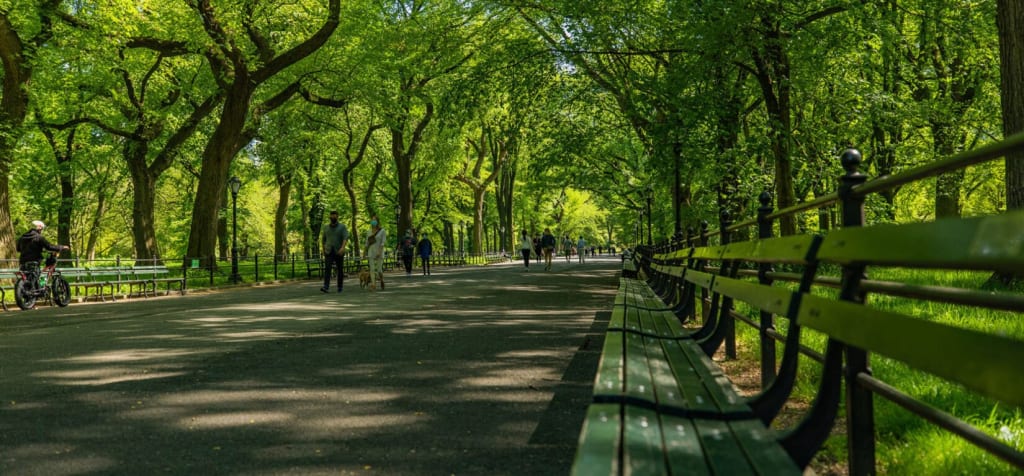
Not everyone goes to the park to find hope. She did. Her father, a preacher, held his hope in the sanctity of the cross. But to her, the congregation seemed more hopeful. To her, the souls devoted religiously and those only there on occasion, seeking a hope that had been battered, brutalized, or altogether lost, they were the people who held the hope. She saw their presence as a testament to their expectancy, being ready at any moment to rightfully receive God’s reprieve and restoration. Parks felt like a similar kind of sanctuary. A meeting ground for people who otherwise might never be seen in the same place, all presently seeking a moment of relief.
I had not been sleeping well for weeks. My treasure, a neighbor’s discarded mattress, punished me nightly as it could no longer offer any support for the anxieties of the day. Last night was different. There’s something about sleeping the night before payday that brings a fleeting sense of security; a temporary hope that puts off the brain’s pain receptors. These Fridays felt inspired. They offered a moment of leverage against the world’s current circumstance. They gave me a chance to remember what I had forgotten. It was now easier to be grateful for a job with no substance, a job some people didn’t have. Easier to regard daily human interaction as genuine and sacred, a phenomenon that I used to take for granted. I was grateful for a pause. Even if fleeting, I was happy to have a moment where I didn’t have to anxiously anticipate a future dancing on the corner of agony and the sublime. It made it easier to see myself, the world, and myself in the world.
In the mirror I see myself. In this moment of leverage, I wonder what else I have forgotten to see. What parts of myself have I lost in the routine of daily life? I look at my feet and try to remember where they have taken me. What lengths have they gone to bring me where I stand as a tribute to my triumph? What prayers have been uttered in the dark when my knees kiss the floor and I offer up my surrender? My hope seems tied to these answers I can’t recall.
In the shower, I wash away these fruitless questions and remind myself of what remains: what is left when I change and grow? There is peace and an understanding of joy. There is the testimony of resilience and a promised reward for faithfulness in my journey and in myself. What more do I need besides the body that has brought me through it all, and carries, proudly, these triumphs on my back? All that really matters is: what more I can find to feed the soul that awakens this body.
On her commute to work, passing strangers masked with cynicism, she considers what happens when we forget our pain. Are we better for it? Having lost a weakness whose burden was too heavy? Or do we lose a bit of our strength to that which couldn’t be endured? For her, she was determined to be reborn as an oasis of her own, so she held on tightly to her pain. Held it close enough to sometimes forget it existed outside of herself. Though the pain had no discernable purpose, she would not let it go unused. She clutched it like pearls, the finished product of the oysters’ pain, waiting for hope to bring what only it could – tempered strength, patience, and wisdom.
Passing through the park on her way to work added a few extra minutes to her journey that she rarely regretted. Now more than ever she enjoyed watching people just be. She admired the audacity it took to seek joy, peace, even a tainted sense of normalcy. She knew that for every person she saw trying, somewhere there were even more people afraid to leave their house. She understood why. The world had quietly and unconsciously slipped into a thick confusion. The great outdoors was now home to an air of apprehension that threatened what connects us all. She was determined not to let those connections be extinguished.
Otto was a friend who frequented the park. He made a home of the streets because current circumstances deemed it necessary. He was not callous or resentful; he was meek but dauntless – a grateful consequence of a good relationship with pain. She was his favorite person to see in the park, and not because she almost always gave him money. To him, she saw people like he did, for what they really are: individually functioning cells, a part of the living organism that is earth.
He smiled when he saw her.
“Top of the mornin’ to ya, madam,” he said exuberantly.
“Hi, Otto. You seem to be incredibly high-spirited today.”
“Well don’t you know? It’s Friday and Fridays are for lovers.”
She gave him a genuine smile.
“I didn’t think you had a lover.”
“The only lover I have is the love I share between me, myself, and I, but that’s still worth celebrating don’t you think?”
“I guess it is.”
I reach for my wallet. He watches me intently.
“I’ve got to be honest with you: I’m probably gonna buy a lottery ticket with whatever you give me.”
$5 isn’t going to change his life and I didn’t intend it to. This was my offering, his reprieve.
“Do what you want Otto. It’s your money now. I don’t care and don’t expect you to buy a house with it or something.”
“Even if I hit the lotto and never see you again?”
“Even if you hit the lotto and never see me again.”
He looks down at the $5 and then back at me. “I hope the world gives you nothing but rainbows and butterflies, sunshine.”
“You too, Otto. I’ll see you around.”
The next day, she returns to the park. This is her small act of resilience that supplements the waning quality of sleep that is sure to continue until the next payday. Today the park is littered with families eager to air out the stuffiness of their home lives, and with friends delighted to reconnect with one another. A few lonesome stragglers, like her, occupy the shadows beneath the trees and the benches along the path. Most are consumed in solitary activity – a woman reads, mouthing the words to herself, a man stretches in layers that don’t match, and she sits there watching it all. This is her sanctuary. Here, life unfolds like a song of praise. She is enthralled to see so many people embrace life with certainty and optimism.
They don’t seem to know pain. And if they do, they don’t seem to be haunted by it. I’ve spent a long time trying to make peace with the ghostly embodiments of my pain. I consider the things I’ve left unsaid to loved ones and strangers alike, dreams and visions of myself that I have abandoned shamefully and cruelly, the weakness in me that I’ve allowed to be greater than my strength. They congregate and cling to me like drenched wool and I feel like I’m made of this heaviness. Being here though, I see for myself that it is possible to know freedom. But where must I go to feel freedom?
Across the way, a butterfly lands on the head of the man stretching in a fashion nightmare. Normally she is frightened by butterflies but today she thinks of Otto. Searching for a way out of her head, she wonders if he is here today and sets out to find him.
Under his usual tree is a person she’s never seen before. They sit against a shopping cart and watch as she passes by.
“Why are you here?” they ask pointedly.
Confused, she stutters for clarity about the question. “I—”
“I think you knew at one time but now your patience has grown thin like your resolve,” they continue.
Their words, seeming almost prophetic, intrigue her. She comes closer.
They speak again: “Where is your God?”
“I don’t think I believe in God.”
They laugh, “You don’t need to believe in God for God to be real. God is love. That’s all. Not a man or a woman above the cosmos. Not a thing or an entity we can’t fathom. God is the nature of things. The commitment the moon has to the boldness of the sun, the grace with which it beckons and commands the waves. It is the nature of the bee: the builder, the creator, the disciple of life. When I ask ‘where is your God’ I mean what is your nature?”
She is baffled into silence.
They smile gently, “It seems you have a lot to consider,” they stand, “I’ve got just the right thing for you.” They rummage around in their cart, “I’ve got something that will change your life,” they say, handing me a small black notebook.
She opens the book. It is empty except for one line on the first page that reads: let love be the legacy.
She looks at the person, and for the first time considers their mental stability.
“Be a beacon of love, light, and truth, and record those deeds on these pages. Then you will know your nature and find you’re God.”
The next morning, she wakes up with the stranger on her mind. She hasn’t found a way to make sense of the encounter but their message still resonates. She returns to the park seeking another sermon.
In their place, under the same tree, she finds her friend Otto. For a moment she is disappointed but the feeling fades as she sees his bright smile.
“Good morning,” he exclaims, “you’re here early.”
“Hey Otto, I had a weird conversation with someone who gave me this,” she says holding up the small black notebook. “I was hoping to catch them again. They were in this same spot so I wonder if you know them.”
“What’d they look like?”
“Well…I’m not quite sure if they’re a man or a woman now that I think about it but they had on a bright red sweater with black pants. I couldn’t see what their hair was like because they had on a blue beanie but they were about my height and very lean. They had a shopping cart but aside from it being full, I didn’t notice anything remarkable about it. I don’t think I’ve seen them here before though.”
Otto started to shake his head, “That could be a lot of people honestly. Never mind that though. I’ve got something to show you.”
He turned around to reveal a blanket covered stroller. He stood besides it with the biggest smile I had ever seen from him.
“Otto…are you a father?”
He laughed, “Nope,” he paused, “well, I guess I could be but this is just something I found on the side of the road. Baby not included.”
He calls me closer and lifts up the blanket ever so slightly to reveal a bag stuffed with neatly wrapped bundles of cash. He smiles devilishly.
“Otto—”
“I won the lottery,” he whispers.
“What?”
“I won the friggin’ lottery!” he says louder, “and wait, there’s more,” he says excitedly reaching into the undercarriage of the stroller. “I brought you breakfast.” He hands me a brand new red and black lunchbox.
“The lottery?!”
“Yes, yes the lottery…but first breakfast!” he exclaims, guiding my hands to the zipper.
I open the lunchbox to see that it’s filled with cash. I look to Otto.
“It was your $5 so it’s your fifth…$20,000.”
About the Creator
Keep reading
More stories from writers in Humans and other communities.
Time to change your life.
Is it even possible for you to change your life? A lot of people, more than there should be, are unhappy with their lives. But what are they doing about it? Usually nothing. People talk about how shitty their lives are and want change, but are they not taking the actions to change?
By Jen Phillips2 days ago in Humans
Why "Find Your Passion" Became Cruel Advice
“Find your passion” used to sound like freedom. It implied that work could be meaningful. That life could feel aligned. That if you paid attention to what lit you up, you’d eventually build something that didn’t drain you.
By Danielle Katsouros7 days ago in Humans



Comments
There are no comments for this story
Be the first to respond and start the conversation.