
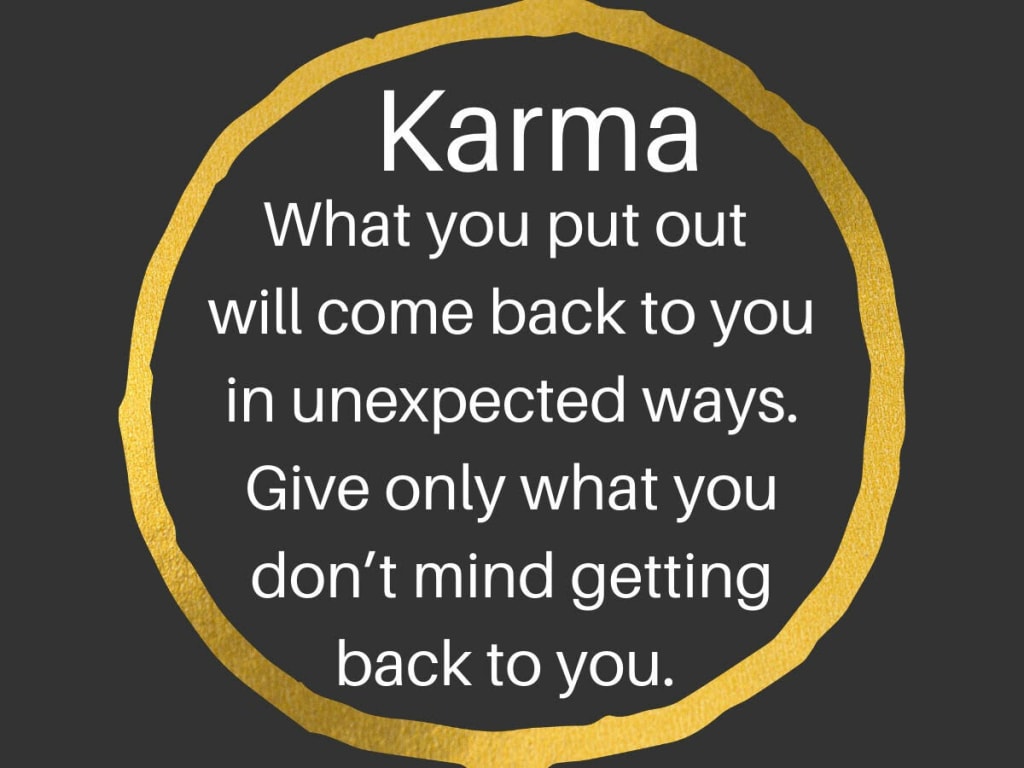
In Hinduism, Buddhism, Jainism, Sikhism, and other Indian religions, karma is the belief that a person's actions in this life will determine their fate in future lives, through the cycle of rebirth. Karma is the sum of a person's actions in this and previous states of existence, and is viewed as deciding their fate in future existences.
The concept of karma is based on the belief that every action has a consequence, and that good actions will lead to a favorable rebirth, while bad actions will lead to a less favorable rebirth. The goal of many Indian religions is to achieve liberation from the cycle of rebirth, known as moksha, by living a virtuous life and performing good karma.
Karma is often described as the law of cause and effect, where every action has a reaction. It is not a punishment or reward imposed by a divine being, but the natural consequences of one's own actions. The effects of good or bad karma can manifest in the current lifetime or in future lifetimes. The ultimate goal is to achieve liberation from the cycle of rebirth by living a virtuous life and performing good karma.
Types:
- Sanchita Karma: This is the accumulated karma from all past lives, and it is the sum total of all actions and their corresponding results. This karma is said to determine the individual's fate in future existences.
- Prarabdha Karma: This is the portion of Sanchita Karma that is responsible for the individual's current life and circumstances. It is the karma that has already been determined and cannot be altered, but can be exhausted through the experiences of this lifetime.
- Agami Karma: This is the karma that an individual creates in their current life through their actions. This type of karma will determine the individual's fate in future lives.
It's also worth noting that some texts further divide the karma in other forms like, Vipaka karma, etc.
How can one clear or reduce his/her Negative Karma?
In Indian religions, there are several ways to clear or reduce negative karma, and to accumulate positive karma. Here are some of the most commonly recommended ways to clear karma:
- Perform good deeds: By engaging in virtuous and selfless actions, individuals can accumulate positive karma and offset negative karma.
- Practice forgiveness and compassion: By letting go of anger and resentment, and cultivating compassion and understanding for others, individuals can reduce negative karma.
- Practice devotion and worship: By devotionally connecting with the divine, one can gain blessings and purification of the mind and soul, which can help to clear negative karma.
- Practice self-inquiry and meditation: By understanding and purifying the mind, one can reduce the power of past negative actions and clear negative karma.
- Practice Karma Yoga: Karma Yoga is the path of selfless service, it's believed that by performing actions without attachment to the results, one can purify their mind and reduce the power of past negative actions.
- Practice of Bhakti Yoga: Bhakti Yoga is the path of devotion and surrender to the divine, it's believed that by dedicating oneself to the divine, one can purify the mind and reduce the power of past negative actions.
It's important to note that the process of clearing or reducing karma can take time and effort, and it's not always possible to completely clear all negative karma in one lifetime.
It's also worth noting that the best way to clear karmas is by understanding the true nature of reality and the self, which is the goal of many Indian philosophy and spiritual practices such as Advaita Vedanta, Jainism, etc.
In summary, clearing or reducing negative karma can be achieved through various spiritual practices such as performing good deeds, practicing forgiveness and compassion, devotion and worship, self-inquiry and meditation, Karma yoga and Bhakti yoga, and by understanding the true nature of reality and the self.
About the Creator
Keep reading
More stories from A Sabarimanigandan and writers in Humans and other communities.
Want To Know Your Mysterious Past Life
In Hinduism, it is believed that one can find memories of past lives through a practice known as "smriti-yoga" which is a type of meditation that involves focusing on memories and past experiences. This practice is said to help one gain insight into past lives and understand the karmic cause and effect of past actions.
By A Sabarimanigandan 3 years ago in Psyche


Comments
There are no comments for this story
Be the first to respond and start the conversation.