
Humanity at Sea, A Cry That Broke the Silence
The Blockade of Gaza: A Cage in the Open Air

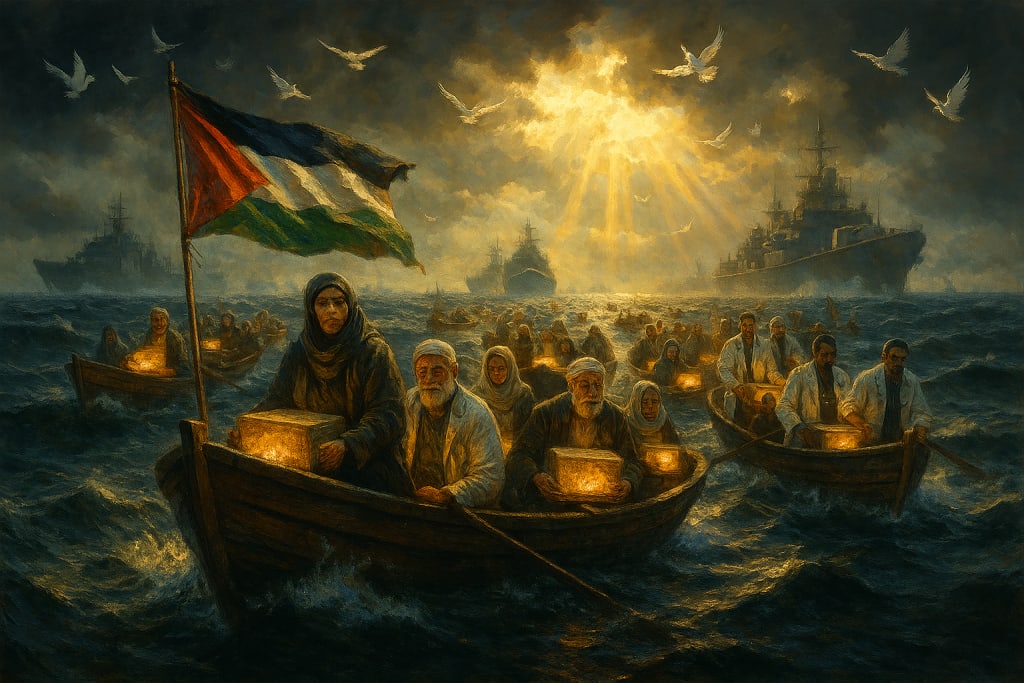
Imagine this: a small, quiet boat on the open sea. The tide moves steady and the sky is wide. On board are ordinary people a nurse with tired eyes, a father clutching a small box of medicine, a student with a notebook, a former senator with a steady voice, and volunteers who have traveled from far countries. They do not carry guns. They do not shout for war. They carry bread, medicine, and the soft, burning will to remind the world that other human beings mothers and children, the old and the sick are begging for help.
Now imagine warships arriving in the night. Bright lights cut the dark. Soldiers climb ropes and step onto the peaceful boats. Phones go silent. People hold up their open, empty hands and say: “We came with mercy.” Even the sound of that simple sentence can shake a hardened heart. Because mercy when met with force makes the rest of us ask what we have become. This is what happened with the Global Sumud Flotilla. The story is not only about politics. It is about the choice every person faces: to see suffering and move, or to see suffering and turn away.
What was this flotilla and why did people risk the sea?
A “flotilla” simply means a group of small boats traveling together. The Global Sumud Flotilla was a peaceful mission made up of dozens of civilian boats carrying symbolic humanitarian aid and hundreds of people from many nations. Their claim was humble: to take basic supplies and a message of hope to Gaza and to show the world, loudly and publicly, that ordinary people will not forget those who are trapped and suffering. The ships were not an army. They were a mirror held up to the world.
Why risk the sea? Because Gaza is a place where basic things food, medicine, fuel are not always reachable. Hospitals can run out of supplies. Mothers worry about their children’s next meal. When official channels seem slow or blocked, activists organized a simple act of conscience: sail, deliver what they can, and draw the world’s attention. For many on board, it was not just about the boxes of aid. It was about saying, with their presence, that every human life matters.
The interception: what happened on the water
As the flotilla neared Gaza waters, Israeli naval forces moved in. According to international news reports, military vessels intercepted the flotilla in international waters, boarded some boats, turned off or jammed communications, and directed many of the vessels toward Israeli ports where passengers were detained. Official statements from the Israeli side said the action was to enforce the naval blockade and to prevent a political provocation. Organizers and many international observers said the boarding happened in international waters and that the flotilla was peaceful.
Different outlets reported the numbers slightly differently as events moved fast, but major agencies described roughly 40 vessels and about 450–500 people involved, with at least 13 boats boarded and many passengers taken into custody. The operation sparked immediate international headlines, protests in several cities, and a wave of anger from governments and human-rights groups who called for the safe release of detainees and protection for peaceful activists.
Names that matter, who was on board?
Among those detained or reported aboard were parliamentarians, lawyers, human-rights defenders, and well-known public figures who had joined the mission to lend their voice and presence. International reports named a number of foreign activists and public figures, which dramatically raised global attention. The presence of high-profile activists made the flotilla’s message harder to ignore and stirred quick diplomatic activity as countries pushed for the safe treatment and return of their citizens.
For Pakistan, the moment was especially personal: former Senator Mushtaq Ahmad Khan was reported to have been aboard and detained by Israeli forces. Pakistani news outlets and human-rights groups confirmed that he led a small Pakistani delegation on the flotilla and that his arrest was part of the wider detentions after the interception. Pakistani officials publicly demanded his release and called for accountability for what they called a heavy-handed move against peaceful activists.
Why this matters right now, Gaza’s human reality
To understand why this flotilla mattered so much, you must imagine daily life under long-term siege and repeated conflict. Gaza holds more than two million people in a small area. Repeated wars, years of blockade, and destruction of infrastructure have left hospitals, schools, and homes in fragile condition. Shelters are crowded. Water and medicine are often scarce. That is why people on the flotilla said they could not be silent: they wanted to carry more than aid they wanted to carry witness. They wanted to tell the human story that numbers and politics sometimes hide.
This is not a distant problem for another place. It is a wound on human dignity. When a baby lacks medicine, it is not a political fact it is a human emergency. The flotilla tried to bring attention to that emergency in the simplest way possible: by arriving in person and saying, “We see you.”
The human face: scenes from the boats
Videos and eyewitness accounts show people on board the flotilla sitting together, singing quietly, praying, or recording simple messages on their phones. They held up boxes labeled with basic goods, and they spoke softly about the people they hoped to reach. When naval teams boarded, many passengers raised their hands, sat down, and remained peaceful. That scene calm faces facing armed soldiers is what makes the story so strong. It awakens conscience. It asks not to choose sides in war but to stand up for human life.
One passenger’s last messages, shared widely on social media before detention, asked: “If the world stands silent now, then who will answer for the children?” These words carried deep sadness but also a challenge: to the nations, to leaders, and to ordinary people. Are we going to look away, or are we going to act?
The legal and political arguments two clashing stories
Israel’s government defended the interception by pointing to its naval blockade of Gaza and saying the flotilla tried to breach that blockade in a political show. From Israel’s view, enforcing the blockade is a matter of national security. On the other side, organizers and many international legal experts argued that peaceful vessels in international waters have the right to free navigation, and that blocking and seizing them raises serious legal and humanitarian concerns. Human-rights groups called for transparency, the safe return of detainees, and a review of how the interception took place.
This clash security vs. humanitarian action is not new. But when peaceful people are met with force, the world is forced to ask whether security policies are being weighed against human dignity. The question becomes: which has the higher duty to secure a nation, or to protect human lives caught in the middle?
Pakistan’s response and the story of Mushtaq Ahmad Khan
Pakistani media and officials reacted quickly. State media, parliament members, and civil society condemned the interception and demanded the immediate release and safe return of Pakistani participants. The arrest of former Senator Mushtaq Ahmad Khan who was described in multiple reports as leading Pakistan’s small delegation became a rallying point inside Pakistan. Political leaders spoke strongly, and human-rights groups in Pakistan urged worldwide solidarity and pressure on Israel to treat detainees humanely and to allow humanitarian help to reach Gaza.
For many Pakistanis, his presence on the flotilla symbolized solidarity across borders not for war or politics, but for humanity. He and others sailed not as soldiers, but as witnesses. Their detention turned them into voices that could no longer be ignored.
Global reactions protests, diplomacy, and pressure
Almost immediately, the interception sparked widespread international outcry. Demonstrations took place in many cities. Several countries publicly criticized the action; some issued diplomatic protests or called for investigations. International human-rights organizations demanded legal clarity on whether peaceful activists in international waters can be seized, while supporters of Israel urged the world to consider the security context. The reaction shows one simple thing: the flotilla touched a global nerve. People from different backgrounds, languages, and faiths felt moved enough to raise their voices.
Why this outcry? Because many people around the world recognize a basic moral rule: when someone in front of you is starving or sick, you help. When peace messengers are stopped, people feel that a higher moral code has been broken.
Spiritual and moral weight, a message for every conscience
Now let us step back from news reports and politics and speak plainly: there is a spiritual language in this event. Across traditions, Muslim, Christian, Jewish, Hindu, Buddhist the call is the same: love your neighbor, care for the weak, and defend the dignity of every life. The flotilla was an act of mercy given flesh. People who boarded those boats did so because their hearts were moved and they believed that faith without action is empty.
For those who hold no religious beliefs, the message is still simple and clear: empathy is the foundation of a humane society. If your heart can break for suffering, then you can help prevent more pain. If your heart is hardened, this story is written to find that small crack and bring warmth back in. Even the most guarded heart can be moved when it watches a small boat full of helpers being met by chains of force because mercy and force are old, vivid symbols that stir something deep in every human.
What would happen if no one acts now?
You asked me to say it plainly: if the world stays quiet, then injustice grows. In history, silence often paved the way for more suffering. When the needs of the desperate are ignored, bad things multiply not always in ways that are easy to predict, but in ways that break human bonds and deepen violence. The flotilla was a warning and a chance: if we ignore it, we choose to let suffering continue without resistance. If we act by raising a voice, by helping charities, by putting pressure on leaders we can slow, limit, or sometimes stop harm. Small actions add up. Quiet courage can change what seems inevitable.
The people on those boats were not naive. They knew the risks. They went because doing nothing felt worse than the danger. Their choice is a simple map: when a moral test comes, stand for life. If you ignore that test, you fail not only the people who suffer now but the next generation who will wake to a world with fewer humane choices.
Practical things you can do simple, peaceful, effective steps
You might be thinking: I am only one person. What can I do? Here are clear, simple actions anyone can take:
Learn from reliable sources. Read the news from solid agencies (Reuters, AP, Al Jazeera, major national outlets). Don’t spread unverified rumors. Accurate knowledge builds true power.
Share the human stories. In your circle with friends, family, and on social media tell the story of real people; facts plus faces move hearts.
Support credible aid groups. Give money, if you can, to organizations that deliver food and medicine to people in need. Even small donations add up.
Write to leaders. Politicians respond to public pressure. A calm, clear letter asking for safe passage of humanitarian aid and the protection of civilians is powerful.
Join or organize peaceful demonstrations if you want to show public solidarity. Numbers and calm voices attract media and politicians’ attention.
Pray or reflect. If you are spiritual, light a candle, pray, or quietly remember the suffering in your own way. If you are not spiritual, spend a moment each day thinking about another human’s life and what small steps you can take.
Protect the truth. When you see false or hateful claims online, correct them with facts. Truth is a vital shield against violence.
Each of these steps is small on its own but together they create pressure and light. The flotilla’s callers hoped for this exact ripple: acts by many people, not one grand gesture from a single person.
A call to both Muslims and non-Muslims the language of compassion
If you are Muslim, remember the clear teachings about helping the needy and standing against oppression. If you are non-Muslim, think of the Golden Rule found in many faiths: treat others as you want to be treated. These teachings all point to the same thing: when someone suffers, we should care. If you read this article and feel nothing, I ask you to sit quietly and imagine yourself in the place of a mother in Gaza, or the small child who needs medicine. Does that image move you? If yes, act on that pull of the heart.
To those who have hardened hearts: this text is for you, too. Hard hearts often hide deep hurts. If you let the simple human story reach you a child’s hunger, a father’s fear you might find a small crack in the armor. Compassion then grows. That is the slow miracle.
The broader picture why the flotilla will matter later
The interception will be written down in news stories and legal reports. But beyond that, events like this can shape public memory. Peaceful acts that meet force often become symbols. They make people ask: what kind of world do we want to leave our children? The Global Sumud Flotilla showed people who chose to be visible in the face of suffering. That visibility crept into the global conscience: it made the invisible visible.
Symbols matter because they change policy when enough people insist. They change law when courts and governments cannot ignore public opinion. They change hearts when individuals recognize their shared humanity. Small boats, quiet volunteers, and detained activists can be the beginning of something larger if many people answer their call.
Closing: a prayer, a promise, and a challenge
Let us end with three short words to hold: See — Feel — Act.
See the suffering. Do not let it be hidden by statistics or politics.
Feel the human pain. Let compassion move you.
Act in whatever way you can speak, donate, write, march, or simply change the way you treat those around you.
The flotilla’s travelers did not sail for glory. They sailed for mercy. They did not expect to change the entire world in one day. They hoped to change a few minds, save a few lives, and wake a few hearts. That is all any one of us needs to try. If even one hard heart is softened by their example, then their voyage was not in vain.
About the Creator
Muhammad Ayaan
🎙️ Rebooting minds with stories that matter.
From news & tech to real talk for youth no face, just facts (and a bit of fun).
Welcome to the side of the internet where thinking begins.
Keep reading
More stories from Muhammad Ayaan and writers in Humans and other communities.
Why Didn't Anyone Tell Us
Men, move along. This is not for you. This is for the women. I was forty-five when I began menopause. It is pretty young for that to be going on in a woman’s life, but I had undiagnosed PCOS, my entire life. Thank you to all the gynecologists I had seen my entire life. That in itself should encourage women to keep seeking second opinions, especially when you are not getting correct answers or any at all.
By Alexandra Grantabout 23 hours ago in Humans
Is It Love, Attachment, or Emotional Dependency? Understanding the Difference
Is It Love, Attachment, or Emotional Dependency? Understanding the Difference Many people say “I love you” — but sometimes what they feel isn’t actually love. It might be attachment. It might be emotional dependency. Or it might be a mixture of all three.
By The Story Scribeabout 6 hours ago in Humans




Comments
There are no comments for this story
Be the first to respond and start the conversation.