
The Lost Hours That Could Have Changed My Destiny
Timeless Strategies of Muslim Leaders on How to Conquer Time Before It Conquers You

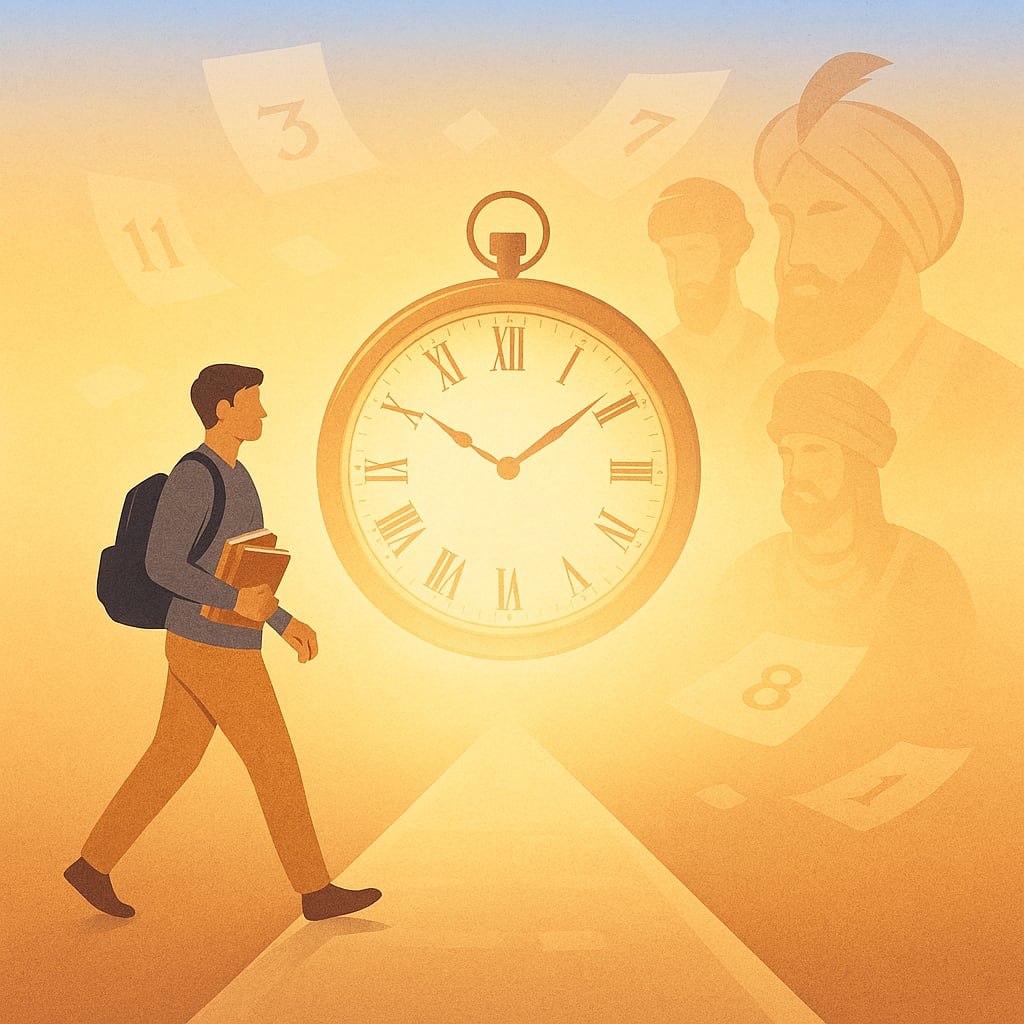
I will be honest with you from the start: if I could go back and give my younger self one single lesson, it wouldn’t be “study harder” or “network more.” It would be this learn to own your hours.
Not manage them half-heartedly. Not schedule them like a wish list. Own them. Treat every minute like a currency you cannot borrow again.
Why? Because talent and luck only get you so far. The real gap between people who talk and people who build is how they use the same 24 hours that we all get. I’ve seen it in my own life: years of low output traced back to millions of lost minutes on short videos, small chats, and things that “felt” urgent but were not.
You want a map? Not a list of inspirational quotes. A map that shows how real people men who changed history used time. Not because they were superhuman, but because they made time work for them.
Over the next parts I’ll show you three real examples from Muslim leaders who mastered their day: the Prophet Muhammad (peace be upon him), Salahuddin Ayyubi, and Allama Iqbal. I’ll tell you what they actually did, how they treated minutes, and exactly how a student today can borrow their methods and win back time.
Let’s start with the most complete example of balanced time: the life of Prophet Muhammad (peace be upon him). His life is not a myth; it is a practical manual on how to live with purpose and structure.
Prophet Muhammad (peace be upon him): The master of balance
When people think of the Prophet Muhammad (peace be upon him), they often picture spiritual scenes prayer, revelation, sanctuary. That is true. But underneath every spiritual moment there was an exact, practical use of time. He had responsibilities: he taught, judged disputes, led people, married, fed the poor, negotiated with tribes, and at times he led armies. He did all of this in a lifetime shorter than many careers. How?
Here’s what matters: his day was anchored in purpose, and that purpose created rules for how minutes were spent.
Clear Anchors The Structure That Makes The Day Work
The Prophet’s life had clear, repeating anchors. Think of anchors as non-negotiable time blocks that organize the whole day. For him these anchors included:
Night reflection and early rising he sometimes woke before dawn for quiet prayer and reflection (Tahajjud). This was not only worship; it was deep planning time the kind of undisturbed focus modern writers call “deep work.”
Fajr (dawn) as the first working hour after Fajr he would teach, meet people, and start public work. He used the first usable hour of the day for important tasks.
Short midday rest (Qailulah) a short nap or quiet time that restored energy for the second half of the day. This is not laziness; it is recovery strategy.
Evening family time despite being leader of a community, he deliberately kept evenings for personal connection: talking, helping with family tasks, listening.
Night reflection and sleep discipline even with long days, sleep was scheduled, not random. He returned to quiet reflection before rest, closing the day with intentional calm.
These anchors are a template you can copy. They create rhythm. Rhythm turns random minutes into a reliable engine.
Small Habits That Add Up Examples You Can Use Tomorrow
The Prophet’s routine included tiny habits that are easy to miss but powerful:
Start early: the brain is clearer before the day noise begins. Use that early slot for your hardest work new concepts, writing, coding.
Short focused sessions: he dealt with people in meaningful ways, not long, scattered chatting. That means set strict time for meetings and questions. 30–45 minutes of focused interaction beats four hours of vague availability.
Short restorative rests: a 20–30 minute nap in the middle of the day (or a walk) resets attention scientifically proven.
Consistent closing routine: end your day with a quick written review: what was done, what must be next. This is the Prophet’s night reflection translated into today’s language.
Why this fits a student’s life
You are not leading a community but your life has identical elements: study, skill-building, health, family, and friends. The Prophet’s system teaches one clear idea: assign non-negotiable anchors, then fill the rest intelligently.
Concrete Example For A Student Tomorrow:
Wake 30–45 minutes earlier than usual. Use that time to study a difficult topic. No phone. Just one topic.
Block your noon hour as a rest or light review time, not a random browsing hour.
Keep evenings to family or a short practice session not doomscrolling.
End the day with a 5–10 minute “what I learned” note in a notebook.
These small changes will begin to shift your hours from “wasted” to “invested.”
The deeper lesson purpose beats productivity
There’s a deeper secret in the Prophet’s time use: his hours were not just scheduled they were given meaning. Work was not a task; it was stewardship. Prayer was not a break; it was guidance. Even when he rested, he did it with an aim: to return stronger for service.
For students, this means time management should not only be about doing more. It must be about doing what matters because when purpose is clear, saying “no” to cheap distractions becomes natural, not painful.
One Small Exercise
Tonight, write down your typical schedule from waking to sleeping every small thing.
Circle three things that are purely distraction (reels, random apps, gossip) no shame, just circle.
Choose one early-morning 45-minute block you can protect for focused study for the next 7 days. No phone. No chat. Only work.
Salahuddin Ayyubi: Turning Discipline Into Destiny
A Man At War Yet Never At War With His Hours
When you hear the name Salahuddin Ayyubi, most people remember the great warrior who reclaimed Jerusalem in 1187. They picture swords, banners, and armies. What they don’t picture is a man who lived under constant pressure managing wars, politics, letters, negotiations, and still keeping his hours disciplined.
And here’s the shock: Salahuddin was not born into greatness. He was not the strongest, not the richest. In fact, as a child, people thought he was soft and uninterested in war. But what he built later in life a reputation of honor and unmatched leadership was possible only because he mastered discipline of time.
You want to know how a university student can learn from him? Look at how he treated each day like a military campaign.
His routine Small But Sharp Decisions
Historians note that Salahuddin lived with remarkable simplicity. No wasting hours in excess luxury, no endless feasts. He carried his own food, rode long hours, and when at camp, used time like a sharp blade.
Here are the anchors of his daily discipline:
Early Start With Prayer And Strategy
His day began with Fajr prayer, followed immediately by meetings with his commanders. Imagine starting your day with both spiritual grounding and strategic planning.
Divide Tasks: War, Governance, Faith
He split his hours into categories: leading armies, managing letters/politics, and personal devotion. Notice the balance: no part of life ate the other.
Rest With Purpose
Even during war, he rested. But rest was not escape. It was brief, timed, and meant to recharge for the next duty.
No Wasted Luxury
He avoided long nights of parties or indulgence. Instead, his evenings were used for study, meetings, and private devotion.
The Key Habit: Simplicity = Speed
Salahuddin’s genius wasn’t just his military tactics it was how he made time move faster by cutting out the unnecessary.
He wore simple clothes no dressing hours.
He ate simple meals no feasting delays.
He prayed on tim no guilt or mental clutter.
He read and wrote quickly because letters meant action, not delay.
This simplicity freed his brain for bigger problems leading armies and freeing cities.
What Students Can Copy From Salahuddin
You are not at war. But your “enemy” is wasted time, distraction, and mental laziness. Here’s how to apply Salahuddin’s method:
Anchor your morning with two actions: one spiritual (prayer, reflection, or meditation), and one strategic (write your top 3 tasks).
Divide Your Day Into 3 Categories:
Study/Skill work (your “battlefield”)
Personal/faith/family duties
Health and rest
No overlap. Keep them clean.
Cut luxury time: reduce time spent choosing clothes, watching random videos, or scrolling. That simplicity is your hidden fuel.
Make rest tactical: don’t rest to escape; rest to recharge. A 20-minute nap, a 30-minute walk, or quiet reading.
Salahuddin’s Deeper Lesson Honor In Minutes
The most powerful thing about Salahuddin is not that he won wars it is that he respected time as honor. When he promised someone his attention, he gave it fully. When he made a plan, he acted on time. Even his enemies admired him because he never wasted their time with broken words.
As students, that means: when you set a task, honor it like a promise. Don’t treat your hours as cheap. When you disrespect your minutes, you slowly disrespect yourself.
For The Next 3 Days, Do This:
At night, write your top 3 tasks for the next day.
Next morning, after prayer/waking, look at those 3 tasks. Do the hardest one first, before you touch your phone.
Track at night: did you finish ? If yes, you are already ahead of 90% of people your age.
Allama Iqbal: The Poet Who Turned Hours Into Revolutions
A Man Who Refused to Waste His Dawn
Allama Muhammad Iqbal is remembered today as the Poet of the East, the philosopher who dreamed of a free Muslim nation, the man whose words still echo in classrooms, gatherings, and hearts. But if you peel away the poetry, what made him extraordinary was how he valued time.
Iqbal once said:
“Nations are born in the hearts of poets, they prosper and die in the hands of politicians.”
Notice the subtle truth here he wasn’t only talking about politics. He was talking about the value of thought, time, and imagination. He believed revolutions don’t begin with armies, they begin with how a thinker spends his hours.
While the youth around him were often trapped in laziness, parties, or colonial distractions, Iqbal was awake before dawn, pen in hand, writing verses that shook empires.
His Daily Routine Hours of Fire and Silence
Iqbal’s life was not a mystery his students, colleagues, and family noted how he used his time.
Before Dawn Worship + Creativity
Iqbal often woke up in the quiet hours of the night for Tahajjud (night prayer).
Right after prayer, when the world was asleep, he wrote. This was his sacred time for poetry and philosophy.
The quietest hour of the day is also the most creative. Don’t waste it on endless scrolling. Use it for your best work.
Morning Teaching and Law Practice
After Fajr, Iqbal either taught at the college or worked as a lawyer. His mornings were reserved for intellectual and professional duties.
No wasted mornings, no excuses.
Mornings are for productive work, not lazy recovery from late-night distractions.
Afternoon Reading and Study
Iqbal was obsessed with books. He devoured literature, philosophy, religion, and science.
He read Goethe, Rumi, Nietzsche, and Quran with equal intensity. His afternoons were often quiet study sessions.
Replace some screen time with reading that feeds your mind.
Evening Society and Inspiration
He met students, friends, and leaders. He delivered speeches. He listened to the concerns of ordinary people.
Evenings became his bridge to society turning knowledge into action.
Don’t isolate yourself completely. Engage, but with purpose.
Why Iqbal Valued Time Like a Weapon
Iqbal understood something most of us ignore: time is not just money, it’s destiny.
To him, an hour wasted was not just personal loss. It was a loss for the entire nation he was trying to awaken.
He believed that every young person’s wasted time was equal to a bullet removed from the gun of freedom.
That’s why his poetry hits so hard even today. It’s not just rhymes it’s the voice of someone who squeezed every drop of his time into his mission.
The Pain of Seeing Wasted Youth
Iqbal wasn’t just disciplined himself he was heartbroken when he saw Muslim youth wasting their lives.
He wrote again and again about students who slept too much, played too much, or copied the laziness of the West without its discipline.
He called youth the eagle (Shaheen) a bird that flies high, never stays in one nest, and never eats dead prey. Why? Because the eagle symbolizes time mastery:
It doesn’t waste energy on leftovers.
It flies high to save time and see far.
It lives a life of discipline and power.
Iqbal wanted every student to be that eagle not a chicken trapped in the dust of wasted hours.
Simplicity of Living, Power of Thinking
Like Salahuddin, Iqbal kept his lifestyle simple. His wealth was not in gold, but in hours.
Meals: He ate simple food.
Clothes: He wore modest clothes, nothing flashy.
Social Life: He avoided gossip and empty company.
This gave him time for the real wealth: thinking, writing, inspiring.
Simplicity is not poverty. It’s a strategy to save time for what matters.
Modern Student Lessons From Iqbal
Here’s how you can bring Iqbal’s discipline into your life:
Create a Sacred Hour
Wake up earlier than the world.
Dedicate one hour to your best skill (study, writing, coding, planning).
Protect this hour like treasure.
Balance Work and Growth
Don’t spend all your time on assignments and lectures.
Read beyond your syllabus. Learn philosophy, history, science. Expand your mind.
Avoid Wasted Company
Stay away from friends who only waste your time.
Seek those who challenge you, inspire you, or teach you.
Turn Pain Into Productivity
Iqbal was sick in his later years, but he still wrote some of his most powerful works.
Don’t let your struggles become excuses. Let them become fuel.
A Hard Truth for Today’s Youth
If Iqbal saw us today, glued to endless reels, memes, and gossip, what would he say? Probably this:
“You were born to fly like eagles, but you are busy scratching the ground like hens.”
It’s harsh but true. We are not short of talent. We are short of respect for our hours.
Practical Routine The Iqbal Model
Here’s a modern student routine inspired by Iqbal:
5:00 am Wake up, prayer/meditation, 1 hour of focused work.
7:00 am – 12:00 pm Lectures, assignments, main responsibilities.
12:00 pm – 4:00 pm Reading, deep study, research.
4:00 pm – 7:00 pm Exercise, social interactions, productive company.
7:00 pm – 9:00 pm Creative work, personal projects.
9:30 pm Wind down, reflection, sleep.
Follow this even 70% of the time, and you’ll transform within months.
Why Iqbal’s Story Still Matters
Iqbal didn’t live to see Pakistan, but his time investment was so powerful that it shaped generations. That’s the beauty of disciplined time: your hours outlive your body.
So the next time you waste 4 hours on reels, ask yourself: What if Iqbal had wasted his nights the same way? Would we even know his name today?
⚡ Iqbal teaches us this unshakable truth:
Your time is either poetry that builds nations or noise that disappears in silence.
The choice is yours.
The Time Management Blueprint for Students
Why You Need a Blueprint
After learning from three giants of history Prophet Muhammad ﷺ, Salahuddin Ayyubi, and Allama Iqbal the message is loud and clear:
Time is not just about success. Time is about legacy.
But here’s the problem for modern students:
Distractions are louder.
Screens eat hours.
Friends waste evenings.
Sleep schedules are broken.
So, how do we apply centuries-old wisdom into today’s lifestyle?
That’s where the Time Management Blueprint comes in.
This is not theory. This is a battle-tested plan inspired by history but designed for your present.
The Blueprint in Three Levels
To master time, you need discipline on three levels:
Daily Routine (Micro) how you spend each day.
Weekly System (Meso) how you balance growth and rest.
Life Vision (Macro) how your hours align with your bigger destiny.
1. The Daily Routine (Micro Management)
Inspired by Prophet Muhammad ﷺ, Salahuddin, and Iqbal, here’s a daily flow:
⏰ 5:00 am The Sacred Hour
Wake up early.
Prayer/meditation/reflection.
Spend 45–60 mins on your highest priority task (study, skill-building, writing).
No phone, no noise. Just focus.
Lesson from Prophet ﷺ: Barakah (blessing) is in the morning.
⏰ 7:00 am – 12:00 pm Focus Work Block
Attend classes, complete assignments, work on professional tasks.
Use the “Salahuddin Strategy”: Attack the hardest tasks first, just as he attacked the strongest forts first.
⏰ 12:00 pm – 2:00 pm Recharge
Lunch, short nap (20–30 mins max).
Light reading or Quran/quotes for mental reset.
Lesson from Iqbal: Midday is for quiet study and reflection.
⏰ 2:00 pm – 6:00 pm Growth Block
Deep study session, projects, coding, research, or skill development.
Cut social media during this block.
⏰6:00 pm – 8:00 pm Body & Social Balance
Exercise, sports, or a walk.
Meet purposeful company friends who add value, not waste it.
Salahuddin’s lesson: Strength = body + mind + brotherhood.
⏰8:00 pm – 10:00 pm Creative/Personal Work
Writing, business ideas, side hustle.
If nothing else, revise the day’s learning.
⏰10:30 pm Wind Down & Sleep
Reflection journaling: What went well? What wasted time?
Sleep early. Your tomorrow starts tonight.
2. The Weekly System (Meso Management)
Discipline isn’t just about hours. It’s about balancing your whole week.
Weekly Blueprint:
5 Days (Mon–Fri): Follow the Daily Routine strictly.
Saturday:
Half-day for revision + creative projects.
Half-day for social connection, family, and mental reset.
Sunday:
Morning = planning for the week.
Afternoon = rest and leisure (in moderation).
Lesson from all three leaders: Balance is key. Even warriors and poets needed recovery.
3. The Life Vision (Macro Management)
Here’s the hardest truth: If you don’t connect your hours to a bigger vision, you’ll always fall back into wasting them.
Prophet ﷺ’s Vision: Spread truth and justice across nations.
Salahuddin’s Vision: Free Jerusalem, unite Muslims.
Iqbal’s Vision: Awaken Muslim youth, create a homeland.
They weren’t managing hours for grades or small wins. They were managing hours for destiny.
Your Turn:
What’s your vision?
Do you want to become an engineer who builds future tech?
A doctor who saves lives?
A writer who inspires generations?
An entrepreneur who changes economies?
Write it down. Without vision, your hours are dust. With vision, even one hour becomes fire.
Practical Tools to Stay Disciplined
The 2-Hour Rule:
Dedicate at least 2 hours daily to your long-term vision (not just assignments).
Time Audit:
Every Sunday, write down how many hours you wasted last week. Be brutally honest.
Digital Discipline:
Delete one distracting app for 7 days. See the difference.
Accountability Partner:
Just like Salahuddin had loyal generals, you need a friend who keeps you on track.
A Direct Challenge to Students
Let’s be honest: You don’t lack intelligence. You lack time control.
If you manage your day like the Prophet ﷺ,
Fight laziness like Salahuddin fought battles,
And think like Iqbal thought in silence,
Then nothing can stop you.
But if you continue wasting hours… even the smartest student will remain average.
Final Words Don’t Waste the Gift
The clock doesn’t forgive. Every wasted reel, every late morning, every night of gossip they’re all unpaid bills your future will collect.
Instead, treat your hours like gold coins. Spend them where they multiply.
Because in the end, history only remembers two kinds of people:
- Those who wasted time.
- And those who used it to change the world.
Be the second.
About the Creator
Muhammad Ayaan
🎙️ Rebooting minds with stories that matter.
From news & tech to real talk for youth no face, just facts (and a bit of fun).
Welcome to the side of the internet where thinking begins.
Keep reading
More stories from Muhammad Ayaan and writers in Humans and other communities.
Humanity at Sea, A Cry That Broke the Silence
Imagine this: a small, quiet boat on the open sea. The tide moves steady and the sky is wide. On board are ordinary people a nurse with tired eyes, a father clutching a small box of medicine, a student with a notebook, a former senator with a steady voice, and volunteers who have traveled from far countries. They do not carry guns. They do not shout for war. They carry bread, medicine, and the soft, burning will to remind the world that other human beings mothers and children, the old and the sick are begging for help.
By Muhammad Ayaan 5 months ago in Humans
Recognizing Cheater Patterns Early Protects Emotional Health And Long-Term Happiness
Being aware of the unhealthy relationship patterns may be of great importance in safeguarding the emotional health. Once individuals discover the actions that can be interpreted as dishonesty or insignificance, they will be able to make a rational choice concerning the future of their relationship. Early realization enables people to note the actions instead of acting on their actions based on promises or words only. The observation of regular actions helps individuals to have a better understanding of the individual who exhibits them on whether they are honest and have emotional investment.
By Willian James2 days ago in Humans
The Politics of Playing Dress-Up
Well, to start off I'd like to say a happy world book day to all who celebrate. I know I haven't really posted anything on my socials about it but I'm not a jubilant kind of person. I lay low most of the time. Let's start off with a popular anecdote from the vaults...
By Annie Kapur5 days ago in Geeks


Comments
There are no comments for this story
Be the first to respond and start the conversation.