
How we Spend our Days is How We Spend Our Lives
When did preparing for the rest of lives become more responsible than living them?


To begin, let's take a look at an average human life.
You will live to be 79 years old. That is 79 years to live and breathe and experience this earth. It is 28,835 days to see the stars and enjoy the sunlight or the cold or the ac. It is one lifetime to be spent however you see fit, but only one. Our bodies are one-time use, after all.
You will spend 33 of those years in bed, either sleeping or tossing and turning or dreaming or watching TV or writing a novel.
13 of those years you will spend working. You may love or hate your profession, get paid a lot or a little, but most likely, 4745 of your days will be spent on your job.
11 years and 4 months of your life will be spent behind a screen. Watching a movie or looking at your dogsitters ex-husbands Instagram, or laughing at a text from the person you love, or reading something that makes you angry.
4 years and 6 months will be spent eating. This is amazing and worth every second.
You will vacation for 3 years and 1 day. A couple of weeks off work here and there to spend Christmas with your Dad or take a trip to see the mountains of Santiago or climb Kilimanjaro or cruise around the Caribian or go to Dollywood or just stay home and have a quiet day.
You will exercise for 1 year and 4 months. You will walk your dog or take a few gym selfies and go home or do Crossfit or train for a marathon or just go swimming cause you love the summer lake vibes.
1 year and 30 days will be spent on romance. A bougie dinner date or a hike or a night in with the one you love or coffee with someone you barely know.
You will spend 1 year and 2 days socializing. Board games with friends or a wedding you had no right being invited to or a night on the town or lunch with a coworker or feeling out of place with a new group of friends.
And then, after all that life, you will get 8 years and 2 months to spend on everything else.
That's it. That is all you get. You could spend it on whatever you choose. It's yours. It is, undoubtedly, the most valuable thing you, or any of us, will ever have.
I have found that numbers and time are both pretty helpful.
This essay will not be comfortable. It was not comfortable studying or writing, and I doubt it will be to read. However, often enough, uncomfortable things are needed to grow outside of one's comfort zone. It was the case for me, and I hope it holds true for one or two readers someday.
This will be a long one, but the gist is that humans are incredible at knowing what is most important to them but largely horrible at spending time on attaining those things. There are multiple reasons this happens, but to adequately explain, and maybe even remedy, some initial leg work must be done. First, let's take a look at our concept of time.
“How we spend our days is, of course, how we spend our lives.” — Annie Dillard
Time is our only finite resource. Okay, that is not entirely true. Time is a resource that we have a limited amount of, we do not know how much we have left, and we have no way of getting more. Other resources are technically finite, but their constraints are that of abundance. For example, money is a limited resource, but we can attain more. This is the case with almost any other quantifiable resource. Time is the only resource we have that when we run out of it, all other resources become meaningless. Everything we attain rests on the shoulders of time. We use this time to get the things we want, mainly to spend the remainder of our time more meaningfully.
This idea leads me to believe that time should be the currency we are all most concerned about. The law of supply and demand would insist that due to its uncertainty and limited nature it would be the most valuable asset we treasure. This is partially true and we can see evidence of it in a number of areas. Medical treatment is something that people seem to spare no expense on. When it comes to extending the time from a purely volumetric standpoint we seem to be in agreement that it is always worth extending regardless of the sacrifice of other resources.
Another example is human rescues. We saw this recently with the Chilian minors that were saved from a collapsed cave. The actual rescue took a large number of resources, time being one of them, and the minors were miraculously saved due to the efforts and resources of the heroes who saved them. Although there have been countless conversations around 'how much is a human life worth' or 'how much should be spent in the preservation of human life' thankfully, the consensus seems to be that there are no constraints on how far the human race is willing to go in order to save those in peril.
When life is not directly threatened, however, humans take a much more lackadaisical approach to valuing their time. Regardless of a few rare occasions, we treat time as our most disposable resource. We spend huge amounts of it making money to ensure comfort over enjoyment. We see this most obviously manifested in making huge career choices based on the pursuit of a comfortable retirement. Countless days, are spent on things we genuinely dislike doing, in order to ensure the marginal comfort of our twilight years. In fact, recent data indicates that 85% of people are not happy with their job, and yet spend about half their waking time working it anyway.
Of course, many people do not have the luxury of choosing to do something they love. We live with the unfortunate reality that many people must work difficult, frustrating, and underpaying jobs in order to achieve basic standards for living. In very unfortunate circumstances even that is not a given. This is a tough reality to come to terms with but there is also some interesting data that suggests that people who are working in order to survive are happier with their job. In fact much more so. The reason for this is unclear but it can be assumed that when you are working to serve your basic needs, you do not have the luxury of free time to think about how much you do or don't like your job, and therefore default to contentment until such a time presents itself.
Regardless of the reason, people who are unhappy working are those who have jobs that provide them with more than they need to live. The rate at which they leave those jobs is astonishingly low. This past year, we had the most people quitting their jobs than ever recorded. These numbers are most likely directly related to the pandemic and resulted in about 1/5 of people quitting their job. These are astronomically large numbers historically but the number of people who stay in unsatisfying jobs, even when they have other options, is well over 70%.
In preparation for this project, I did a ton of reading about the reasons people stay in jobs they dislike. Statistically, high salaries are not one that is often cited. Many of the categories can be broken down into a single, terrifying statement.
I stay here because it is could be worse elsewhere.
Understanding this mentality has been frustrating for me to grasp for some time now. If the purpose of wealth is to be able to spend time doing what we love, why are we so willing to forgo present enjoyment for hypothetical future comfort?
There are several potential answers to this question. One is that wealth is not in fact about creating freedom of time, but instead is desirable due to the social status it communicates to our tribe. Our social hierarchy seems to be designed around the pursuit of status as a reflection of competence and intelligence (or physical prowess in the sports arena). This is of course a desirable goal because it makes one seem more desirable as a mate, can contribute to building relationships that offer protection, and can (seemingly though not statistically) combat loneliness.
Another answer to this question is one that I find far more interesting. Human beings seem to value life more than time. These two concepts are somehow rather interchangeable in our societal language.
Here is where the disconnection between life and time occurs: People only become aware of the importance of their time when they know how much they have left. Time is only treated as a valuable resource when the end is in sight and the volume remaining is quantifiable. Let us look again at the Chilian minor catastrophe/miracle as an example. The entire coverage of that event was based on the projected amount of time that minors had to live. This gave every decision a tremendous amount of weight. The oxygen levels, starvation potential, risk of the rescuers, and many more factors were all considered in terms of a limited amount of time. This clock informed every decision that the rescue team made. And thankfully using this method of decision-making, they were able to balance risk and free the minors before they died.
They were able to properly optimize their actions in order to achieve a certain goal based on the quantifiability of remaining time.
This same concept is why phrases like "live like you are dying" are so powerful. It is why graphics like the 'a human life in weeks' can seem motivating (if not a bit morbid). It is why there is a common movie trope where a character quits their job immediately after finding out they have a limited amount of time to live. It is why soldiers leaving for dangerous missions call their families to tell them they love them.
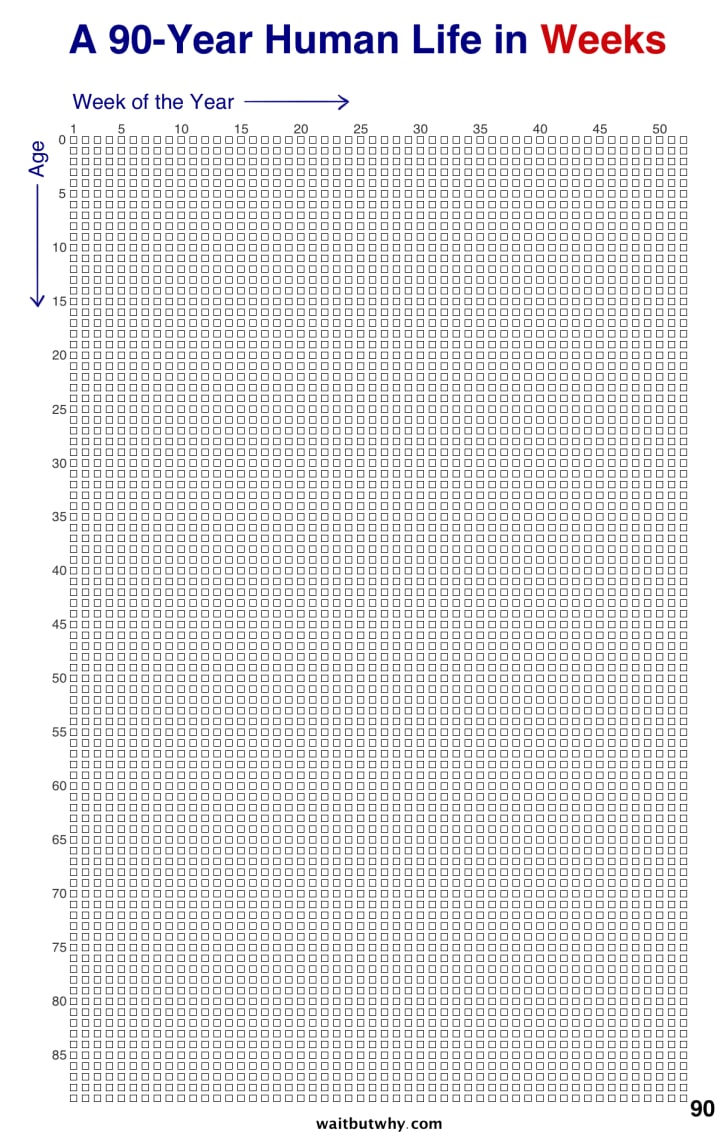
Knowing the end makes the remaining journey feel more important.
The most insane thing about this concept is that although knowing how much time you have left makes the time seem more valuable, it's not. Time is always exactly what you make to be. You have just as much power to spend today meaningfully as you would if you knew today was your last.
With this idea at the forefront of my brain for the last few years, I have begun to look at moments of time for their potential value. I believe that each moment has an ideal way to be spent. I also believe that I will never spend a moment ideally. The goal is not perfection but instead to attempt to get as close as possible to that ideal.
I have begun to call this concept temporal potential value (apologies for that one, my deep physics nerd comes out in long-form projects). Each moment has its own potential value, and it is my desire to get as close as I can for each one. This works, for me at least, because although I still have no idea how much time I have left, I can look at each moment as disconnected from the whole.
Using this technique I free myself from the pressure of living the ideal life, and can instead try and fail and try again, to make my days better. Ironically enough, social media companies actually use this same concept to the opposite effect, but more on that later.
Time is such a tricky resource because, besides the rare occasions of terminal illnesses or being trapped in a chilian cave, we have no idea how much we have left. Everything else we have is easily quantified. It is simple to budget money, or gas, or the sun's energy because they are all easily known and countable. Time is finite in the same way all those things are. We have a limited amount, it is being used up, it will run out. However, what we know about gas and money, and the potential energy of the sun that we do not know about our time is when they will run out. This not knowing leads us down what I fear is the most dangerous possible path.
Because we do not know how much time we have left, we default to treating it like it is unlimited.
The abundance mindset being applied to time is devastating. This mindset has led us, as a species, to spend 600 lifetimes this week watching Red Notice on Netflix.
Netflix's new ranking site displays the number of total hours spent watching their most popular shows and movies. Red Notice, a new action heist movie has topped the charts at 200 million hours this week (at the time of writing this).
This movie is kinda bad. The world, this week alone, has spent roughly 600 lifetimes watching a pretty bad action movie. I honestly don't know how to feel about this, it is impossible to criticize knowing that a couple of those hours belong to me. This I am sure, is not the ideal way to spend those moments. The lost potential in those 600 lifetimes being gobbled up by the never satisfied digital content monster makes me incredibly sad.
This sort of data begins to beg an uncomfortable and important question.
Is it ethical to develop entertainment designed around taking as much of people's time as possible?
Due to the abundance mindset that is created by not knowing how much time we have left, the always tomorrow mindset gives us permission to live without urgency. This of course causes us to waste time.
My fear is that although the average lifespan is getting longer and longer, our time spent actually living is rapidly shrinking.
Red Notice is a fairly silly, and random example of this issue. Netflix users on average spend well over a billion hours consuming content weekly. This equates to thousands of lifetimes spent per week. Netflix is not even the biggest offender. Facebook and Youtube are now algorithmically designed to take up as much time as possible. The more time users spend on the platform, the more ad revenue they can generate. Even writing sites like Medium and Vocal uses this principle, by paying writers based on how much time paying users to spend reading their content.
What these platforms understand that is lost on most users is that time has become currency. Your attention has become more valuable than your money. Red Notice is a prime example of this. Netflix spent 200 million on this film and did come close to recouping that in new subscribers. However, being able to outshine the competition and generate revenue from product placement is well worth the investment.
People are still painfully aware of what constitutes 'wasting time. For a few years in the social media space, this was a topic with a lot of buzz. However as this issue gained more prevalence, the developers found a way to combat the time constraints that people began putting on their digital consumption.
Social media companies began by shrinking the time commitment that was required for individual pieces of content. Twitter was the first to do this so obviously. By constraining Tweets to a character count, the user was promised to need less time in order to consume a piece of content. This however does not, under any circumstances, mean that people spent less time on Twitter than other platforms. The opposite happened.
This constraint actually made people feel more comfortable dedicating larger amounts of time to Twitter because 'just one more' was a much smaller commitment than it was on the competitor's platforms. When we are browsing a social media site, we do not think of the experience as one whole block of time. For some reason, our brains seem to default in a more segmented zone of consumption. Essentially, we are not scrolling Instagram for 2 hours, we are looking at 120 posts for one minute each. Because of the diversity of content, we stay engaged and entertained for longer. We are also less likely to leave the platform knowing that another shot of dopamine in just one thumb motion and a few hundred pixels away.
Consuming information in this way also is much more inefficient than taking in information one subject at a time. It takes more effort for our brains to switch subjects than it does to focus on a singular topic for the same amount of time. (It is also more boring to do so as you may be experiencing right about now.)
The point is simply this; creating platforms algorithmically designed to take as much of our time as possible through addictive means of entertainment is criminal.
Primarily, this puts humans at a major disadvantage when it comes to spending their time. We have created platforms that are designed to work against us, not for us. This is all due to a mindset that money is a more valuable resource than time. If we adopted the time first, money second mentality. Social media platforms would be forced to shift to how they can make our lives more efficient instead of more monetarily entertaining.
Not all time spent on social media is, of course, wasted. Much of it is spent on connecting with people, developing one's self, and for many, creating a job or a business that they love. These are all fantastic uses of this tool. However, when platforms are developed around the idea of getting people to spend as much of their time as possible using them, the good things get overwhelmed by the many things. The thirst for content is so unendingly high, that we have now developed artificial intelligence to write content for us. The content that AI produces contains no original thought whatsoever. It instead is designed purely to fill the gap in the overwhelming demand for a 'new' piece of writing and serve the all great and powerful search engine algorithm. AI has already made an impact in the written space and I can only imagine will soon begin to fill the photo and video world as well.
All this being said, if we stay on the current trajectory by the end of a lifetime, the average person will spend about 3 years on social media. This is if we remain constant in our consumption. Things are trending up and the actual number could be much higher.
All this to say, our time matters. It has real value and should not be spent flippantly. Our moments are numbered and we have the responsibility to spend them in a meaningful way. Not just for the benefit of the individual but also for the attempted progression of the collective.
When properly broken down there are only four options on how to spend your time.
It can be spent on maintenance. This would include things like brushing teeth, doing dishes, even taking a walk, or meditating. These are all things that are required in order for a future time to be useful. Without spending time on maintenance we would soon find our future very painful and eventually, unliveable. Time spent on maintenance is sometimes the most frustrating time spent but is also some of the most fulfilling, and valuable time you can spend.
It can be spent on contributing to future gain in some way. This differs from maintenance because it is not about keeping the status quo of what is, but instead about trying in some way to improve the future. This can be both good or bad depending on the desired outcome and of course the individual. The value of this time is almost completely subjective. The meaning gained from time spent contributing to one's future could be categorized by learning, investing time in making money in order to use that money for future enjoyment, it could be spent developing relationships, or even building things. Time spent this way is often highly sacrificial as it can contribute to others' future more than that of the person spending it. Raising kids, volunteering, teaching or a thousand other endeavors fall into the future gain category.
Time can also be spent on raw enjoyment. This includes time spent on moments you love just for the sake of the moment. Time spent in this way is the reason we do the other ones at all. It is the pinnacle of the human experience.
The wonderful thing about all three of these is that there they often overlap in wonderfully surprising ways. Working a job you love helps you maintain your current lifestyle, build for your future and enjoy the moments you spend working. It might look something like this:
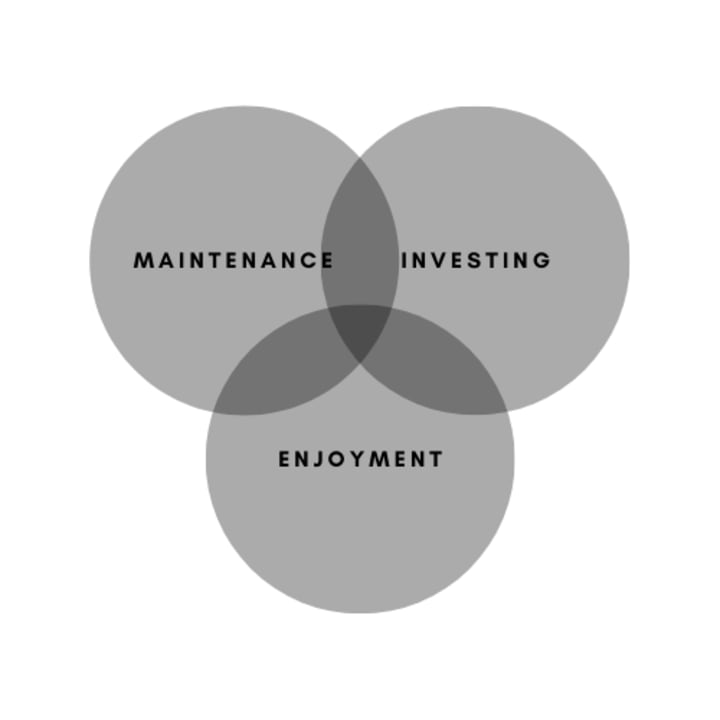
Maintaining Current Lifestyle, Investing in Future, Enjoying the moment.
My hope is that we can all find ways to find enjoyment in things that also contribute to the good of the world. We can find ways to enjoy our moments without the need to sacrifice our future enjoyment. The issue here is that enjoying fulfilling endeavors takes a tremendous amount of practice. However, when we get it right and manage to hit the center of that diagram, our time becomes something truly worthy of pursuit. It becomes your passion.
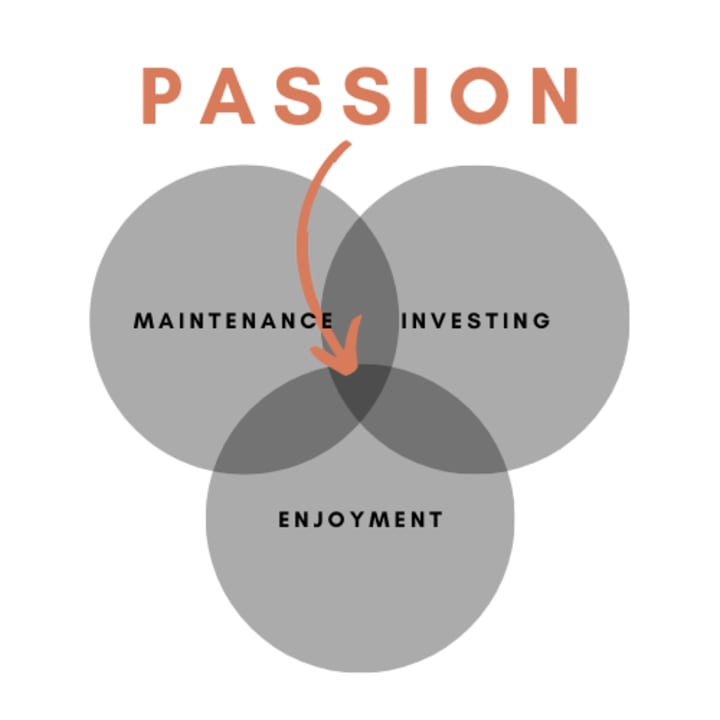
Many things can be done that kill two birds with one stone. This is what I believe we should strive for. Finding ways to spend our time that are both enjoyable and fulfilling, but also serve the purpose of benefitting the future for ourselves and others.
Unfortunately, there is a fourth category. It is the only one that can not be used in tandem with the other three. It saps the life from the other categories and the more time spent in it, the less the others seem to matter at all.
The last way to spend your time is to escape. There are so many ways to escape. Escaping is easy, momentary, and takes no effort. The harder life gets, the more appealing escaping seems, and the more one escapes, the harder life gets. It is a horrible spiral that takes saps hours like a tick. It's a parasite to live and leaves the beauty of the world tragically unseen.
If beauty is in the eye of the beholder, escapism is the screen that blocks our view.
In the end, the diagram looks more like this:
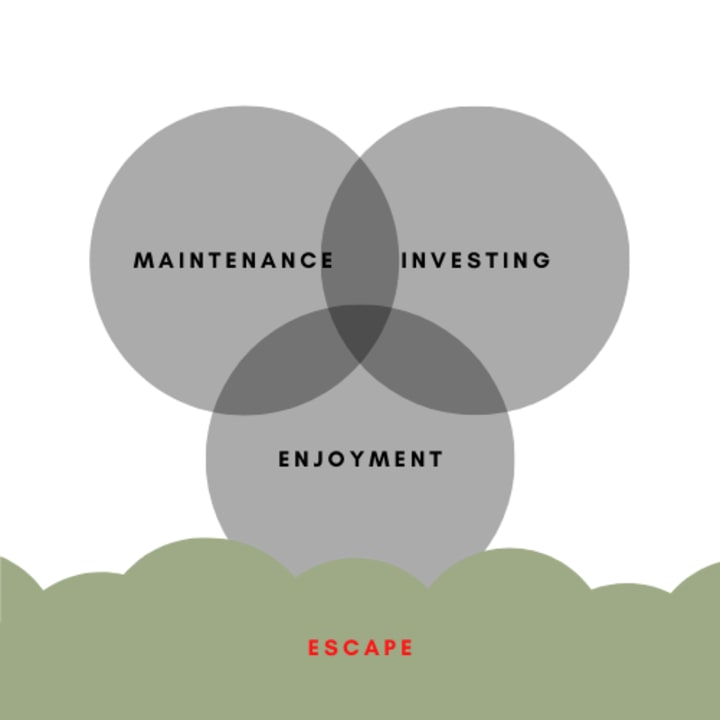
We trick ourselves into thinking that there is no difference between enjoyment and escaping because escaping can feel so enjoyable. But it does not last. It does not recharge or offer rest.
Escapism is being designed by the bucketload. The demand will only increase as people spend less and less of their time doing things that bring real fulfillment and more time avoiding the difficult things that life brings. Overcoming challenges is one of the most beautiful things in the human experience. They can never be overcome if the default is escape instead of confrontation.
Time is all we really get. How we spend it matters not just for us but for those we love and those who come after we are gone. If the world continues to devolve into a celebration of escapism, I fear that we may lose the best parts of humanity. We will trade comfort for beauty, and be all the uglier for it.
Time is all we really get. Let's spend it well.
“Time is free, but it’s priceless. You can’t own it, but you can use it. You can’t keep it, but you can spend it. Once you’ve lost it you can never get it back.” — Harvey Mackay
Wow, you're still here? Thanks for getting all the way through. Part 2 will be on suffering, and how we can use our time to remedy it.
About the Creator
The Whispering Wind:
My spiritual journey, like a winding river, has meandered through periods of intense focus and blissful ignorance, periods of deep questioning and unwavering faith. But it wasn’t a grand epiphany or a profound meditation that dramatically shifted its course. Instead, it was a quiet, almost absurd moment involving a misplaced photograph, the scent of sandalwood incense, and the whispering wind through the leaves of an ancient oak tree.
By Wilson Igbasiabout 8 hours ago in Humans
Do You have a Support Network?
Life is harder when you’re on your own. Human beings are social creatures, and we usually feel better when we have support from a strong social network around us. For most people, it’s our families that hold us together like glue.
By Elizabeth Woodsabout 17 hours ago in Psyche




Comments
There are no comments for this story
Be the first to respond and start the conversation.