
Linden had a habit, a bad habit. Linden collected things, things from shops and tag sales, things she didn’t pay for. They weren’t ever big things, or expensive things; she craved the small thrill of taking things. It was a hobby. No, it was more like a sport. In truth, it was an addiction. Linden was addicted to thieving.
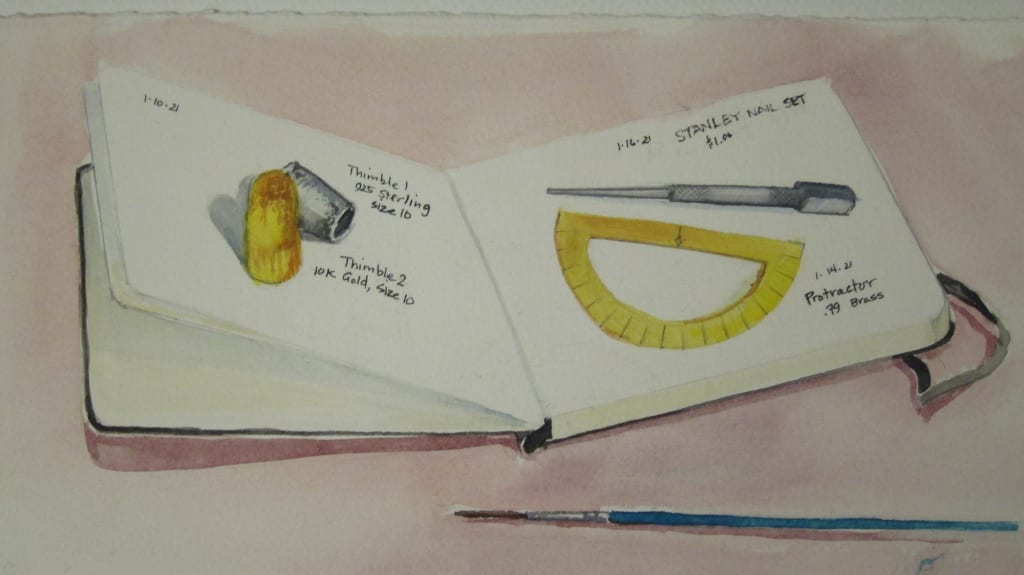
Back at home she carefully cataloged the items she had stolen in a small black book (which she had paid for) with a fountain pen (which she had also paid for.) The scritch, scritch, scritch of the nib on the cream-colored page was as much a part of the ritual as the theft itself. She recorded the date, the item, the price and details about where and how she had obtained it, not unlike a bird enthusiast compiling a life list. Often, she made a drawing of the object, an intimate still life in watercolor. Each time it felt like a conquest, albeit a small one. Each time she felt the hit of dopamine, the reward, the thrill of getting away with something, and even though she felt a pang of guilt, she knew she would do it again.
The items varied: a Stanley nail set slipped into the finger of her glove at a tag sale, a brass protractor deftly wedged into the back pocket of her blue jeans along with her cell phone, two thimbles- one sterling, one gold- poked into a skein of yarn at an estate sale, the yarn then purchased. The thimbles were probably the most valuable things acquired in the decade she’d been at it. The objects filled a half dozen little black books.
House sales were Linden's favorites, because she loved the opportunity to see the inside of classic old homes in the prestigious neighborhoods of her mid-sized, midwestern city and fantasize about the people who had lived there, creating whole stories based on the items offered for sale. Was this home to one person or two, or perhaps once a family with just one member left? Which partner remained at the end? Had they travelled, pursued hobbies, liked to cook or to entertain, played golf, fly fished? What did their books reveal about them? Had that Beidermeier secretary come down through generations, and was there no relative who wanted it? Linden loved the details in the old homes— glazed tiled fireplaces, the decorative fillips on the banister of the front staircase compared to the lack of embellishment of the servants’ stair, ingraved door hinges, the occasional dumb waiter and even a bowling alley in the basement of one turn of the century house.
Linden habitually checked the pockets of fur coats, especially the one secreted along the coat's fore-edge, and the inside pockets of men’s suit jackets. She looked in the drawers of fine old furniture, admiring dovetail joinery and book matched veneer. She admired the cleverness of a master cabinet maker who included hidden compartments in his desks or built them with a mechanism that required drawers to be opened in a particular sequence without which some would not open at all.
It was a desk like this that delivered Linden’s best find yet- a find that made her contemplate giving up her petty thefts. It was a partner desk at an estate sale, and by that I mean a desk designed for two business partners’ use. It was large and reddish, with leather inset into the top. Oriental in style, its age not easily deciphered; it resembled a pair of chests from one side. A person could sit on that side and have at his disposal three drawers - a shallow center drawer and a drawer on either side of a knee hole- each of those above a door that swung open provided the drawer above it was not quite closed. The brass pulls nested neatly into brass plates, hardly visible as anything but decorative save for a little moon-like sliver where one could insert a fingernail to raise the bail. All that said, this was clearly the side on which the junior partner sat.
Linden went around to the other side and sat down at the capacious desk. She leaned back in the diamond tufted, leather chair and daydreamed about being an eighteenth century importer with an office overlooking a Dutch harbor… she tried all the drawers and to her astonishment, when she slid one of the drawers open, an envelope fell at her feet with a barely audible “floop”.
Linden froze for moment, then glanced around the room. It was nearly three o’clock, on the afternoon of the second day of the sale and traffic had definitely slowed to a trickle. There was only an hour left for that day, and many of the rooms had been emptied of most of the smalls having only clothing, books, office supplies and furniture left in them. It sounded like the staff had gathered on the main floor, enjoying a warm cuppa’ at the end of the day and chatting amiably among themselves. No one was in the room or even in a line of sight to where she sat.
She leaned down. The envelope was from a bank that had long since merged with another, which then merged with another, and was then absorbed by another. But it was a name she knew; her grandparents had done their banking with that institution back in the 1960s and had earned a set of china for each of their four daughters, a place setting per twenty-five dollar deposit at a time. The envelope was dusty, probably from sitting behind or under a drawer for fifty years. It was sealed. But it had something in it— not really fat, the envelope contained perhaps a two or three page letter. Without stopping to think, Linden slid the envelope up her jeans leg, hooking it into the top of her sock. Her jeans were straight-cut, narrow enough that she felt sure the letter would be secure until she got to her car.
Linden made her way down the back stair, just to be sure the envelope would stay in place, and on to the cashier near the door to purchase two volumes she’d selected earlier, Károly Gundel’s Hungarian Cookbook and Swedish Recipes, Old and New. She paid her two dollars and fifty cents (everything under fifty dollars was half price on the second day of the sale), thanked the woman and walked to her car.
While eager to know what the envelope contained, Linden felt she ought to leave the scene before assuaging her curiosity. At the first stop sign, she removed the envelope from her pant leg and laid it on the passenger’s seat. But she didn’t open it. She would enjoy the drive home devising scenarios involving the envelope’s contents, engaging in flights of fancy, being freely outrageous with the story lines.
Once home, she set the envelope on the kitchen table. Then she propped it against a vase of tulips on the table. She looked at it. It’s probably nothing, some lost correspondence fallen over the back of the drawer, gathering dust, but it could also be someone’s Last Will and Testament. She pondered, then grabbed her lap top and typed “How to unseal an envelope without damaging it” into the search bar. After all, if it was someone’s Last Will and Testament, she might want to return it surreptitiously the next day, and then bring it properly to someone’s attention. The most popular advice involved putting the envelope in the freezer overnight- the cold would “dry out” the glue and it should just pop open.
“We shall see.”, she said to herself.
The next morning, as water for tea came to a boil, she retrieved the envelope from the freezer and examined it. Helped by gentle persuasion from a butter knife, the flap released. She emptied the contents onto the counter and was dumbfounded to see large denomination bills with the face of Grover Cleveland on them. These were thousand dollar bills. Linden knew that United States currency comes in six denominations: one dollar, two dollar, five dollar, ten-, twenty- and one hundred dollar bills, so this was a surprise. There were thirteen one thousand dollar bills on her counter, thirteen Grover Clevelands gazing stage right. Eleven had been minted in 1934 and two in 1928; they were worn but by no means tattered.
She took the whistling tea kettle off the stove, poured the water over two teabags in a large tea pot and reached for her lap top, typing, “US currency, one thousand dollar bill” into the search bar. According to the internet, thousand dollar bills, along with five hundred dollar notes and other large denominations were discontinued in 1946. However, they continued in circulation until the Federal Reserve started recalling them in 1969. Linden learned that they are still legal tender, but are likely worth more than face value to a collector. Good- she didn’t want to take them to a bank. If the internet was to be believed, Linden had about twenty thousand dollars fanned out in front of her.
About the Creator
Keep reading
More stories from writers in Humans and other communities.
Autonomy Is The Real Privilege
Good morning, freedom-seekers! Today we’re gonna be looking at autonomy. A strange word, I know; one many would probably look at blankly and run away from on sight. We’re gonna figure out what it actually means, consider how it’s achieved, and decipher just how deeply most of us are tangled up in dependence without realising it.
By That ‘Freedom’ Guy5 days ago in Humans
Book Review: "The Queen" by Andrew Morton
You're probably wondering why on earth I would read this book. It was free and it was a fair length. That was basically it at first. But another reason is because I enjoyed the show The Crown and so, it only makes sense to read a book that goes through separating facts from fictions - and to be fair, there aren't a lot of fictions about the show it seems. From the birth of the little princess and the way in which her father was reluctantly to become the king, all the way to meeting and marrying the veteran prince, Duke of Edinburgh and even down to the death of her father, queendom and beyond, this book actually gives us a lot about a woman who basically embodied the greatness and modernisation of the British 20th Century.
By Annie Kapur7 days ago in Geeks




Comments
There are no comments for this story
Be the first to respond and start the conversation.