
Engineering point of view to quantify toxic behavior
Graphing narcissist vs empath

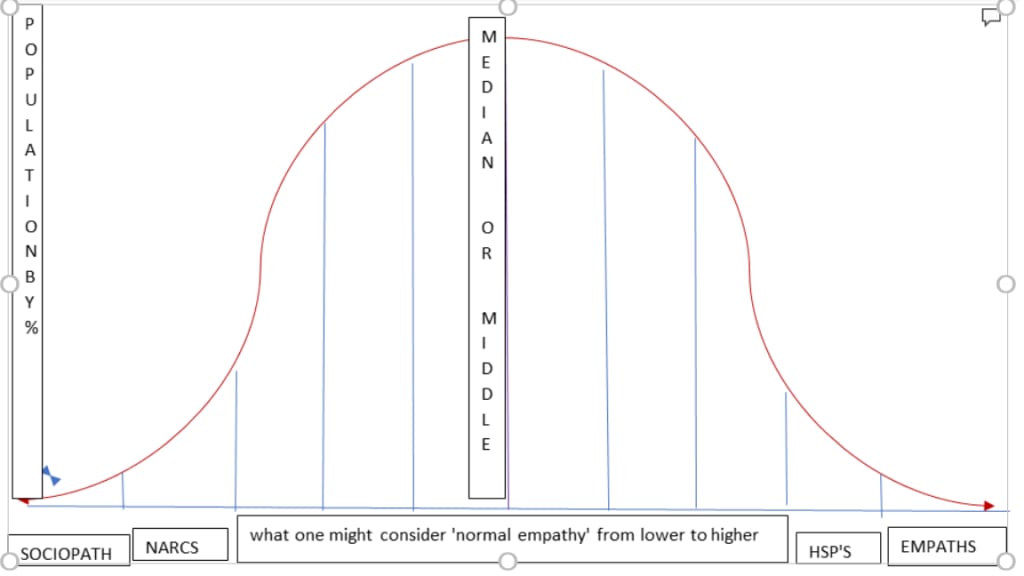
I am an engineer by trade, but that came much later in life. Having taken the Briggs-Meyers test many times, I was an INTJ until having my own ‘awakening’ Jan 2011. Answering the questions as honestly as before, the results came out ESFJ. I do feel that the logical ‘stuff’ and ordered thoughts are still there; but the creativity that has come in the past 10 years has shaped the logic differently. I also found myself alone a LOT, and had a lot of work to do on myself. The beginning of this journey started with dating a toxic, abusive person. Releasing that relationship came with torturous, ruminating thoughts. Being the logical person, I had no idea the calculating, manipulative ways I was being deconstructed and exploited. Oh those weaknesses were there from the start of my creation pretty much; just took an ‘expert’ to find the cracks and blow them into canyons.
After that came line of relationships, with toxic or otherwise emotionally unavailable people. Some of those people were probably ‘broken’ from infancy or some had traumatic events happen later in life; but there were some common themes. Writing this now after 10 years and in dismal emotional shape at the time, so I'm trying to recall with better lenses looking back. There are a few ‘data points’ that lasted only a month each, but it was odd that the break-up was so explosive. And the other person would reach out, I would capitulate, we would reintegrate, and then the inevitable final explosion. Then came the digesting & decomposing of the relationship; why did this happen? How much of it was my fault? Why did I react that way? Wash, Rinse, Repeat.
Forward to more recent years, where I can better recall events & timelines. 3 year relationship with M (and lots of interference with toxic sociopathic ex-BF), 6 months with K2 (some ties to supposedly toxic ex-BF), 4 months with A who was living upstate with toxic sociopathic baby-daddy. So a decaying pattern on the time axis with a repeated pattern of dealing with ‘current ex-boyfriends'. Obviously my fault for allowing something to percolate with someone with toxic ties, but as I always say: nobody wears T-shirts or has bumper stickers advertising their critical faults (neither do I). But I’m working on mine, and the amount of time I allow to pass before cutting them off is on a decay function. Now I’m not currently pursuing anyone, and 2020/2021 has been a TREMENDOUS growth period on many fronts!
Maybe I’ll generate another article on why people stay stuck, with toxic stringy ties to exes. But as for my theory about ‘do narcissists have empathy’ or the origin of Narcs Vs Empaths...it is an overblown, tired topic because both terms are getting thrown around in everyday language (improperly, even by me). But I like to try to make neat, tidy summations of things so I can wrap my head around them. And even if I’m wrong, at least I’ve tried to figure things out on my own and maybe help others in the process. I believe Narcs & Empaths have a very similar beginning. For me it came with a lot of physical & emotional abuse as a child. From my own experience, I think it was me exercising a muscle we all have: when Daddy or sometimes Mommy was coming at me angrily down the hallway, was I going to get beaten, scolded, shamed, or other? So I think that invisible brain muscle in me was using every sense I had to try to detect, before they got to me, what was going to happen? What were they thinking? I believe Narcs start off the same way, but they choose another path. They snap inside, go inside themselves. They can’t help the parent or other abusers actions, but internalize it and identify with the abuser. IF I become like Abuser, THEN I won’t get hurt anymore and eventually can do this to others. ELSE the abuse will continue (Fawning reaction) Whereas the Empath tries to understand the abuser, reaches out with Empathy trying to read why this is happening, and identifies with the victim at first. Hopefully, eventually, the Empath will get away from the abuser and start to heal from it. But can’t turn off the ‘feeling other people’s feelings’. So I am surmising that there are 2 types of Empathy: active empathy that the empath has trouble turning off. And Passive empathy that the Narc also has, but only senses it as a tool to get under the skin of their target. This passive empathy a Narc possesses is more like animal instinct; used to sniff out the weakness (however temporary it might have been) of their prey; in order to exploit it. Once they get their claws into you, it begins a lopsided, losing tug-of-war.
So the graph I’ve come up with more speaks towards active empathy, because that’s what we show outwardly (to humans, animals, even inanimate objects). Following the 6 sigma rule, or 3 standard deviations from the mean (center), that will cover the majority of individuals. While out in the tail of the graph, that covers the more extreme individual. And if you fold the graph along the center, the two parts of the curve that now touch ‘feed’ off of each other. No offense; but starting from the sociopath side they would most benefit from feeding off the Empath. And the Narc would most benefit feeding off the Highly Sensitive Person. Again this is all theoretical as I have not seen it elsewhere, and it may have no statistical basis. Just a way for me to try to present the idea that A: narcs & Empaths have similar beginnings whereas narcs have nigh-infinite masks hiding that inner wounded child. And probably by the % in population of sociopaths, narcs, etc would be represented by the area under the curve. Again very general, and may even just be fiction. But it’s a starting point, Empaths & HSP’s trying to ‘fix’ Narcs & Sociopaths
About the Creator
William Willet
I've been writing since my teens, but have not really put it out for public view.I know subjects such as self-help, spiritualism, life-coaching, narcissistic abuse recovery, healing, trauma, comic books, classic video games, other fun stuff
Keep reading
More stories from writers in Humans and other communities.
This Is the Secret Reason Why Your Good Writing Is Not Getting Views.
You write well. Your sentences flow. Your ideas show depth. Your grammar holds steady. Nobody reads it. The reason hurts because it sounds unfair. Quality alone does not earn attention online. Relevance does.
By Wilson Igbasia day ago in Humans



Comments
There are no comments for this story
Be the first to respond and start the conversation.