
Drawing Fire
The artist drew me as I wasn't, and for that I thanked him.


The artist’s knuckles were enormous, arthritic, bent. He scratched at the page, huddled in the corner of the pub in his newsboy cap and swallowing wool coat. How his fingers could even grasp the pencil, I wasn’t sure, nor how his eyes—milky, rheumy—could catch my likeness.
“I’m ugly,” I told him. “Why are you drawing me?”
He shrugged but didn’t look up. “Ugly is better,” he said. “More interesting.”
I wore a stained dress the color of wet cement, and the curl had left my hair hours ago. I was half-drunk already on cheap bourbon, no wind-swept goddess, no passive beautiful muse to inspire him. The artist turned the page of his little black book and started anew. “Tilt your chin.”
I did, taking the opportunity for another sip of my drink. The artist—if he were even a real artist, I hadn’t seen his drawings—had a lilt and clip to his speech, a continental marker on the vowels and Rs that sounded French.
“Tell me your story, love.”
I frowned, uncomfortable with the familiarity of his language. “I’ll tell you mine if you’ll tell me yours.”
A smile touched his lips. “Okay.” The word sounded heavy in his mouth, an Americanism he must’ve picked up.
He told me about himself, sketching as he spoke, shading and finishing lines I could not see. He had been a decadent, a dandy, a stylized coiffed bohemian in the days before the Great War, lounging on sofas of the rich and sleeping past noon every day. He leaned in to whisper, “Lovers,” he said, “with someone great,” and he gave me a little wink. Old as he was, he’d fled Paris last year because “They would kill me, too.”
“Jewish?”
“No.”
For a moment I sat perplexed, running over the details of what he’d told me. Lovers with someone great, the flash of dandy style—a shimmer of green fabric beneath his enormous coat—and the pieces fell together. “Oh,” I said, not blushing but understanding too well. There had been something we saw in each other, then, even on the smokey floor of the pub with too-loud jazz coming through the juke. Gone was the rich red carpet of Parisian salons that contained the city's quiet indiscretions. Now he sat in a ill-lit pub in the Bowery drawing a woman with a crooked nose and circles under her eyes.
“I don’t live here,” I told him. “In this area, I mean.”
“You just come for the nice atmosphere.”
I smiled. “Yes.” It was true that my apartment wasn’t in the neighborhood, but I also didn’t live far. I hadn’t exactly dressed down for a night in the slums, I just appreciated not having to dress up to go anywhere else. I wasn’t here to flirt with anything but my drink.
“My name is Francine Marks,” I told him. “But I go by Frannie. Born and raised here in New York. I work in an office uptown, and I’m twenty-eight.” I was thirty-four and I worked on 14th street, but it was close enough.
“Married?”
I swallowed hard, concentrated on keeping my chin at the proper angle. “Yes.”
“Husband at war?”
I looked at him, something hard in my eyes. “Yes.” I did not want to talk about my husband, or think about the fact that he could return any day.
“Okay,” he said again, lifting the palm of his drawing hand in apology. “Je comprends, I see.” There was a moment of silence as he eyed what he’d created. He frowned, shook his head, then shrugged. “Well, you were a lovely subject.” He closed the small book and tucked it into his pocket, pushed his chair back, and began fishing coins from his change purse for the table.
“Hey, wait a minute!”
His eyebrows went up.
“Don’t I get to see it?”
“Ah,” he shook his head, tut-tutting with his tongue against his teeth. “Not tonight.”
I eyed him curiously. “Another night, then?”
His smile was slippery and mysterious. “Yes,” he said. “Some other night, Frannie Marks.”
The artist tipped his cap and moved, more gracefully than I’d expected, toward the pub door. He hummed as he went, something that sounded like the lilting notes of “J’attendrai.” I knocked back the last of my bourbon and bounced my leg under the table, contemplating another drink alone.
I raised my fingers to the waiter. What else was there to do?
—
Fortune smiles, they say, but I had never met its toothy grin. I typed letters to business correspondents for a small insurance company by day, and then I walked home in the rain, collar turned up. Somehow, still, always an icy drip ran down my neck. I ate boiled carrots and drank carefully rationed coffee, made bread with flour that had moths in it. I tore a run in my last pair of stockings.
Then, some three months after the evening I’d met the artist in that Bowery bar, a package arrived in the mail. It was addressed to me in sure, penciled lettering. The object was small and square: a book. I slipped off the brown paper to reveal a familiar black cover, well-loved and worn at the corners. Tucked in the first pages was a folded slip of paper containing more of the same writing.
“I saw fire in you that night that no cold wind should ever put out. Bring this book to Arthur Durand at the Metropolitan Museum of Art.”
I turned the paper over twice, looking for more. Bring it to the Met? I thumbed through the pages and found drawing after drawing: men on a park bench, a summer garden, a woman adjusting her cloche hat while one stocking drooped down below her knee. A naked man sleeping in rumpled bedding, lovingly captured. They were beautiful.
I looked for my own likeness and found it, of course, near the end of the full sketchbook. The artist had drawn me as I wasn’t, and for that I thanked him. There were four pictures in all, each more striking than the last. He’d caught something in me I hadn’t known was there—a kind of delicacy in the longing and frustration I felt, which to me had always seemed rough and hard. He had softened it, made it into determination rather than shrewdness.
My fingers, of their own accord, moved toward the penciled line of my neck, the hard set of my eyes, but I drew them away before touching. I didn’t want to smudge the vulnerable graphite. Who had he been, I wondered, and why send the book to me?
—
“How did you get this?” The man’s beady eyes stared like knives. He had not been expecting me. He did not trust me. In his small alcove office, I held my head high and cleared my throat to explain.
The note, the drawings of my face, my name scratched below the final sketch: these pieces finally added up for Arthur Durand, who clutched at the small book with covetous hands. He’d recognized the style, even the handwriting, at once. The artist’s name, when Durand had said it, had sent an electric fire down my back. I knew the name, of course. Everyone did. I had never suspected.
Twenty thousand dollars, he said the book was worth. A fortune.
“Of course you’ll need an appraisal, an authentication, maybe even an agent to broker it—“ his eyes drifted up, unfocused, dreamy. “Everyone thought he was dead.”
I thought of the artist’s graceful movement as he moved through smoke and dancers toward the pub door. “He’s not dead.”
“No.” Durand’s face twitched. “But I suppose he doesn’t want to be found either.”
—
When I was four years old, I bit into a stick of butter. I had been both curious and desperate for a mouthful of its richness: I wanted to see if my mother had lied about the necessity of moderation. (Less is more. Small bites, Frannie.) The texture had been oily and thick, heavy and cloying to my tongue even as the butter melted against its heat. I had swallowed it all in one hard gulp.
My mother had slapped me when she saw the tell-tale depression left by my teeth in the fat. She called me wasteful, called me greedy. Now, as I stood in a shop on Fifth Avenue and bought its most expensive dress, I thought of the butter. I thought of the artist and his green silk shirt. I thought of the fullness I hadn’t allowed myself since I was a child swallowing that forbidden luxury in a Chelsea tenement.
My small fortune would not last forever, I knew. The money would spend down, and I would still need to work. Stockings and coffee were still rationed. But I also knew that I would not eat boiled carrots tonight, nor moth-ridden bread.
The artist's gift would keep my fire lit for a little while longer, and I would seize every rich moment I could put into my mouth.
About the Creator
Beth Doane
Beth recently earned a PhD in literature and women's studies with research and writing focused on horror and weird fiction, especially how these genres deal with gender and race. She spends her time between Brooklyn and central PA.
Keep reading
More stories from Beth Doane and writers in Humans and other communities.
In Defense of The Queen's Gambit
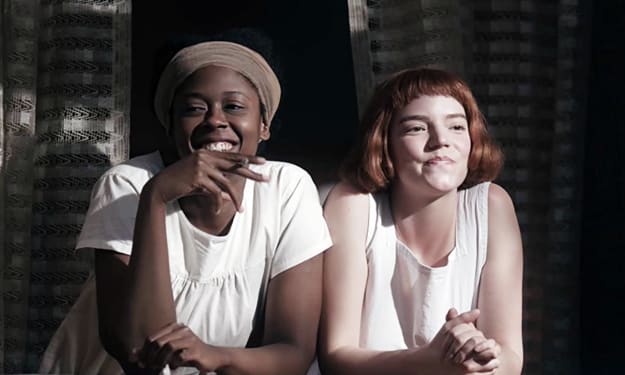
I’ve watched this series all the way through twice now, and on my first watch, I knew the critiques were coming. When Jolene (Moses Ingram) reappears in the second-to-last episode, I thought “Uh oh… here they come.” And come they did. Bitch was quick to call out the series, as was The Mary Sue, even the Washington Post: Jolene’s character is tokenized, they say, and even worse, an example of the “Magical Negro” trope (in which Black characters appear to save white characters, sometimes—though not always—by mysterious or supernatural means). I thought these very same things when Jolene reappeared at Beth’s darkest moment to pull her from the depths. When we first meet Jolene, she is stereotypically brash and loud-mouthed, and she remains always secondary to the white protagonist’s narrative. Jolene’s return adds something even less forgivable when she steps in at the eleventh hour to “rescue” Beth at the story’s climax, implying that her purpose is only ever in service of her white counterpart. This is purely bad representation. Isn’t it?
By Beth Doane5 years ago in Geeks
The CEO of Everything
They say "jack of all trades, master of none," but they forgot to mention the part where the jack of all trades is also the camera woman, the makeup artist, and the person currently yelling at a tangled Wii microphone cable in a her own bathroom while recording herself singing and trying to make it look realistic and professional. (As professional as you can make it with nothing but a cell phone camera and a mic that doesn't work)
By Sara Wilson4 days ago in Humans



Comments
There are no comments for this story
Be the first to respond and start the conversation.