
Dr. Andrew Rudin, MD on the Quiet Reckoning Over Coronary Stents
What Happens When One of Medicine’s Most Common Procedures Is Due for a Rethink?

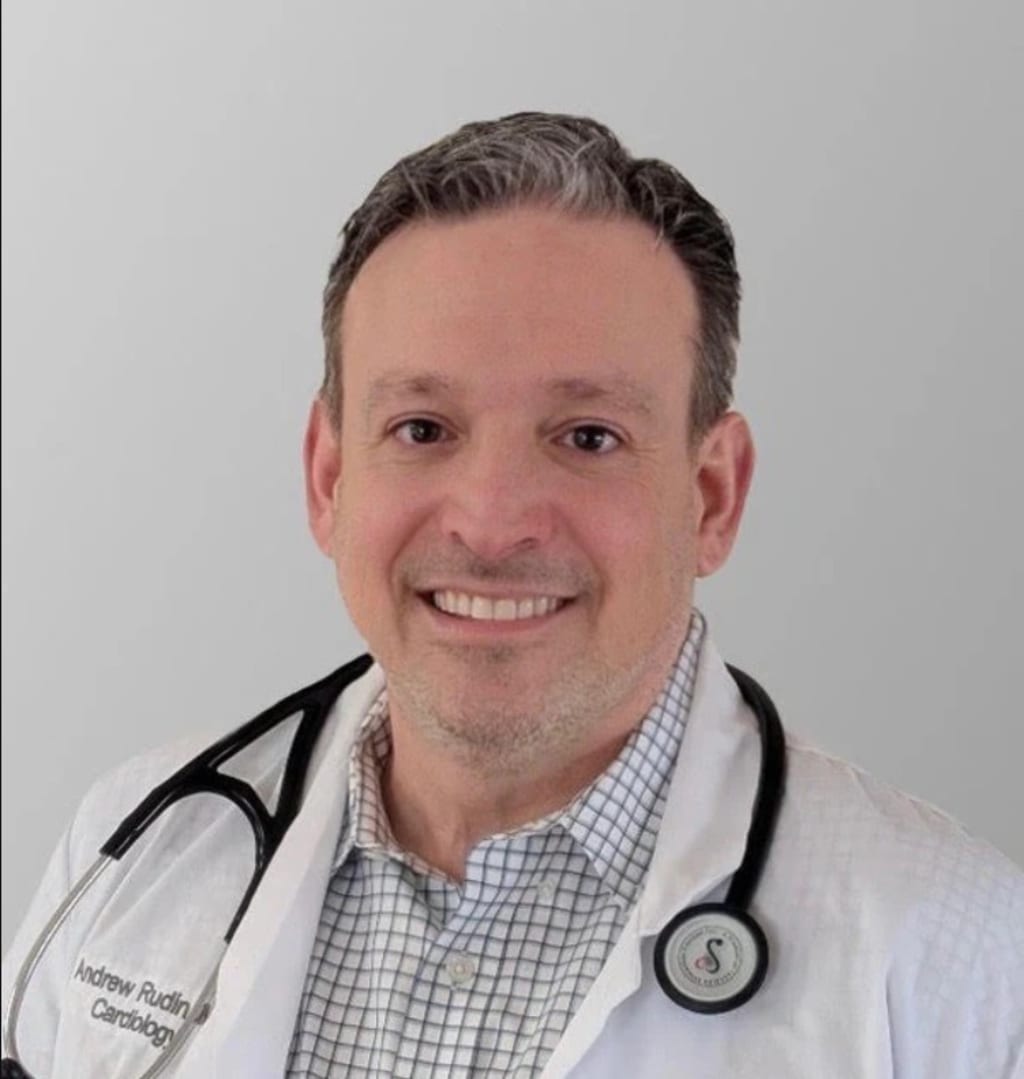
Walk into almost any cardiology department today, and you’ll find coronary stents at the center of its operations. These tiny metal mesh tubes, inserted into arteries to restore blood flow, have become emblematic of modern cardiovascular care. In emergency settings, such as acute heart attacks, their use is often lifesaving and undisputed. But according to Dr. Andrew Rudin, MD, a nationally recognized cardiologist, there is an uncomfortable truth medicine has yet to fully confront: we are placing far too many stents in patients who may not actually need them.
This isn’t a story about failure or malice. It’s a story about how good intentions, combined with outdated assumptions and institutional inertia, have led to overuse. It’s a story about a procedure so effective in some circumstances that it became ubiquitous in others, regardless of evidence. And it’s a story that challenges both physicians and patients to reconsider what it means to treat disease wisely.
Dr. Rudin has been speaking out about this quietly growing crisis for years. He has seen firsthand how patients with stable coronary artery disease—those whose symptoms are mild, intermittent, or even nonexistent—are routinely referred for stenting procedures that offer no improvement in survival or future heart attack prevention. What they receive instead is a narrative of danger narrowly avoided, and a metal device that may not change their prognosis but can forever alter how they view their health.
The origins of this trend are not difficult to trace. Since their introduction in the late 20th century, stents have been transformative in the treatment of acute myocardial infarction. In those scenarios, opening a blocked artery quickly can prevent the death of heart muscle and dramatically reduce the risk of mortality. The procedure works. But as cardiologists began to apply this tool to patients with chronic, stable coronary disease, the evidence for benefit became less clear. Large randomized trials like COURAGE, ORBITA, and ISCHEMIA have repeatedly shown that in such patients, stents do not reduce the risk of future heart attacks or death when compared to medical therapy alone.
Yet despite this growing body of data, stenting in stable patients continues—largely unchallenged in many institutions. Dr. Rudin believes one reason for this is that both physicians and patients remain deeply influenced by the imagery of blockage and the metaphor of the clogged pipe. To most laypeople, being told they have a “70% blockage” conjures something alarming, something imminently dangerous. The idea of fixing it with a stent feels like a rescue.
But the body is not plumbing. The cardiovascular system is a dynamic, adaptive, and complex network, and not all blockages are created equal. Many are stable plaques that have existed for years without causing symptoms or reducing blood flow. Others may be vulnerable to rupture, but are not necessarily the ones most visible on imaging. Treating every narrowing as a crisis often leads to overtreatment and neglect of more holistic, preventive care.
What makes this issue more challenging, Dr. Rudin notes, is that stents do sometimes reduce angina symptoms in patients whose medications haven’t helped. But this benefit is specific and limited—it does not equate to life extension or protection against future events. Unfortunately, the average patient is rarely presented with this nuance. In many cases, the test results are shown, the blockage is identified, and the procedure is scheduled. The conversation about whether the stent will actually make a difference is brief or absent altogether.
Dr. Rudin sees this as a failure not of science, but of communication and culture. In his own practice, he makes it a point to have deeper conversations with his patients before proceeding with stenting in non-acute scenarios. He explains the nature of their disease, the role of medical therapy, and the importance of lifestyle change. He doesn’t talk them out of stents—he gives them the opportunity to choose, based on complete and honest information.
These conversations take time. They challenge assumptions. They require a doctor to say, “I know we can do something, but I’m not sure we should.” That kind of restraint takes experience, humility, and a willingness to accept uncertainty. For many physicians working under time pressure, institutional expectations, or fear of litigation, it’s easier to act than to explain inaction.
But the stakes are not small. Stents, while generally safe, are not risk-free. They require antiplatelet therapy, sometimes indefinitely. They can cause bleeding, allergic reactions, or very rarely, thrombosis. More importantly, the psychological impact of receiving a stent—a moment that often feels like a near-miss with death—can deeply affect a patient’s relationship with their own health and body.
Dr. Rudin believes we need a systemic shift. Part of that involves updating patient education and public understanding of coronary disease. Part of it involves shifting reimbursement models so that clinicians are not incentivized toward procedures over conversations. And part of it is cultural—training the next generation of cardiologists to value thoughtful decision-making as highly as technical skill.
He points to the increasing number of professional societies, including the American College of Cardiology, that now promote more selective criteria for stenting. Initiatives like Choosing Wisely are encouraging clinicians to avoid unnecessary tests and procedures, including stents in stable patients. But progress is slow, and uneven.
Ultimately, the movement Dr. Andrew Rudin, MD advocates for is not anti-stent—it’s pro-patient. It asks the medical community to remember that just because we can intervene doesn’t mean we must. It invites us to restore clinical judgment to its rightful place at the heart of care.
In the hands of the right patient, under the right circumstances, a stent can be lifesaving. But when used as a reflex, or a substitute for conversation, it can become a symbol of missed opportunity—the opportunity to treat wisely, to listen deeply, and to act only when action truly serves the patient.
As Dr. Rudin often reminds his colleagues and students, the most powerful thing a physician can sometimes offer is not a device or a drug, but a moment of pause—a chance to think, to talk, and to choose the path of meaning over motion.
About the Creator
Dr. Andrew Rudin
Dr. Andrew Rudin is a cardiologist who specializes in finding causes of cardiovascular diseases and arrhythmias and treating them without pharmaceuticals.
Keep reading
More stories from Dr. Andrew Rudin and writers in Humans and other communities.
Andrew Rudin MD | The Silent Risk in Modern Medicine: How Excessive Testing Is Harming Patients
As medicine becomes increasingly digitized, data-driven, and diagnostic-focused, a profound yet quiet problem is growing beneath the surface: overtesting. While diagnostics are vital in delivering effective healthcare, a surge in unnecessary tests is now linked not only to increased healthcare costs—but to physical harm, psychological distress, and even cancer.
By Dr. Andrew Rudin5 months ago in Humans
I Tracked Every Minute of My Time for a Month. The Data Shamed Me Into Changing My Life.
I tracked every minute of my time for thirty days. No gaps. No estimates. Every action logged. Sleep. Work. Scrolling. Eating. Thinking breaks. The data hurt more than any insult.
By Wilson Igbasi7 days ago in Humans


Comments
There are no comments for this story
Be the first to respond and start the conversation.