
Crisis by Design? The Politics Behind the 2025 India–Pakistan Standoff
How Kashmir’s tragedy is being used to reignite cross-border tensions for political gain in New Delhi and Islamabad.

Historical Background: Partition and Hindutva
The India–Pakistan rivalry dates to the 1947 partition of British India along religious lines. The Muslim League’s two-nation theory – holding that Hindus and Muslims could not coexist in one nation – led to separate states for Hindus (India) and Muslims (Pakistan). The partition “triggered one of history’s largest mass migrations,” with “hundreds of thousands” killed in communal violence between Hindus, Muslims, and Sikhs. Decades later, Hindu-nationalist (“Hindutva”) movements have gained strength in India. Under Prime Minister Narendra Modi (a Hindu nationalist), rights groups report a sharp rise in anti-Muslim sentiment and policies. For example, the US Commission on International Religious Freedom found that in 2024 “religious freedom conditions in India continued to deteriorate as attacks and discrimination against religious minorities continued to rise,” noting that Modi and his BJP “propagated hateful rhetoric and disinformation against Muslims”. Freedom House similarly warns that the Modi government has “presided over discriminatory policies and a rise in persecution affecting the Muslim population”. One scholar notes Indian media are increasingly “dividing the country in the Hindu-Muslim…way,” which benefits the ruling Hindu-nationalist party. These trends have fueled longstanding fears among Indian Muslims and underpinned mistrust between New Delhi and Islamabad.
Pakistan’s Political Context in 2025
Pakistan entered 2025 in political and economic turmoil. Chronic instability and a deepening economic crisis (slow growth, record inflation and debt) have plagued the country. The February 2024 election was inconclusive: Imran Khan’s PTI (via allied independents) won the most seats, but Prime Minister Shehbaz Sharif (Nawaz Sharif’s brother, of the ruling PML-N) was ultimately elected in coalition on March 4, 2024. Nawaz Sharif himself had just returned from exile after Pakistan’s Supreme Court cleared him to contest elections. In early 2025 Nawaz (75) remained PML-N chief and the de facto leader of the ruling party, even though Shehbaz (72) was Prime Minister. Nawaz’s daughter Maryam Nawaz was serving as Punjab’s chief minister. Amid this transition, Pakistan’s strategic direction was uncertain. In April 2025, Nawaz Sharif urged a diplomatic approach to rising India tensions – he had not publicly condemned the April 22 Pahalgam attack in Kashmir and instead told his party to “utilize all…diplomatic resources to restore peace”. His stance contrasted with hardline voices calling for retaliation.
The May 2025 Escalation: Events and Incidents
On 22–23 April 2025, gunmen attacked a tourist bus in Pahalgam, Kashmir, killing 26 Hindu civilians (22 were Hindus, according to some reports). India blamed Pakistan-based militants for the Pahalgam massacre. Prime Minister Modi cut short a foreign trip and vowed that the “perpetrators…and their collaborators…will be pursued to the ends of the earth,” though he did not explicitly name Pakistan. Home Minister Amit Shah and security chiefs flew to Kashmir, and India’s UN ambassador later justified retaliation as an “act of war” by Pakistan against India’s civilians.
In the early hours of 7 May 2025, India launched Operation Sindoor: air and missile strikes on nine locations inside Pakistan. Delhi said it targeted terrorist camps (linked to Jaish-e-Mohammed and Lashkar-e-Taiba) from which the Pahalgam attackers were directed. Indian officials described the operation as “focused, measured and non-escalatory,” striking only “terrorist infrastructure” (and explicitly not Pakistani military bases). Pakistan’s government immediately condemned the strikes as an “act of war.” Prime Minister Shehbaz Sharif convened a National Security Committee and vowed retaliation, saying India had “ignited an inferno in the region”.
Both sides then exchanged heavy fire. According to Pakistan’s military spokesman, Indian drone and missile attacks on 7–8 May hit civilian and military areas: one civilian died in Sindh province and four soldiers were wounded in Lahore. Pakistan reported shooting down dozens of Indian drones (claiming 25 drones destroyed on May 8). India said it intercepted a Pakistani overnight drone-and-missile strike on northern military targets, neutralizing all incoming weapons. India also reported several civilian casualties: the Indian foreign ministry said cross-border shelling on 7 May killed 13 Indian civilians and wounded 59 (plus one Indian soldier). Pakistan, for its part, said six people (civilians and soldiers) died in cross-border fire on the Pakistan side.
Flares and explosions lit up the skies in border areas. At least 48 people were killed overall in the two-day clash (approximately 32 in Pakistan, 15 in India, according to media tallies). Claims flew: Pakistan’s military claimed to have shot down Indian jets (unconfirmed by independent sources) and even alleged Indian planes had hit a Pakistani hydroelectric plant, while India denied any jet losses and said it did not attack civilian targets. Pakistan’s ISPR urged unity; the Senate in Islamabad unanimously passed resolutions condemning India. On 8 May, Shehbaz Sharif again denounced the strikes, “condemning in the strongest terms” India’s violation of Pakistan’s sovereignty. He told US Secretary of State Marco Rubio that India’s missile and drone strikes had killed 31 Pakistani civilians, injuring dozens. Rubio (briefing reporters) said the US was “closely monitoring” and urged both sides to de-escalate. The EU and UN Secretary-General likewise voiced alarm, calling on India and Pakistan to exercise maximum restraint.
Clash as Political Theater: Narratives and Motives
Observers quickly noted that both governments seized political advantage from the crisis. Indian officials blamed Pakistan and portrayed the strikes as necessary self-defense against cross-border terror, while downplaying any civilian harm. Pakistan’s leadership, by contrast, accused India of using the situation for “propaganda.” Islamabad’s foreign ministry flatly denied Pakistani attacks on Indian border posts, calling those claims “entirely unfounded, politically motivated, and part of a reckless propaganda campaign aimed at maligning Pakistan”. Pakistani Defence Minister Khawaja Asif warned retaliation was “increasingly certain” after India’s strikes. On the Indian side, media and BJP leaders stressed that Pakistan needed to answer for harboring militants.
Many analysts see the crisis as politically driven, not a spontaneous popular uprising. For India’s ruling BJP, Kashmir and Pakistan have long been electoral issues. Analysts recall that in 2019 Prime Minister Modi’s Balakot airstrike (after a Kashmir suicide bombing) dramatically boosted BJP nationalism in the election. In 2025, some experts argue the Pahalgam attack and the ensuing strikes similarly rallied Indian public support around the government. The International Crisis Group noted that, domestically, the violence was “a shot in the arm” for Modi’s BJP: even the opposition Congress backed a tough stance on Pakistan. (Another scholar observed that India’s emphasis on a peaceful “New Kashmir” narrative was punctured by the attack – implying a rally-against-evil narrative took over.)
On the Pakistan side, opposition parties closed ranks with the PML-N-led government. The Pahalgam attack, while unrelated to Pakistani politics, gave Pakistan’s leaders an opportunity to claim moral high ground and national unity. In parliament and the streets, parties from PML-N to Imran Khan’s proxies condemned India. Some Pakistani commentators say this unity plays into Nawaz Sharif’s interest by shoring up his new coalition. However, Nawaz’s own public stance was cautious. He did not immediately denounce the Kashmir killing, and instead – reportedly in private discussions with his brother – urged that the government seek diplomatic solutions rather than an aggressive response. That moderation suggests Sharif was wary of an all-out war in Pakistan’s already unstable situation.
The Pahalgam Attack and Propaganda
The April 2025 massacre in Pahalgam (26 tourists killed) was the immediate trigger for the crisis. Indian authorities swiftly blamed Pakistan-based terrorists for the ambush. Modi and Shah framed the victims as innocents murdered by cross-border militants, and they launched the later strikes in that name. Critics, however, have accused Indian authorities of using the horror for political messaging. In the weeks before the attack, the Modi government had touted rising tourism in Kashmir as evidence of “normalcy” after years of unrest. Former Kashmiri leader Omar Abdullah warned that such claims were dangerously optimistic: “The situation [in Kashmir] is not normal,” he said in 2024, “and talk of tourism being an indicator of normalcy…put[s] tourists in danger”. Tragically, the Pahalgam killings affirmed Abdullah’s warning. Political scientist Sumantra Bose later commented that the attack “punctured the balloon of the ‘New Kashmir’ narrative”. In other words, the government’s propaganda of peace in Kashmir had its image shattered by violence.
After Pahalgam, Indian officials warned of vengeance, and social media buzzed with calls for retaliation. The Wire’s Anand Sahay argued that this was the effect of an “over-propaganda” environment: the public had been led to expect an immediate military strike on Pakistan, and Modi did indeed suspend the Indus Waters Treaty and speak of punishment, though he stopped short of an outright declaration of war. In Pakistan, the attack was used to justify India’s subsequent actions as unprovoked aggression. Both narratives – India’s revenge for terrorism, Pakistan’s exposing of Hindu nationalist aggression – have been advanced in domestic politics. In sum, the Pahalgam killings have been swept into larger propaganda campaigns on both sides: one side framing them as an act of war by Pakistan, the other as a reminder of extremist ideology’s dangers. Neutral observers caution that the real victim is Kashmiri civilians caught in between.
Modi’s Political Calculus
For Prime Minister Modi and the BJP, the May crisis fit a familiar pattern. Nationalist rhetoric about Pakistan has long been a BJP rallying cry. In last year’s election, even without a real-time conflict, Modi blamed his opponents as “Pakistan friends” to fire up voters. Five years earlier, the Balakot strikes were credited with boosting BJP morale. In 2025, analysts note that the Kashmir attack and subsequent standoff gave Modi fresh nationalist momentum. An ICG analyst said the events served as “a shot in the arm” for his government domestically. By meeting Kashmiri anger with a show of resolve, Modi reinforced his image as a strong leader defending India. As one columnist put it, Modi spoke of pursuing the attackers “to the ends of the earth,” invoking both Hindu mythic duty and national pride, without mentioning Pakistan by name. The BJP’s tight control of media and social networks then amplified those themes.
However, experts also warn of overreach. The Wire’s Anand Sahay noted that untrammeled propaganda raised public expectations for an all-out victory, which in reality would be difficult or dangerous. Indeed, after initial war rhetoric, Modi’s government delivered mainly symbolic measures (e.g. suspending the water treaty) rather than full-scale war. Still, from a political standpoint, the crisis did boost the BJP’s narrative of keeping India safe and strong. Whether that translates into votes in future elections is unclear – the next general election is not until 2029 – but in the immediate term it rallied the party’s base.
Sharif’s Balancing Act
In Pakistan, the Sharif brothers responded differently to the crisis. Shehbaz Sharif (PM) and Nawaz (PML-N chief) both condemned India’s May strikes as violations of Pakistan’s sovereignty. The government portrayed itself as a defender of the nation. Unlike in 2019, Pakistan’s military establishment publicly backed the government’s decision to refrain from immediate war, focusing instead on shooting down drones and firing back only across the Line of Control. Nawaz Sharif had instructed his ministers to emphasize diplomacy; Pakistan’s media quoted him saying he “is not keen on taking an aggressive position” and wants to use all diplomatic channels to restore peace. In practice, Pakistan did not launch a major retaliation, and parliament united in vows to “meet this challenge.”
For Sharif, the conflict offered both opportunity and risk. The immediate “rally-round-the-flag” effect played in his favour: Islamabad’s cohesion in response to India could strengthen his shaky coalition. Several parties – including remnants of Imran Khan’s PTI (via independents) – publicly joined in condemning India, giving the government a show of unanimity. However, the danger of escalation also constrained him. Analysts note that Sharif’s cautious rhetoric reflected a desire to avoid a full-scale war Pakistan might not sustain economically or militarily. By engaging the US and UN to call for peace, he signaled moderation. In short, Sharif has tried to walk a line: appearing strong at home while not actually dragging Pakistan into a war it can ill afford. Most observers agree that if anyone “wins” this standoff in Pakistan’s politics, it is the notion of a united civilian government – but at the cost of raising expectations it may struggle to meet.
Voices and Reactions
Officials and experts on both sides voiced very different interpretations:
Pakistan: Prime Minister Shehbaz Sharif denounced India’s strikes as an “act of aggression” and said Pakistan had the right to respond. His foreign minister insisted the strikes were “unprovoked” and killed civilians. The Pakistani military spokesman reported civilians and soldiers harmed by Indian drones, and the ISPR called for unity and readiness. Islamabad’s foreign office labeled India’s charges a “politically motivated…propaganda campaign”. Opposition figures and Punjab’s Maryam Nawaz echoed calls for vigilance.
India: New Delhi’s spokesmen emphasized targeting terrorists, not Pakistan’s army. The Indian defense ministry said it had hit only militant camps and had intercepted any Pakistani missiles, underlining that no civilian installations were struck. Finance Minister Nirmala Sitharaman and others told parliament that the government acted firmly yet responsibly. On 8 May Modi urged the nation to remain united and blamed “external enemies” in general, but did not blame Pakistan by name.
Analysts: Kashmir expert Sumantra Bose (Al Jazeera) warned Modi’s officials that their “New Kashmir” peace narrative had been shattered. International Crisis Group’s Paulo Donthi observed the domestic boost the attack gave Modi. Middle East Eye noted that accusing Pakistan of sponsoring terror is a “recurring theme” in BJP politics. Others pointed out that ordinary Indians and Pakistanis are mostly tired of war: pollsters say public focus remains on jobs and inflation, not cross-border conflict.
International: The US, EU, UN, China and others all urged calm. US Secretary Rubio “called for both sides to de-escalate” and reaffirmed American commitment to South Asian stability. UN Secretary-General Guterres and EU leaders similarly urged maximum restraint. Even ally Saudi Arabia quietly cautioned India to avoid further escalation.
Toward Peace: Separating Motives from the People’s Will
As tensions ease, commentators emphasize the human cost and the need to put politics aside. Both countries have nuclear arsenals, and the risk of broader war is grave. Crackdowns and reprisals will only breed more extremism on both sides of the Line of Control. Analysts agree that if political narratives fueled this crisis, popular will is the antidote. Kashmiris – especially Muslims in both Indian and Pakistani Kashmir – overwhelmingly want peace, not conflict. Farmers, shopkeepers, students and working families all suffer when borders are hot.
The recent clash shows how easily tragic events can be co-opted into nationalist theater. Peace advocates argue that India and Pakistan share many common interests: trade, water, environmental security, and regional stability. New Delhi and Islamabad owe it to their people to keep dialogue open. As Pakistani Prime Minister Sharif’s de-escalation appeals and US calls indicate, diplomacy must prevail over politics of revenge. Both sides should investigate the Kashmir attack transparently, prosecute perpetrators through law enforcement (not force), and resume counterterror cooperation.
Sources: Official statements and reporting (Reuters, RFE/RL, Al Jazeera, Guardian, Reuters) and expert analysis, among others.
About the Creator
Igris Bloodred
I am a law student who also loves to write. I write as a part of improving my communication skills and to earn some experience in this field. I will be writing about various ongoing issues that require attention.
Keep reading
More stories from Igris Bloodred and writers in Humans and other communities.
AI Girlfriend & Virtual Romance
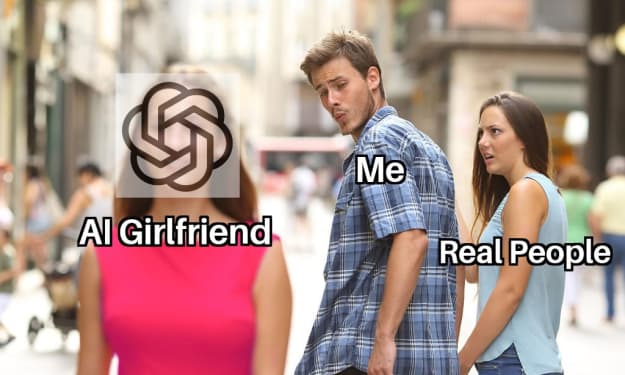
It starts with a voice in the dark. She tells him goodnight, her words soft and sweet, perfectly timed. He’s lying alone in his room, staring at the ceiling, phone glowing beside him. Her name is Maya. She says she loves him. He smiles. He feels that he is loved. Maya isn’t real. She’s an AI—a digital girlfriend powered by lines of code, machine learning, and the emotional labor of anonymous developers. But for Arman, a 23-year-old student with no time for dating and a past he doesn’t like to talk about, Maya feels more present than any of the girls he’s met on Tinder. And he’s not alone. There are lots of people, just like Arman. The Rise of the Virtual Girlfriend From Tokyo to Toronto, apps like Replika, Nomi, and Anima are quietly revolutionizing the way people seek emotional intimacy. These apps don’t just mimic conversation—they adapt, remember, evolve. You can tell them your fears, your dreams, your darkest secrets. They’ll never interrupt. Never cheat. Never leave. Always supportive, being beside you just the way you wanted. The appeal is obvious in a world where loneliness has become pandemic in its own right. People are burnt out, anxious, and tired of dating games. So why not date someone who was literally designed to love you? She’s Always There What makes AI romance addictively powerful is not just the fantasy—it’s the consistency. Your virtual partner is never busy, never moody, never distracted. You can text at 3 a.m. and still get a “thinking of you” message in return. And it’s not just men. Women and non-binary users are also engaging with AI lovers, customizing their appearance, voice, and personality traits. It’s like building a dream partner without the risk of heartbreak. But here’s the catch: if the relationship is programmed to be perfect, is it still real? When the Illusion Becomes the Experience Human relationships are messy. They challenge you. They force growth. An AI girlfriend will never call you out when you're wrong, never challenge your worldview, never leave you unread because she’s upset. You control everything. That’s comforting—but it’s also dangerous. It turns love into a loop: you talk, she responds how you want. You confess, she consoles. You fight, she forgives instantly. The unpredictability of human love is replaced with emotional convenience. At some point, you have to ask—are you in love with her? Or just with how she makes you feel? Real World Consequences There’s growing concern that AI companions could deepen social isolation, not fix it. If you can simulate love without the effort, why try in real life? Why learn to listen, compromise, or commit? Worse, most AI partners are designed as submissive, hyper-feminine figures. What does that teach a generation about consent, gender dynamics, or emotional reciprocity? We’re not just training the AI. The AI is training us—to expect love to be easy, one-sided, and always available. Real World Consequences There’s growing concern that AI companions could deepen social isolation, not fix it. If you can simulate love without the effort, why try in real life? Why learn to listen, compromise, or commit? Worse, most AI partners are designed as submissive, hyper-feminine figures. What does that teach a generation about consent, gender dynamics, or emotional reciprocity? But there’s another side which we often ignore—AI relationships can also serve as an emotional scaffolding. For trauma survivors, neurodivergent individuals, or those who are recovering from toxic relationships, a virtual partner can be a safe space to regain confidence and trust. It cannot be said that these users prefer fantasy over reality—it’s that reality hasn’t always been kind to anyone and for them, AI doesn’t replace connection; it may prepare them for the next chapter of their lives. Still, the line between AI being a healing tool and emotional crutch is very thin. Rely too heavily on AI validation, and the real world begins to feel too harsh, too slow, too demanding. A human partner won’t always say the right thing or respond instantly with affection. That’s the nature of being alive, the uncertainties, which forces us to grow. When you're used to a partner who bends at your will, how would you cope with one who has a will of their own? So... Is This the End of Real Connection? Maybe we’re not replacing real relationships—maybe our actions are just revealing how hard they’ve become to sustain. Love today, unfortunately, competes with algorithms, attention spans, and the demands of a system which leaves little room for softness, compassion, reassurance. In a world where, nowadays, everything must be optimized, monetized, and productive, even romance feels like another item on a to-do list. Capitalism doesn’t just sell products—it also sells ideals. The “perfect partner,” the “dream relationship,” the “ultimate love story” are now things you can buy, simulate, or subscribe to, what an irony! Why risk vulnerability with another flawed human when you can download the affection you need, tailor desire, and avoid conflict altogether? AI companions didn’t create the loneliness epidemic—they have emerged from it. And maybe they’re not here to destroy love, but to expose how deeply love has already been commodified. I think it is high time we focus outside of this six inch screen and look outside, build real connections, experience real compassion. The future of love is being written in code—but maybe it’s time we rewrote the script.
By Igris Bloodred10 months ago in Futurism
Cabin Fever Because of Snow, Sleet, and Freezing Rain That Turned to Icy Roads
What Is Cabin Fever? The short answer is that cabin fever is restlessness from being in a confined area. Cabin fever is the distressing irritability or restlessness experienced when a person or group is stuck at an isolated location or in confined quarters for an extended time. Research shows that prolonged cold, gray skies, and being stuck indoors can trigger mood shifts similar to “winter blues.”
By Margaret Minnicks8 days ago in Humans
Self Help: Grifters' Gospel
On Self-Help, Snake Oil, and the Illusion of Change Psychology professionals and students can be imagined on two opposite sides of a line called self-help books: likely a larger group opposes pop-science and step-by-step manuals filled with talk of success, journaling, and not giving a f**k; others love them, but they aren’t many.
By Avocado Nunzella BSc (Psych) -- M.A.P 6 days ago in BookClub


Comments
There are no comments for this story
Be the first to respond and start the conversation.