Igris Bloodred
Bio
I am a law student who also loves to write. I write as a part of improving my communication skills and to earn some experience in this field. I will be writing about various ongoing issues that require attention.
Stories (2)
Filter by community
Crisis by Design? The Politics Behind the 2025 India–Pakistan Standoff
Historical Background: Partition and Hindutva The India–Pakistan rivalry dates to the 1947 partition of British India along religious lines. The Muslim League’s two-nation theory – holding that Hindus and Muslims could not coexist in one nation – led to separate states for Hindus (India) and Muslims (Pakistan). The partition “triggered one of history’s largest mass migrations,” with “hundreds of thousands” killed in communal violence between Hindus, Muslims, and Sikhs. Decades later, Hindu-nationalist (“Hindutva”) movements have gained strength in India. Under Prime Minister Narendra Modi (a Hindu nationalist), rights groups report a sharp rise in anti-Muslim sentiment and policies. For example, the US Commission on International Religious Freedom found that in 2024 “religious freedom conditions in India continued to deteriorate as attacks and discrimination against religious minorities continued to rise,” noting that Modi and his BJP “propagated hateful rhetoric and disinformation against Muslims”. Freedom House similarly warns that the Modi government has “presided over discriminatory policies and a rise in persecution affecting the Muslim population”. One scholar notes Indian media are increasingly “dividing the country in the Hindu-Muslim…way,” which benefits the ruling Hindu-nationalist party. These trends have fueled longstanding fears among Indian Muslims and underpinned mistrust between New Delhi and Islamabad.
By Igris Bloodred9 months ago in Humans
AI Girlfriend & Virtual Romance
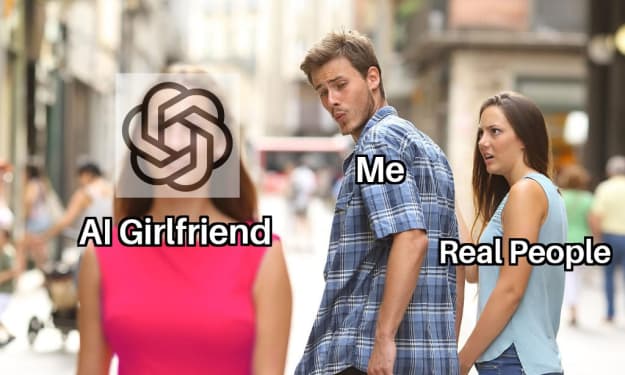
It starts with a voice in the dark. She tells him goodnight, her words soft and sweet, perfectly timed. He’s lying alone in his room, staring at the ceiling, phone glowing beside him. Her name is Maya. She says she loves him. He smiles. He feels that he is loved. Maya isn’t real. She’s an AI—a digital girlfriend powered by lines of code, machine learning, and the emotional labor of anonymous developers. But for Arman, a 23-year-old student with no time for dating and a past he doesn’t like to talk about, Maya feels more present than any of the girls he’s met on Tinder. And he’s not alone. There are lots of people, just like Arman. The Rise of the Virtual Girlfriend From Tokyo to Toronto, apps like Replika, Nomi, and Anima are quietly revolutionizing the way people seek emotional intimacy. These apps don’t just mimic conversation—they adapt, remember, evolve. You can tell them your fears, your dreams, your darkest secrets. They’ll never interrupt. Never cheat. Never leave. Always supportive, being beside you just the way you wanted. The appeal is obvious in a world where loneliness has become pandemic in its own right. People are burnt out, anxious, and tired of dating games. So why not date someone who was literally designed to love you? She’s Always There What makes AI romance addictively powerful is not just the fantasy—it’s the consistency. Your virtual partner is never busy, never moody, never distracted. You can text at 3 a.m. and still get a “thinking of you” message in return. And it’s not just men. Women and non-binary users are also engaging with AI lovers, customizing their appearance, voice, and personality traits. It’s like building a dream partner without the risk of heartbreak. But here’s the catch: if the relationship is programmed to be perfect, is it still real? When the Illusion Becomes the Experience Human relationships are messy. They challenge you. They force growth. An AI girlfriend will never call you out when you're wrong, never challenge your worldview, never leave you unread because she’s upset. You control everything. That’s comforting—but it’s also dangerous. It turns love into a loop: you talk, she responds how you want. You confess, she consoles. You fight, she forgives instantly. The unpredictability of human love is replaced with emotional convenience. At some point, you have to ask—are you in love with her? Or just with how she makes you feel? Real World Consequences There’s growing concern that AI companions could deepen social isolation, not fix it. If you can simulate love without the effort, why try in real life? Why learn to listen, compromise, or commit? Worse, most AI partners are designed as submissive, hyper-feminine figures. What does that teach a generation about consent, gender dynamics, or emotional reciprocity? We’re not just training the AI. The AI is training us—to expect love to be easy, one-sided, and always available. Real World Consequences There’s growing concern that AI companions could deepen social isolation, not fix it. If you can simulate love without the effort, why try in real life? Why learn to listen, compromise, or commit? Worse, most AI partners are designed as submissive, hyper-feminine figures. What does that teach a generation about consent, gender dynamics, or emotional reciprocity? But there’s another side which we often ignore—AI relationships can also serve as an emotional scaffolding. For trauma survivors, neurodivergent individuals, or those who are recovering from toxic relationships, a virtual partner can be a safe space to regain confidence and trust. It cannot be said that these users prefer fantasy over reality—it’s that reality hasn’t always been kind to anyone and for them, AI doesn’t replace connection; it may prepare them for the next chapter of their lives. Still, the line between AI being a healing tool and emotional crutch is very thin. Rely too heavily on AI validation, and the real world begins to feel too harsh, too slow, too demanding. A human partner won’t always say the right thing or respond instantly with affection. That’s the nature of being alive, the uncertainties, which forces us to grow. When you're used to a partner who bends at your will, how would you cope with one who has a will of their own? So... Is This the End of Real Connection? Maybe we’re not replacing real relationships—maybe our actions are just revealing how hard they’ve become to sustain. Love today, unfortunately, competes with algorithms, attention spans, and the demands of a system which leaves little room for softness, compassion, reassurance. In a world where, nowadays, everything must be optimized, monetized, and productive, even romance feels like another item on a to-do list. Capitalism doesn’t just sell products—it also sells ideals. The “perfect partner,” the “dream relationship,” the “ultimate love story” are now things you can buy, simulate, or subscribe to, what an irony! Why risk vulnerability with another flawed human when you can download the affection you need, tailor desire, and avoid conflict altogether? AI companions didn’t create the loneliness epidemic—they have emerged from it. And maybe they’re not here to destroy love, but to expose how deeply love has already been commodified. I think it is high time we focus outside of this six inch screen and look outside, build real connections, experience real compassion. The future of love is being written in code—but maybe it’s time we rewrote the script.
By Igris Bloodred10 months ago in Futurism