

She keeps her emotions contained.
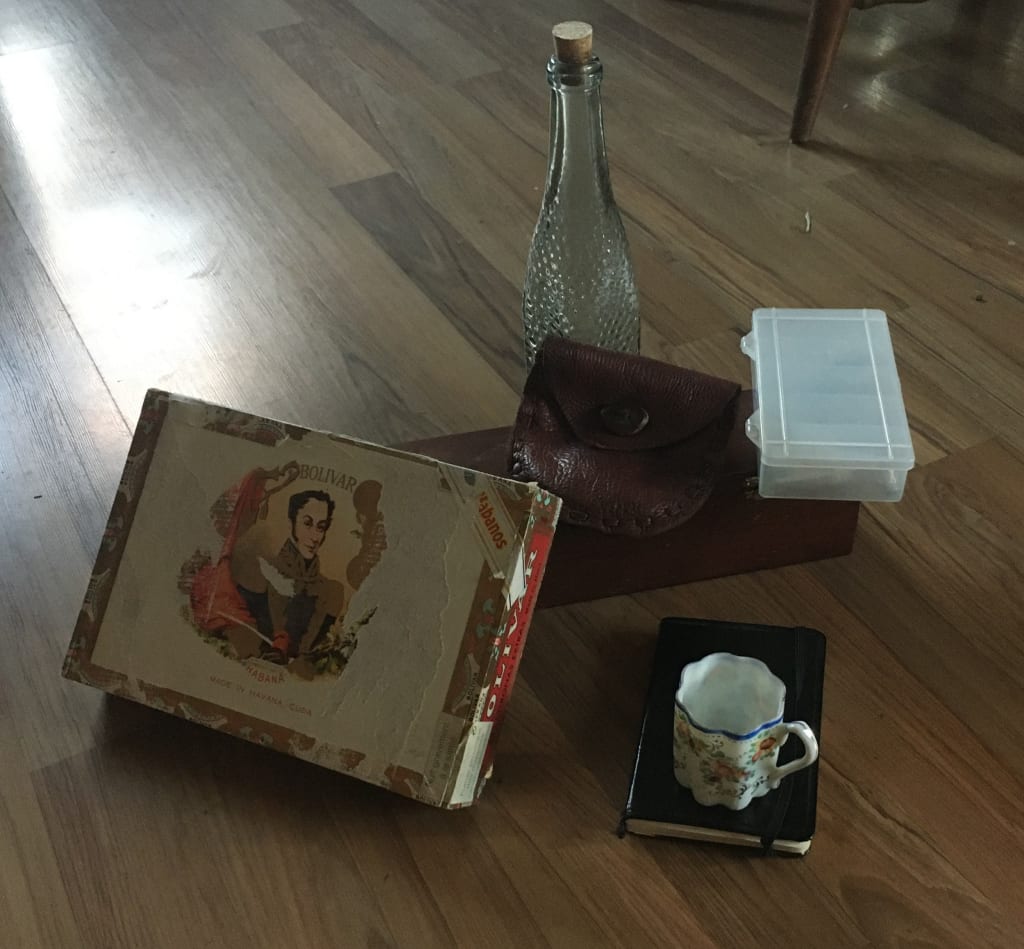
Her rage is spoken through clenched teeth, directly into a solid, wooden box, worn smooth with use, splitting with the effort to hold it all in. If she had realized the need, she would have made it larger, but at the tender age of five she still had hope and the belief of pure goodness. Now the box zaps and sizzles every time she screams into it. Torn, ragged edges of anger arc and escape before the lid has closed.
Regret and misery are held in a bottle made of clear crystal, cold condensation dripping down the sides. It must be corked with care, lest it break and all that sorrow puddle and drown her chaotic mind and tattered soul.
Joy rolls around like a lone marble in a cigar box made of cardboard. Tiny, inconsequential, it is lost in the cavernous space, waiting with innocent anticipation for friends to frolic and click with. It waits and waits and waits. It has not been opened in years. The cover carries a thick layer of dust.
A plastic divided container snaps shut with a double snick. Confusion is sorted, resorted, categorized, and catalogued. Wishes and desires swirl like smoke and wisp through grasping fingers into a stainless-steel coffin. It clangs shut with utter finality. Locked with a sturdy deadbolt, the key is embedded within the walls of her left ventricle so that with each lub-dub of her heart the sharp edges are felt, piercing, cold, a reminder of what can never be attained.
Huddled together in a leather pouch, repulsed by one another, yet unable to separate, tremble fear and disgust. They are thrown into the dark, formless space, retrieval and working through them, unlikely.
Trust and anticipation were splashed into a porcelain cup long ago where they evaporated, never to be seen again.
Surprise is one emotion Monika hadn't remembered until the semi jack-knifed on the road right in front of her. For a miniscule portion of a second, she marveled at this unknown emotion, then fear took over. It grew to enormous proportions until detonation. Every container was smashed to bits. Shards and splinters pierced matter. Utter chaos reigned. Then a sweet, empty, weightless nothing.
* * *
Indistinct beeps and whirs came from outside the void Monika resided in. They were comforting, rhythmic, a definite pattern. But the interrupting squeak of footfalls and the susurrus of voices jarred and scared. She shied away from those back into the nothing, the warm cloud of peace and the earthy smell of sawdust tempered by the sharp tang of wood stain.
Nika breathed in the familiar scent and nuzzled in deeper, relishing the soft flannel draped over the hard muscle beneath. Half asleep, pretending to be fully so, she kept her body heavy and motionless.
"Hey Sapling, time to go up to the house and into bed." A callused finger caressed her cheek and her lip twitched the teensiest bit. "I caught you, you little faker you. I know you're not asleep." She hardly dared to breath. Safe arms held her securely and he began walking. "I'll carry you up, but you still have to brush your teeth." Daddy half whispered, "Sleeping children don't hang on so tightly you know." Nika went limp in an instant so he got a better grip and threw her over his shoulder, making her breath whoosh out loudly. Her chubby hands grabbed the back of his shirt. "Let's see what happens to kids who fake sleeping, making their poor, old, tired daddy carry them to bed." As his foot hit the top step, he began to tickle her. By the time they reached her room she was giggling and writhing in earnest. In another quick, sure movement Nika was flying across empty space to land with a bounce in the middle of her bed.
She scrambled up onto her knees, gasping for breath.
"Now what do you have to say for yourself?" Her dad stood, hands on hips, a twinkle in his eye.
"You're not old Daddy."
One corner of his mouth quirked up. "Go brush your teeth Sapling. I'll be back in ten minutes and I expect you to be in jammies and ready for bed." Then he turned and walked out. His image began to shimmer and fade.
"No!" Small plump fingers reached out to keep him there.
Long, thin fingers moved against rough, starched sheets in a hospital bed many years later. No one was there to see it. When reviewed by the technician later that same day, the spike in her heart rate would be considered a glitch in the system. After all, she had not moved or responded to any treatment yet and with each passing day her chances of doing so decreased exponentially.
From that day forward, the warm black hole became smaller and less stable until one month later, like the death of a star, it fizzled out, letting in the cold, the harsh light and the smell of medicine and urine. Monika’s body was violently racked with spasms as silent tears ran down her cheeks. Her mouth was open as if to scream, but not a sound emerged. Medical personnel came rushing into her room to hold her down, trying to keep her from hurting herself. The shaking finally subsided, and she fell back into the abyss. It was different this time. This darkness was not as complete or as warm, nor did it feel safe. The noises and smells of the hospital played in the background.
For five days she ventured in and out of consciousness. Doctors and nurses came. On the sixth day she lay there, eyes wide with fear and confusion.
“Good morning Monika. I’m Darla, you nurse for today. How are you feeling?”
Monika’s eye widened even more, and she shook her head an infinitesimal amount, but it was as if she could not stop.
“You’re shivering. Are you cold Dear? Let me put another blanket on you.” The patient was panting by the time the nurse added the blanket, to warm her thin frame. With the patience of a saint, the nurse continued talking. “You seem a bit confused. Are you wondering what happened and where you are?”
Monika sucked in a breath and abruptly stopped shaking. She gave a slow, definitive nod.
“Alright, you were in a car accident about three months ago. You broke your pelvis, several ribs, and your right arm. Your lungs were punctured, and you had some internal bleeding. You were in a coma for most of that time. Now that you’re awake, we can start getting you back on your feet.”
Monika was breathing rapidly, looking around the room, obviously agitated.
Darla reached into her pocket and pulled out a pen and a scrap of paper, handing it to the woman. It took a few tries, but Monika was eventually able to write. Why can’t I talk? She handed the nurse the paper.
“That’s something to discuss with the doctor.”
Darla could not get the image of Monika curled into a ball and silently crying out of her mind. No one had visited the poor dear the entire time she’d been hospitalized. So, on her way into work the next day, Darla made a quick stop at the bookstore. When she walked into Monika’s room, she wore a little smile. “Hello dear. I brought you something.” She handed her patient a simple, little black book with tiny lines and a set of colored pens. “I hope this helps. I thought you could use it to write things down, either for yourself or to talk with us.”
For the past twenty-four hours, Monika had been desperate to scream, but she could not; no sound would emerge from her throat. Fear and rage were building inside her to enormous proportions, and she needed to release it somehow. All her carefully created containers were gone. She couldn’t even fathom recreating them. Where would she begin? Then this nurse, Darla, walked in and handed her a way. She hoped it would work. She took the gift with trembling hands and blinked a thank you.
Monika began writing in that little, black book and the emotions poured out of her and onto the page. It was well past midnight before she stopped. She felt light and dizzy and dare she say calm? With relief, she dropped off to sleep. No fears or nightmares assailed her.
For the next two weeks Monika continued to write and feel comforted by it. She wrote notes to the staff on scrap bits of paper they supplied. The journal was saved for her personal needs. The things she would never tell anybody were written in that book. She composed letters she would never send, but somehow, they made her feel better for writing them. She listed her fears and it lessened them. She wrote down her secret desires and it made them seem for attainable. That little, black book held who she was and what she wished to be.
By the end of those weeks, she was able to whisper, but she felt no need to scream. Clutching that journal, she left the hospital on weak, shaky legs. Yes, she was a bit afraid, but she was also willing to take chances and grow.
When Darla arrived for her shift five days later, she found an envelope with her name on it. The note was brief:
Dearest Darla,
You saved my sanity when you gave me that little black book.
Thank you,
Monika
PS. It’s not the jackpot, but it’s something
A lotto ticket was also in the envelope and when Darla checked the numbers, she saw that she had won $20,000! She knew just what she would do with that money. Her granddaughter needed help paying for college. This windfall came at a much-needed time. She kept $100 out to get herself something special. Plus, she kept another $200 out to buy as many little, black books she could with it. They would be left at the hospital for any patient who might need them.
About the Creator
Keep reading
More stories from writers in Humans and other communities.
Time to change your life.
Is it even possible for you to change your life? A lot of people, more than there should be, are unhappy with their lives. But what are they doing about it? Usually nothing. People talk about how shitty their lives are and want change, but are they not taking the actions to change?
By Jen Phillipsa day ago in Humans
Improving Mental Health By Choosing Supportive And Healthy Relationships Intentionally
Being selective about relationships implies that we have been very selective in relationships where we are likely to gain emotional wellness, trust, and respect. Relationships have an extensive influence on our mental health, as supportive relationships give rise to resilience, confidence, and stability, whereas toxic relationships enhance stress, anxiety, and depression. Being conscious of our choice of who we admit to our living space, we build a world that fosters self-development and emotional safety.
By Willian Jamesabout 9 hours ago in Humans



Comments
There are no comments for this story
Be the first to respond and start the conversation.