

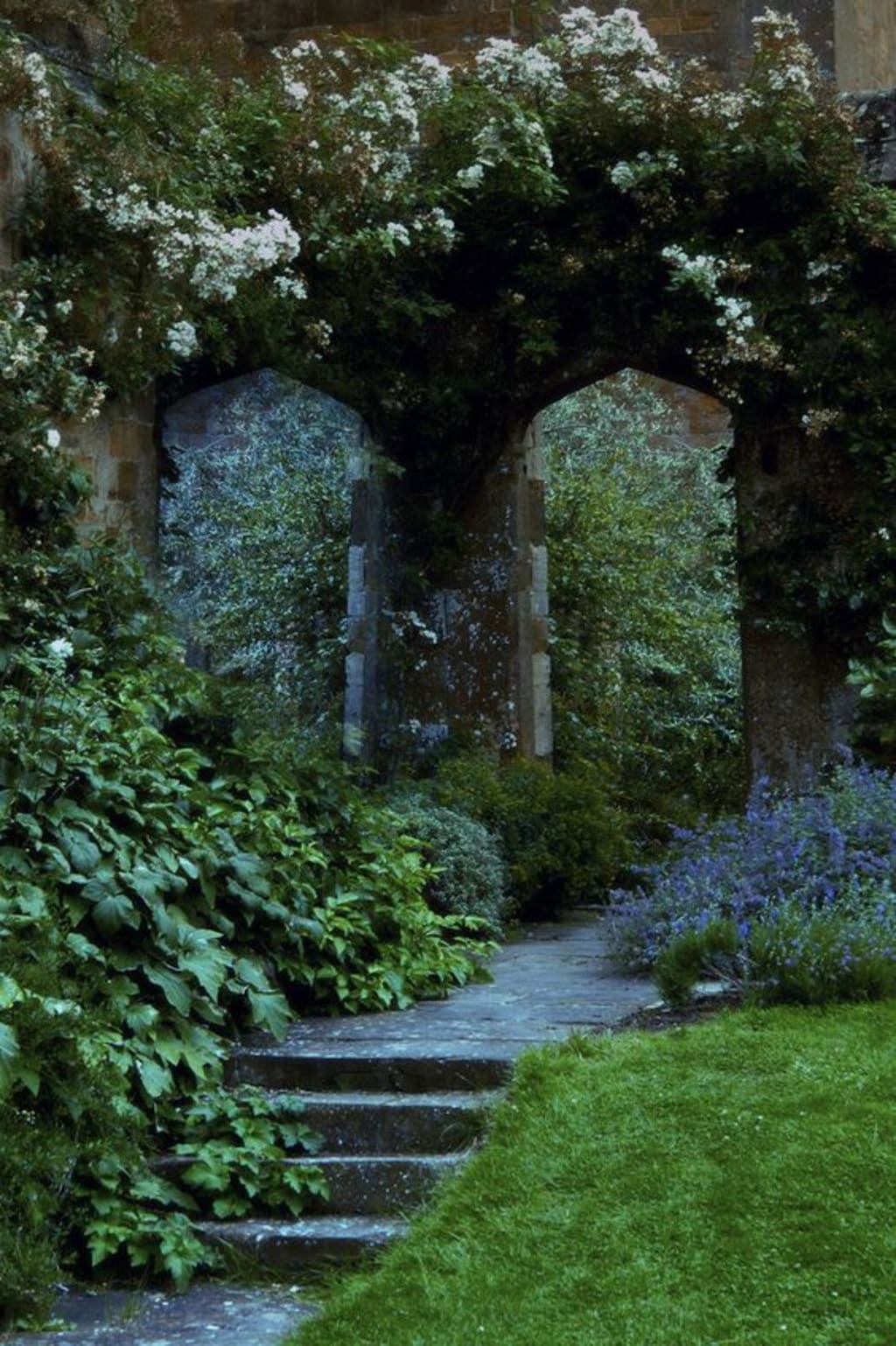
It was the man in the bowler hat that started the whole business. No one saw him arrive- but there he was at the front of the garden, with a briefcase and a long, black coat over his arm. His eyes pointed outward and over us, floating, superior.
That penetrating, alien presence was slowly felt by the group, and we turned, as children do when they realise the teacher has fallen silent. Waiting. He didn’t stay long, ten minutes in total. He explained in measured tones the contents of the book, the repercussions of opening it, and why we might like to. Someone giggled.
“Goodie, a game,” they whispered. “Who hired this bloke?”
When he’d finished speaking, he opened his briefcase (lid facing us) and removed the book. It was the size of a pocketbook, with a muted black leather binding. There was nothing to suggest its curious nature, except for its attachment to the strange man who’d appeared to deliver it. He placed the book on the glass top of the table beside him and looked at us once more.
“You may begin,” he said, and walked back along the garden path and into the house.
We watched him go, his figure a purple smudge under the hazy evening, to the top of the garden and up the steps. No one spoke until the house swallowed him, and then we turned to the book. Thirty people began speaking at once.
“A garden of Eden,” Ruthie said excitedly. “A test of wits. Who will resist the tree of life?”
“Wasn’t it the tree of knowledge of good and evil?” someone replied.
“Isn’t that all the same thing?” she posed philosophically.
Flies gathered by the sandwiches. The punch was warm. It was a sticky evening, plum in colour and wet in weight. I should mention before going any further that this was a party. It was on the occasion of Ruthie’s recently announced pregnancy. There were duck shaped biscuits and a polka dot tablecloth. A homemade banner with yellow paint scrawled across it.
“What do you think?”
It was Eli, a friend of Roger’s. He was tall with feet to match and an uneasy smile, clearly shy. He worked with numbers. Accountancy or banking.
“Hm?”
“What do you think?” he said again. “Do you think it’s all a joke?”
He stood very close, his voice quiet. He was eager, uncertain. He didn’t want to offend any orchestrators with his doubts.
“I don’t know,” Ruthie said. She hadn’t had time to think. This was all quite silly, really.
“It can’t be real,” he persisted. Convincing himself. “$20,000 in that little book? It’d have to be a check, wouldn’t it, to fit? Certainly not cash, no. And who paid for this?”
He was looking about now at the swarm of guests, estimating their worth, their role.
“Are any of your relatives…wealthy?” he whispered the word as if it were dangerous.
“Are you?” she returned, mock horror in her voice. He shrank back, his confidence shrivelled.
“I- I apologise. That was rude.”
Ruthie smiled. “You’re forgiven.” She turned away before he could answer.
There was a great bustle as everyone organised themselves. We ended up sitting on the grass, frocks and slacks disregarded.
“Alright, everyone,” said Ruthie, standing at the front by the glass table. She smiled in that way that made people say she’d make a lovely mother. “This appears to be a game of some sort, but I suggest we approach it carefully.” A common blue butterfly spun past her face.
“Now,” Ruthie continued. Her bump was barely perceptible through her sundress. “Does anyone know who did this?”
The words were met with a curious silence, each of us wondering who was responsible.
“This is all ridiculous,” a voice emerged. A middle-aged woman in a large sunhat and pearls. “No one can predict death.”
“That’s not what my psychic says,” muttered someone else.
“Someone just open the book.”
The stars were beginning to peek out from beneath the lid of the sky. Finally, a breeze drifted through the garden, under the hedges and the hair on our necks, lifting the subtle scent of sweat. We were quiet again.
Roger stood up. “I don’t see what’s so bad about knowing when you might die. Might be better than not knowing,” he reasoned, and walked forward. The book stared at him, and us at it, until Ruthie put a hand on his arm.
“It’s just a game,” she said. “You don’t have to do it.”
His face became soft and he pinched her cheek. Then he opened it.
There was a brief moment so full of tension, weight of it was felt on the top of our heads, at our fingertips, in the mingled breath of the party. He was reading, his back to us. Only Ruthie saw his face, but her scream was enough. Knees buckled, thud on the grass, his body like a tree falling, until his cheek pressed into the dirt.
She stumbled forwards and landed beside Roger. She pressed her fingers to his neck, still warm, still clammy…still. He was dead.
A number of snatched phrases made their way to Ruthie, but she was busy trying to breathe, trying to make him breathe. Ha, ha, ha, ha, staying alive, staying alive. Ha, ha, ha, ha, staying alive, staying alive. That’s what they taught her in First Aid. 1,2,3,4,1,2,3,4.
“Is he dead? The man didn’t say that would happen. He just said we’d know when.”
“Maybe this was Roger’s time.”
“The poor baby. A terrible fate, to grow up without a father.”
“I bet only one of us can take the money. It wouldn’t be a real game otherwise.”
She leaned back. Logic was fighting her, fighting Roger’s body in the grass. It was a coincidence- he’d had a heart attack, a stroke. Ruthie was clutching her knees; her knuckles were white. The terror in her face was like a rabbit’s. “His face,” she sobbed.
Four more people opened the little black book. It went like this:
“It has to be the right person! Who deserves it?”
“To die or to get the money?”
“Shut up, Lou. Have some sensitivity.”
“Sensitivity? We’re all still playing, aren’t we? I’d say we lost our chance at sensitivity when we didn’t burn the thing.”
“Ruthie deserves it more than anyone. She has to raise the baby by herself now.”
“Look. We all have struggles. The money could be anyone’s.”
“What if whoever wins splits it amongst the group evenly? That’s fair.”
“Alright Howard, you go first then. If you’re so ‘fair’.”
Howard did go first. Ruthie held on to Roger, cradling his head in her lap. Her face was frozen, shoulders pinched. No one offered to move him into the house. They were distracted. The fairy lights had come on in the absence of daylight, the evening turned cold. But we stayed in the garden, letting the star jasmine and wisteria night-bloom and blow fragrance into the dark without notice. All that mattered was the book, the bloody book and Roger’s body. Howard picked up the book and faced us. He said, “I’m not afraid” and opened it. Again, there was a pause while he read. And then a terrible pain was on him, eating him whole. He didn’t make a sound. The ragged shape of his mouth was a black pit. He died still standing, and after he was gone, the body folded up and fell. More screaming.
“This is sick. Someone call the police.”
“Don’t! Someone could still win!”
“I’m leaving. Come on, George.”
An exchange of hands ensued, slippery, clean notes out of Carmon Brown’s wallet and into the hands of Wendy Fowler, for her silence. She took George Fowler’s arm and yanked him away without another word.
I won’t go into great detail over the events of the next hour. I’m not fond of violence, or the memory of it, so I will be brief. In the end, three of us remained. Ten left the party, their pockets heavy, their eyes fixed ahead as they stepped over the bodies. More than you might expect tried the book. Carmon amongst them. The human capacity to feel untouchable is so great that we deny death until the moment it looks us in the face. A brawl broke out between four guests. I don’t know what happened to start it, but the end was entirely silent. There was no victor.
Reader, I am very sorry to have to tell you all of this. But you see, when you are trapped in a garden with a book, $20,000, death, and the unspeakable need to win, strange and terrible things happen. As I said, in the end there were three.
Eli, Ruthie, and myself.
“It has to be one of us,” Eli said, his eyes unblinking, mouth dry. “Ruthie.”
She looked up at him. “I won’t do it,” she whispered. “I can’t. I don’t care if you get the money.”
His face took on a feral countenance, a gaze that devoured. “It’s me then. I win. I’m the last one.”
He approached the glass table and lifted that silent book of glory and death. “I won,” he repeated to himself. The only sound was a gasp in the back of his throat and he was gone, just like the others.
Ruthie stood up. Her head was light, her legs heavy. She tried to remember she was real. She would go into the house and call the police and…Eli had dropped the book when he fell. It lay open on the grass beside him.
“I won’t touch it,” Ruthie assured me. “I’ll never touch it.”
She edged closer. The open page was blank, except for a check that nestled there, made out for $20,000. There was no forewarning of the day of Ruthie’s death, as the man in the bowler hat had told us. A gust of wind blew in from the poplar trees, picked up the check in its cool hands, and placed it at Ruthie’s feet. She trembled. It was then that she understood: knowing your death makes your life finite. Until then, you are immortal. She didn’t look at her death, or mine, and so we lived.
She stood in the middle of the garden with the check and my life in her hands and she looked up at that banner, the cheery yellow paint which read: Congratulations! You’re a mother!
“I’ll never forsake you,” Ruthie whispered to me, her hand on her belly.
It wasn’t till many years later that she told me the story about the garden party and the little black book.
“You were there,” she said smiling. “You were the one that stopped me, that made me know it wasn’t worth it.”
Fair warning, dear reader. It’s not until you put human life above power, wealth, vanity, even knowledge, that you truly survive. That you truly win.
The garden is beautiful now, as it was then. There are daisies and butterflies and hedges full of rabbits. Sometimes we sit out there, Mum and I, and listen to the birds. It’s peaceful. The clouds wheel overhead and we are part of something big and wonderful, she and I. “This book will tell you the moment you are going to die,” the bowler hat man had said. “It contains a prize of $20,000. Should you open the book, the money will be yours. But remember,” he said, “the choice is also yours. The book holds no power which you don’t give it.”
Someday I will have children of my own. I will meet them in my belly and I will know the power of motherhood, of a deep and furious love that protects above all else. I will choose them over glory, over everything. Then, and only then, will something inside whisper: “Congratulations. You’re a mother.”
About the Creator
Time to change your life.
Is it even possible for you to change your life? A lot of people, more than there should be, are unhappy with their lives. But what are they doing about it? Usually nothing. People talk about how shitty their lives are and want change, but are they not taking the actions to change?
By Jen Phillipsabout 19 hours ago in Humans
The Social Killer
Are you scared to go out to a meeting to speak to a client? Do you need to deliver a speech but feel like fainting at the thought of going in front of the class to present? Are you scared to attend a social gathering for no clear reason? You might have social anxiety disorder.
By LaMarion Ziegler6 days ago in Humans


Comments
There are no comments for this story
Be the first to respond and start the conversation.