
Are Toilets Built for Toddlers Now?
A Grown-Up Look at a Quiet Design Failure

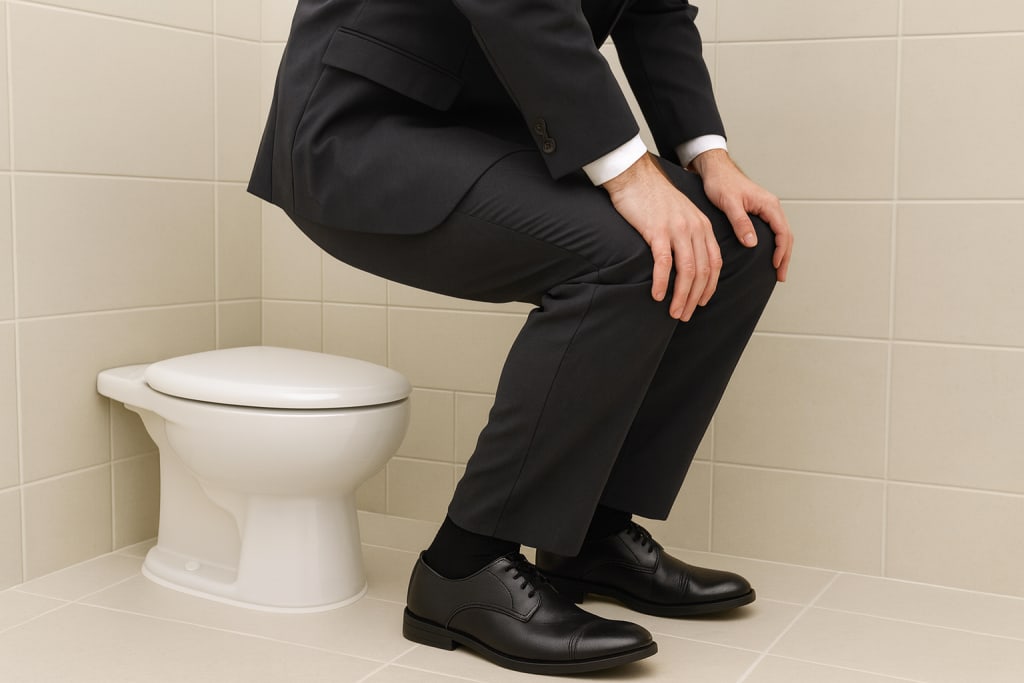
Sit on a public toilet today and you might swear someone swapped it with a daycare chair. Most non-ADA bowls perch only 14 to 15 inches off the floor—barely above preschool height. If your joints are mint-condition, fine. But add arthritis, bad knees, a hip replacement, or just plain mileage, and every sit-to-stand becomes a micro-battle.
What should be routine suddenly feels like punishment.
Back in the 1960s and 1970s, default bowls were a notch taller. Nobody called them “comfort height” yet; they simply matched adult anatomy. Over time, cheaper parts, minimalist design trends, and stagnant building codes nudged “standard” downward. Comfort became an upcharge. Today, if you want a toilet that respects your knees, you’ll often find yourself paying more for what used to be standard.
The reasons are neither mysterious nor noble. Manufacturers shave costs because shorter bowls are cheaper to produce, ship, and install. Designers chasing sleek aesthetics push “low” as modern. Building codes—many untouched for decades—still accept 14 to 15 inches unless ADA rules apply. And consumers rarely notice until their knees or hips start objecting.
Meanwhile, marketing continues to sell “comfort height” as a luxury upgrade instead of the baseline it should be.
And no, the “squatting is healthier” grenade does not hold. Squatting requires strong, pain-free joints. The people hurt most by low bowls—older adults, post-surgical patients, people with arthritis or spinal issues—cannot squat safely in the first place.
Turning necessity into a trend only highlights how divorced design has become from lived reality.
Orthopedic and rehabilitation research backs up what anyone with bad knees already knows. Chair-height bowls in the 17 to 19 inch range cut knee flexion strain by roughly 40 percent. Seniors using taller fixtures report less fatigue, steadier balance, and more confidence. Occupational therapists have recommended higher bowls for decades because they align with biomechanics instead of fighting them. The difference is not subtle; it shows up in reduced pain, fewer falls, and greater independence.
One persistent rumor blames immigration, claiming toilets shrank to suit shorter bodies.
The timeline collapses under scrutiny. U.S. standards for 14 to 15 inches predate post-1980 immigration waves. Squat toilets common in Asia never entered American building codes. Internal manufacturing records and code hearings show no link between demographics and fixture height.
Cost-cutting and design aesthetics explain the shrink; ethnocentric tall tales do not.
What ultimately matters is joint mechanics. Angles decide whether you rise smoothly or brace yourself against the wall. Chair-height toilets align with ordinary seating, trimming torque on hips and knees. They reduce strain for the 54 million Americans with arthritis, the 30 million managing chronic spine issues, and anyone recovering from surgery—or even just a brutal workout.
Raising the seat a few inches is not a luxury; it is an ergonomic safeguard that touches millions of lives.
Bathrooms sit at the crossroads of privacy and vulnerability. When fixtures ignore aging bodies, it’s not just an annoyance; it becomes silent discrimination. Some people skip water intake to avoid the restroom altogether. Others risk falls they cannot afford, all because a contractor saved a few dollars on porcelain or a designer wanted a sleek showroom look.
The failure is not just physical—it’s ethical.
When everyday fixtures disregard the realities of aging and disability, they rob people of autonomy in their most private spaces.
If you are building, renovating, or simply shopping, choose the higher seat. It is not luxury; it is logic. A toilet should never feel like a squat challenge or a dignity test.
Design for real bodies, not showroom fantasies, and daily life becomes a whole lot easier.
It is one of the simplest choices that can restore dignity, prevent injury, and give people back control in a place where privacy matters most.
---------------------------------------
Sources That Don’t Suck:
Centers for Disease Control and Prevention. (2021). Arthritis Prevalence and Activity Limitations.
Watanabe, Y., et al. (2019). “Effects of toilet seat height on lower extremity muscle activity during sit-to-stand movement in older adults.” Journal of Physical Therapy Science.
Smith, D.L., et al. (2018). “Impact of ergonomic toilet height on knee joint stress.” American Journal of Occupational Therapy.
National Institute on Aging. Mobility, Disability, and Aging Statistics.
ADA.gov. Guidelines for Accessible Restroom Design.
About the Creator
Dr. Mozelle Martin
Behavioral analyst and investigative writer examining how people, institutions, and narratives behave under pressure—and what remains when systems fail.
Keep reading
More stories from Dr. Mozelle Martin and writers in Humans and other communities.
Instant Soul Recognition: The Subtle Cues That Signal a Lifelong Connection.
In a world filled with fleeting encounters and surface-level interactions, meeting someone who feels instantly familiar can be a rare and profound experience. This phenomenon—often called recognizing a kindred spirit—goes beyond mere chemistry or shared interests. A kindred spirit is someone whose energy, values, outlook, and inner rhythm align so seamlessly with yours that it feels like your soul has encountered an old friend, even if you've just exchanged names.
By Wilson Igbasi3 days ago in Humans
TUS NUA - ch 53
TUS NUA – ch 53 New Beginnings – Mia and Midnight (*)(*)(*) Finola knew Ali’s brother-in-law needed to put his mind at rest. She fed her arm through his and led him outside. “We’ll sit here. If you like, I can put a block around us so our conversation will be private.”
By Margaret Brennan2 days ago in Fiction


Comments
There are no comments for this story
Be the first to respond and start the conversation.