
(3) Authority Without Consequence
How Power Detached from Liability Produces Elite Insulation


- The Moment Authority Became Untethered -
Every functioning system of governance relies on a constraint so fundamental it often goes unnoticed until it disappears: authority must be exposed to consequence. When those who make decisions experience the downstream effects of those decisions personally, power is naturally disciplined by risk. That discipline does not require virtue or foresight. It operates mechanically. Decisions that produce harm are abandoned because they injure the decision-maker, and decisions that succeed are reinforced because they reward restraint. Modern political systems did not lose this constraint through a single reform or moral collapse. They lost it gradually, through delegation, bureaucratic layering, procedural complexity, and the normalization of distance between action and outcome, until authority could be exercised without meaningful exposure to its effects.
Once this separation is established, behavior changes in predictable ways. Risk ceases to be something decision-makers must manage carefully and becomes something they can redirect elsewhere. Costs are externalized, harms are diffused across populations, and accountability is delayed until it loses corrective force. This transformation does not require malicious intent or coordinated conspiracy. It requires only a structure that allows benefit to be captured immediately while consequence is absorbed collectively and later. At that point, insulation is no longer an abuse of power. It is the rational optimization of it.
- Why Consequence Is the Only Real Constraint -
Norms, ethics, and institutional principles only restrain behavior when they are backed by consequence. Without consequence, they function as language rather than limits. The defining strength of consequence is that it does not rely on character. It assumes self-interest and contains it. When decision-makers know that failure will harm them personally, restraint becomes rational rather than heroic. When they know failure will harm others while leaving them intact, recklessness becomes efficient. This is why consequence is the only constraint that scales across populations and time. It does not require widespread moral agreement to function.
Once consequence becomes uneven, systems stop correcting themselves and begin optimizing for insulation. Power flows toward positions where downside is minimized and upside is retained. Over time, this produces not just poor outcomes, but a durable class of actors who are structurally protected from the effects of their own authority. At that point, the system no longer governs behavior primarily through rules. It governs populations through managed exposure to harm, selectively distributing risk downward while preserving safety upward.
- How Elite Insulation Is Built -
Elite insulation is rarely explicit or formally codified. It is constructed architecturally rather than declaratively. Responsibility is fragmented across committees, agencies, and overlapping jurisdictions so that no single actor can be clearly identified as accountable. Enforcement is slowed through procedural complexity, appeals, and negotiated settlements. Penalties are converted from personal liability into institutional costs that can be absorbed, deferred, or passed along. Time itself becomes a shield, ensuring that consequences, if they ever arrive, do so after benefits have already been secured and decision-makers have moved on.
This architecture allows those within it to plausibly deny responsibility while reliably capturing advantage. Harm is reframed as systemic, unintended, or unavoidable, while benefit remains individualized and immediate. The result is not instability, but a stable pattern of extraction. The system continues to function, but its function shifts. It no longer exists primarily to balance power and responsibility. It exists to protect itself and those most embedded within it.
- Why Enforcement Becomes Selective -
Once insulation exists at the top, enforcement cannot remain uniform without threatening the structure itself. Equal enforcement would reintroduce consequence where it has been deliberately removed, collapsing the protective architecture. Discretion therefore becomes mandatory. Rules must be interpreted rather than applied. Violations must be managed rather than punished. Negotiation replaces accountability, and settlements replace liability. Complexity becomes a feature rather than a flaw because it allows outcomes to be shaped without appearing arbitrary.
As enforcement becomes discretionary at the top, it necessarily becomes rigid at the bottom. The system must demonstrate control somewhere, and it does so where resistance is weakest and compliance is easiest to compel. For ordinary people, law is immediate, procedural, and unforgiving. For elites, it is contextual, delayed, and negotiable. This asymmetry is not hypocrisy in a moral sense. It is functional necessity in a system that depends on insulation to survive.
- The Emergence of a Ruling Class Without Titles -
A ruling class does not require hereditary status, formal hierarchy, or explicit coordination. It requires only consistent exemption from consequence. When a small group can influence policy, shape enforcement, control narrative, and avoid personal liability, it functions as a ruling class regardless of democratic form. Members of this class may compete publicly, disagree ideologically, or belong to opposing institutions, but they share a common interest in preserving the structure that protects them.
This is why challenges to insulation provoke unified resistance even across apparent divisions. The threat is not to ideology or policy preference. It is to position. Systems will tolerate corruption, incompetence, and even failure far more readily than they will tolerate the removal of the mechanisms that prevent accountability from reaching the top.
- Why the Law Begins to Feel Directional -
For those outside this insulated class, the system increasingly feels hostile rather than neutral. Law no longer appears as a shared boundary but as a directional force applied downward. Compliance is demanded without reciprocity. Punishment is swift for minor infractions while major harms disappear into process. People experience the state less as a protector of shared order and more as a manager of behavior in service of interests they do not share.
This perception is often dismissed as cynicism, but it is better understood as pattern recognition. When enforcement is unequal, law ceases to function as law. It becomes a mechanism of control. Coercive power remains intact, but legitimacy erodes. Authority persists, but consent becomes brittle and conditional.
- Why Reform Is Treated as a Threat -
In a system dependent on insulation, reform is not evaluated on moral claims or stated intentions. It is evaluated on risk. Any effort to reattach consequence to power threatens the architecture that keeps authority safe from liability. Such efforts are therefore framed as dangerous, destabilizing, or irresponsible, regardless of how moderate or principled they may be.
Resistance escalates not because reformers are extreme, but because reform is structurally incompatible with insulation. A system that survives by avoiding accountability cannot allow accountability to return without undermining itself. This response is not personal. It is systemic.
- Why This Is Not a Moral Judgment -
Describing this dynamic is not an accusation of universal corruption. It is a structural analysis. Most people operating within insulated systems are responding rationally to incentives. Careers, reputations, and livelihoods depend on navigating the structure successfully. Moral failure is not required. Conformity is sufficient.
This is precisely why reform cannot rely on virtue. Systems that require exceptional moral courage to function are already broken. Only structures that bind power to consequence can reliably produce restraint at scale.
- What This Means for Ordinary Lives -
For people outside the insulated class, this structure manifests as constant pressure with diminishing return. Effort increases while stability declines. Compliance expands while trust contracts. Participation is demanded, but influence feels illusory. Over time, this produces resentment, exhaustion, and disengagement, not because people reject responsibility, but because responsibility is no longer reciprocated.
Understanding this dynamic does not solve it. But it does explain why so many people feel targeted rather than represented, managed rather than governed, and constrained rather than protected. These feelings are not failures of civic virtue. They are responses to structural reality.
- Consequence as the Missing Link -
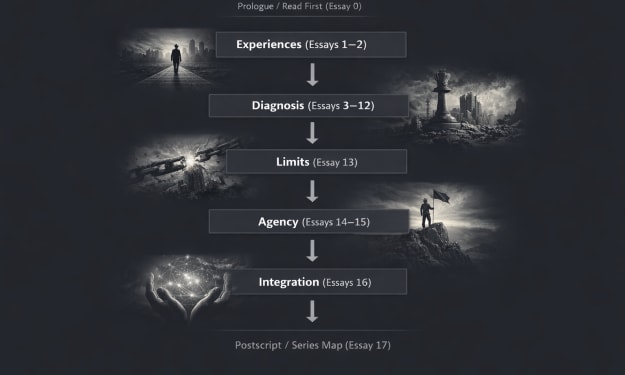
If the previous essay traced how representation became abstract, this essay shows what followed. Authority detached from consequence produces insulation. Insulation produces unequal enforcement. Unequal enforcement destroys legitimacy. This sequence is mechanical, not ideological, and it does not reverse itself through rhetoric, elections, or moral appeals.
Only structural realignment can interrupt it. Authority must once again increase exposure rather than reduce it. Power must carry risk rather than evade it. Without that correction, every reform will be absorbed, redirected, or neutralized. Systems do not fail because people lose faith. They fail because faith is no longer earned.
About the Creator
Peter Thwing - Host of the FST Podcast
Peter unites intellect, wisdom, curiosity, and empathy —
Writing at the crossroads of faith, philosophy, and freedom —
Confronting confusion with clarity —
Guiding readers toward courage, conviction, and renewal —
With love, grace, and truth.
Keep reading
More stories from Peter Thwing - Host of the FST Podcast and writers in Humans and other communities.
(2) From Stake to Abstraction
- The Original Logic of Representation - For most of human political history, representation was not conceived as a mechanism for expressing individual preference or personal identity. It was understood as an extension of responsibility. Political participation flowed to those who bore the material risks of maintaining the community, because those risks imposed discipline on decision making. To have a voice in governance meant being exposed to the consequences of governance. That exposure included taxation, compulsory service, property seizure, legal punishment, and, in many cases, the obligation to physically defend the community. Representation was therefore not grounded in abstract equality, but in the practical need to align authority with liability so that decisions would remain tethered to reality rather than sentiment or impulse. The system did not assume wisdom or virtue. It assumed self-interest and constrained it by consequence.
By Peter Thwing - Host of the FST Podcast2 months ago in Humans
Early March 2026: 4 Goals Accomplished
It's early March and I've now accomplished my 4th writing goal for the year of 2026. Before diving into the behind-the-scenes of it... why not tell you up front what that accomplishment was? I was published in a 2nd publication for this year. Published in Helix Literary Magazine out of Central Connecticut State University. You can read it for free right now!
By Stephen Kramer Avitabile7 days ago in Writers



Comments
There are no comments for this story
Be the first to respond and start the conversation.