
(16) A Coherent Orientation
How Structural Diagnosis, Personal Agency, and Meaning Fit Together as One Worldview

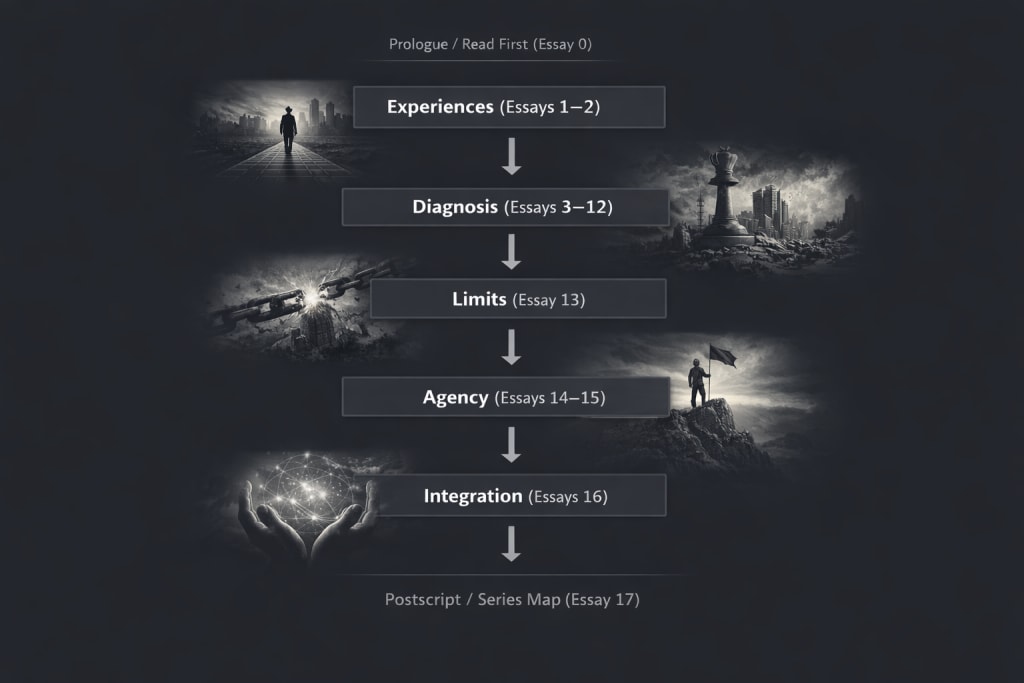
- Seeing the Whole Rather Than the Pieces -
At this point in the series, it becomes possible to see what could not be seen at the beginning. Each essay examined a distinct failure mode, but none of them were independent. Representation becoming abstract, authority detaching from consequence, law becoming unequal, fear governing populations, coercion turning inward, participation hollowing out, and collapse arriving through withdrawal were not separate phenomena. They were expressions of the same underlying design failure viewed from different angles. What initially appeared fragmented resolves into a single, intelligible pattern once the system is observed as a whole.
This matters because fragmented explanations produce fragmented responses. When people treat each failure as isolated, they search for isolated fixes. When they see the structure, they understand why fixes fail. A coherent orientation does not simplify reality. It organizes it. It replaces confusion with clarity, not by reducing complexity, but by integrating it.
- The Systemic Chain That Cannot Be Broken at One Link -
The core chain is now visible. When power is insulated from consequence, authority drifts. When authority drifts, law becomes unequal. When law becomes unequal, fear replaces legitimacy. When fear governs, participation becomes ceremonial. When participation loses substance, withdrawal follows. When withdrawal spreads, collapse occurs through exhaustion rather than revolt. None of these steps require malice. They require only misaligned incentives allowed to persist.
Understanding this chain explains why partial reform fails. Adjusting one link without addressing the others only shifts pressure elsewhere. More participation without consequence increases exhaustion. More enforcement without legitimacy increases coercion. More redistribution without exposure increases extraction. The system absorbs reform because reform is not aimed at the structure that generates outcomes. Orientation requires accepting that the chain must be addressed as a whole or not at all.
- Why Diagnosis Had to Come First -
Many people want solutions immediately. They want to know what to do before they know what is happening. This impulse is understandable but dangerous. Acting without diagnosis leads to wasted effort and false hope. The first half of this series resisted prescription deliberately, not to withhold answers, but to prevent misdirected action.
Diagnosis establishes constraint. It defines what cannot work. It narrows the space of plausible responses. By the time agency and meaning were introduced, the reader was already grounded in what systems can and cannot do under current conditions. This prevents illusion. Orientation built on diagnosis is durable because it does not rely on outcomes that the system cannot produce.
- How Personal Agency Fits Without Contradiction -
Personal agency enters only after the limits of systemic correction are understood. This ordering matters. Agency framed too early becomes moralized responsibility for failures individuals did not cause. Agency framed too late becomes resignation. Placed correctly, agency becomes stewardship rather than control.
Agency without illusion accepts that individuals cannot fix systems alone. It also rejects the idea that individuals are powerless. It locates agency where effort still compounds, where value can still be built, and where meaning can still be preserved without feeding the system’s worst incentives. This agency is selective, disciplined, and relational rather than performative or oppositional.
- Meaning as the Stabilizing Layer -
Meaning is the final stabilizing layer because it addresses what neither diagnosis nor agency can resolve alone. Systems can fail without destroying life if meaning is not entirely dependent on them. Conversely, even functioning systems cannot sustain people who lack orientation. Meaning grounded beyond institutions allows individuals to endure periods when legitimacy collapses and outcomes remain uncertain.
This is not an abstract add-on. It is structural at the human level. Just as systems require incentives to function, individuals require meaning to remain coherent. When meaning is outsourced entirely to institutions, institutional failure becomes existential crisis. When meaning is anchored elsewhere, systems lose the ability to define reality completely.
- Why This Worldview Resists Extremes -
One of the strengths of a coherent orientation is that it resists false extremes. It does not collapse into naive optimism or total cynicism. It does not demand blind participation or total withdrawal. It does not sanctify authority or romanticize rebellion. Each of these extremes is attractive because it simplifies decision-making. Each fails because it misreads structure.
This worldview allows for tension without paralysis. It accepts that systems can be illegitimate without being meaningless, that authority can be necessary without being righteous, and that endurance can coexist with critique. This balance is not comfortable, but it is stable.
- The Moral Logic That Emerges -
Across the series, a consistent moral logic has quietly emerged. Responsibility must track power. Authority must carry consequence. Participation must impose constraint to matter. Enforcement must be reciprocal to be legitimate. Meaning must outlast institutions to endure collapse. These are not ideological claims. They are structural principles observed across contexts.
This moral logic does not depend on perfect actors. It assumes human limitation and self-interest. That is why it emphasizes design over virtue. Systems and lives built on these principles remain intelligible even under stress. Those built against them drift toward incoherence.
- Why This Is Not Pessimism -
It is easy to mistake structural clarity for pessimism, especially in cultures accustomed to reassurance. But false hope is not optimism. It is delay. This series does not predict inevitable collapse. It explains the conditions under which collapse occurs and the conditions under which restoration is possible. That distinction matters.
Real hope is grounded in reality. It recognizes constraint and acts within it. By removing illusion, this worldview makes genuine restoration conceivable, even if distant. It also makes meaningful life possible regardless of outcome. That is not despair. It is realism with orientation.
- What This Series Has Actually Been Doing -
Taken as a whole, this series has not been arguing for a policy agenda, a party, or a movement. It has been doing something quieter and more fundamental. It has been making the system legible. It has been reconnecting lived experience to structural cause. It has been naming the incentives that shape behavior so that individuals can stop internalizing failure that does not belong to them.
This legibility is itself an act of restoration. Before systems can be repaired, people must stop misunderstanding what they are living inside. Clarity reduces manipulation. Orientation reduces fear. Understanding restores agency at the level where it is still possible.
- The Threshold Before the Map -
This essay closes the argumentative arc. What remains is not further explanation, but orientation for the reader. The next step is not to add content, but to step back and show the shape of what already exists. A map only makes sense once the terrain has been fully traversed.
With diagnosis complete, agency clarified, and meaning grounded, the work can now be framed as a whole. The final meta essay will not argue. It will orient. It will show how each piece fits, why the order matters, and what kind of reader this work is for. Everything needed for that map is now in place.
About the Creator
Peter Thwing - Host of the FST Podcast
Peter unites intellect, wisdom, curiosity, and empathy —
Writing at the crossroads of faith, philosophy, and freedom —
Confronting confusion with clarity —
Guiding readers toward courage, conviction, and renewal —
With love, grace, and truth.
Keep reading
More stories from Peter Thwing - Host of the FST Podcast and writers in Humans and other communities.
(15) Meaning Beyond Systems
- The Limits of Institutional Meaning - Modern societies quietly train people to derive meaning from institutions. Careers, credentials, civic participation, political identity, and social status are framed not merely as functional roles, but as sources of purpose. When institutions appear stable, this arrangement feels natural. Effort is rewarded, progress is legible, and contribution seems to matter. Meaning and structure reinforce one another. But when institutions fail structurally, this arrangement collapses. The same systems that once promised significance begin to feel hollow, extractive, or hostile.
By Peter Thwing - Host of the FST Podcast2 months ago in Humans
Practical Breakup Healing Advice For Rebuilding Confidence After Heartbreak
A failed relationship may seem like a personal trauma, and people go through it doubting their self-esteem and psychological strength. The initial move towards the healing process is the acceptance that heartbreak is an ordinary thing in life and an unavoidable reality in human relationships. Pain, sadness, and disappointment do not mean that we are weak, but they are emotional cues, telling us that our attachment to a partner is broken. By coming to terms with these feelings, people will be able to work with their emotions rather than suppress them which will slow down the recovery process.
By Mark Hipster8 days ago in Humans


Comments
There are no comments for this story
Be the first to respond and start the conversation.