
(15) Meaning Beyond Systems
How Faith and Orientation Sustain Endurance When Institutions Fail

- The Limits of Institutional Meaning -
Modern societies quietly train people to derive meaning from institutions. Careers, credentials, civic participation, political identity, and social status are framed not merely as functional roles, but as sources of purpose. When institutions appear stable, this arrangement feels natural. Effort is rewarded, progress is legible, and contribution seems to matter. Meaning and structure reinforce one another. But when institutions fail structurally, this arrangement collapses. The same systems that once promised significance begin to feel hollow, extractive, or hostile.
This collapse produces a unique form of disorientation. People are not merely frustrated with outcomes. They lose their sense of why effort matters at all. When institutions no longer reciprocate contribution, meaning evaporates alongside legitimacy. Attempts to restore purpose through renewed participation fail because the underlying structure has not changed. Meaning cannot be sustained by systems that no longer bind power to consequence.
- Why Endurance Requires a Non-Institutional Anchor -
Endurance over long periods of decline requires an anchor that does not depend on institutional validation. Systems rise and fall. Narratives shift. Authorities change language without changing structure. Any source of meaning tied exclusively to these mechanisms becomes fragile by definition. When legitimacy erodes, so does the meaning built upon it.
A non-institutional anchor provides continuity when external structures cannot. It does not require approval, participation metrics, or recognition. It allows individuals to endure without needing to believe that the system will reward them. This anchor is not escapism. It is insulation of the self against structural volatility. Without it, exhaustion accelerates and withdrawal becomes total rather than strategic.
- Faith as Orientation Rather Than Comfort -
Faith is often misunderstood as emotional consolation or denial of reality. In the context of systemic failure, faith functions differently. It provides orientation rather than comfort. It answers the question of how to live rightly when outcomes are uncertain and structures are misaligned. It offers a framework for action that does not depend on success, recognition, or immediate justice.
This orientation matters because systems in decline actively erode moral clarity. They reward compliance over integrity and adaptability over principle. Faith resists this erosion by grounding action in transcendent standards rather than contingent outcomes. It allows individuals to act consistently even when doing so appears irrational within the system’s incentive structure.
- Why Meaning Cannot Be Manufactured -
As institutions lose legitimacy, they often attempt to manufacture meaning through narrative. People are urged to find purpose in participation itself, in being on the “right side” of history, or in symbolic alignment with institutional goals. These narratives provide temporary motivation but lack durability. Manufactured meaning collapses under sustained contradiction between promise and experience.
Authentic meaning cannot be imposed from above or constructed through rhetoric. It emerges from alignment between belief, action, and consequence. When systems break that alignment, meaning must be sourced elsewhere or it will disintegrate. Faith endures precisely because it does not rely on institutional coherence to remain intelligible.
- The Difference Between Hope and Expectation -
One of the most destructive confusions during systemic decline is the collapse of hope into expectation. Expectation assumes that structures will behave predictably and reward effort. When expectation fails repeatedly, hope collapses with it. People conclude that nothing matters, because nothing works as promised.
Faith distinguishes hope from expectation. Hope is not a prediction. It is a posture. It allows individuals to act well without demanding that outcomes conform to desire or timetable. This distinction is crucial for endurance. Expectation binds meaning to results. Hope binds meaning to faithfulness. Only the latter survives prolonged disorder.
- Endurance Without Bitterness -
Systems in decline generate bitterness easily. People feel betrayed, used, and ignored. These feelings are often justified. But bitterness corrodes endurance by anchoring identity to grievance. It keeps individuals emotionally tethered to the system even as they reject it intellectually. Bitterness demands resolution from the very structure that caused harm.
Faith offers an alternative. It allows people to name injustice without becoming defined by it. It affirms moral reality without requiring immediate vindication. This does not eliminate anger or grief, but it prevents them from becoming totalizing. Endurance becomes possible without surrendering humanity.
- Living Under Authority Without Worshiping It -
One of the quiet dangers in institutional decline is the temptation to replace faith with politics or ideology. As traditional sources of meaning weaken, people seek substitutes that promise moral clarity and collective purpose. These substitutes often demand total allegiance while delivering none of the stability they promise.
Faith resists this substitution by placing all temporal authority in proper proportion. It recognizes the necessity of governance without sanctifying it. Authority is respected where it functions justly and resisted where it does not, but never worshiped. This posture preserves moral independence in environments that pressure conformity.
- The Role of Suffering in Clarifying Meaning -
Suffering has a clarifying effect when meaning is grounded beyond systems. It strips away illusions about control, reward, and fairness. In systems that still function, suffering is often treated as aberration. In systems that fail, it becomes common. Faith does not eliminate suffering, but it prevents suffering from becoming meaningless.
This matters because meaningless suffering destroys coherence. When pain cannot be integrated into a larger framework, it fractures identity. Faith integrates suffering into a narrative that does not depend on institutional justice. Endurance becomes possible not because suffering is justified, but because it is not final.
- Why Faith Produces Quiet Strength -
Faith-based endurance rarely appears dramatic. It does not generate viral moments or symbolic victories. Its strength is quiet, cumulative, and resistant to capture. It manifests in consistency, patience, and refusal to surrender moral orientation under pressure. These qualities are invisible to systems optimized for spectacle, but indispensable during collapse.
This quiet strength often becomes visible only later, when institutions fail abruptly and people search for stability. Those who anchored meaning beyond systems are less disoriented, less reactive, and more capable of stewarding what remains. Faith becomes a reservoir rather than a refuge.
- Meaning as the Last Uncapturable Resource -
Systems can extract labor, compliance, data, and attention. They can manage behavior and shape incentives. Meaning, when grounded beyond institutional validation, remains largely uncapturable. It cannot be taxed, regulated, or redirected easily. This makes it the final domain of genuine freedom in declining systems.
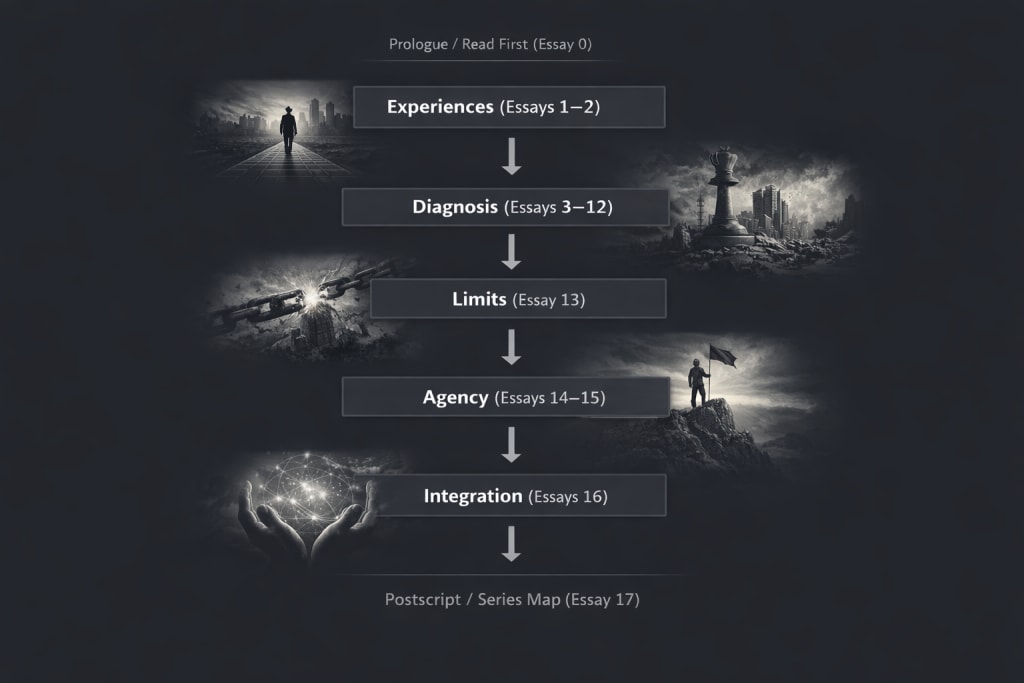
If earlier essays diagnosed structural failure, withdrawal, and the limits of reform, this essay establishes the deeper ground on which endurance rests. Meaning that outlasts systems does not negate responsibility to the world. It makes that responsibility survivable. When institutions fail, those who retain orientation do not simply endure. They preserve the conditions under which renewal, if it comes, remains possible.
About the Creator
Peter Thwing - Host of the FST Podcast
Peter unites intellect, wisdom, curiosity, and empathy —
Writing at the crossroads of faith, philosophy, and freedom —
Confronting confusion with clarity —
Guiding readers toward courage, conviction, and renewal —
With love, grace, and truth.
Keep reading
More stories from Peter Thwing - Host of the FST Podcast and writers in Humans and other communities.
(14) Agency Without Illusion
-The False Choice Between Submission and Revolt- When people recognize that a system is structurally misaligned, they are often presented with a false binary. Either submit fully and play along, or reject the system entirely through open resistance. Both options are framed as moral imperatives, and both are inadequate. Submission feeds a structure that exploits compliance without reciprocity. Revolt invites consequences that rarely produce reform and often strengthen the very mechanisms it seeks to oppose. This false choice paralyzes people because neither option aligns with lived reality or rational self-preservation.
By Peter Thwing - Host of the FST Podcast2 months ago in Humans
Why Didn't Anyone Tell Us
Men, move along. This is not for you. This is for the women. I was forty-five when I began menopause. It is pretty young for that to be going on in a woman’s life, but I had undiagnosed PCOS, my entire life. Thank you to all the gynecologists I had seen my entire life. That in itself should encourage women to keep seeking second opinions, especially when you are not getting correct answers or any at all.
By Alexandra Grant2 days ago in Humans
5 Signs You Found a Kindred Spirit in an Unexpected Place.
Human connection shapes the direction of many lives. Some relationships grow from family, school, or work. Others appear without warning in places no one plans for. A short conversation with a stranger at a café, a message from someone across the world, or a brief meeting during travel shifts into something deeper.
By Wilson Igbasi5 days ago in Humans




Comments
There are no comments for this story
Be the first to respond and start the conversation.