
(12) The Illusion of Participation
Why Modern Systems Preserve the Form of Democracy While Emptying Its Substance

- Participation as Ritual Rather Than Power -
Modern political systems place extraordinary emphasis on participation while quietly reducing its effect. Voting, public comment, civic engagement, and discourse are celebrated as evidence of legitimacy, yet their practical influence on outcomes steadily declines. Participation becomes ritualized. Citizens are invited to act, to speak, to choose, but the structure ensures that these actions rarely alter underlying incentives or constrain authority. The appearance of involvement is preserved even as the substance of influence is removed.
This transformation is subtle because participation still feels meaningful at the emotional level. Casting a vote, signing a petition, or voicing an opinion provides psychological relief and a sense of agency. But systems are not governed by feelings. They are governed by constraints. When participation does not meaningfully bind power or alter consequence, it functions as ceremony rather than control. The system absorbs engagement without being shaped by it.
- How Choice Is Narrowed Without Appearing Removed -
The illusion of participation is maintained by narrowing choice rather than eliminating it. Options are constrained upstream through party structures, funding mechanisms, media framing, and procedural barriers. By the time a decision reaches the public, the range of outcomes has already been filtered to those compatible with existing power arrangements. Participation remains real, but it operates within a pre-approved corridor.
This narrowing avoids overt repression. People are not told they cannot choose. They are told these are the only viable choices. Dissenting options are marginalized as impractical, extreme, or irresponsible. The system thus preserves the language of freedom while shaping outcomes in advance. Participation becomes selection among managed alternatives rather than genuine authorship of direction.
- The Role of Complexity in Neutralizing Influence -
Complexity is one of the most effective tools for neutralizing participation without openly suppressing it. As systems grow more intricate, causal relationships become opaque. Policies span agencies, timelines, and jurisdictions. Accountability diffuses. Even when participation technically influences a decision, tracing that influence becomes nearly impossible. Outcomes appear disconnected from inputs.
This opacity discourages sustained engagement. People struggle to see how effort translates into effect. When participation feels disconnected from results, motivation declines. The system does not need to prevent engagement. It only needs to make engagement feel futile. Complexity accomplishes this quietly, preserving formal rights while eroding practical power.
- Why Elections No Longer Function as Corrective Mechanisms -
Elections are often treated as the ultimate check on authority. In theory, they allow populations to remove leaders who fail and replace them with those who promise improvement. In practice, elections increasingly shuffle personnel without altering structure. New leaders inherit the same incentives, constraints, and insulation as their predecessors. Outcomes remain stable even as rhetoric changes.
This pattern teaches the public an unintended lesson. Voting changes language, not direction. Promises shift, but behavior persists. Over time, elections lose their corrective function and become symbolic reaffirmations of legitimacy rather than mechanisms of accountability. Participation continues, but expectation declines.
- Participation Without Consequence -
For participation to constrain power, it must impose consequence. Authority must face tangible cost when it disregards public will. In modern systems, that link is weakened or broken. Leaders may lose elections but retain influence, wealth, and protection. Institutions persist regardless of public approval. Policy trajectories continue with minimal deviation.
Without consequence, participation becomes advisory at best. Public input is gathered, acknowledged, and archived without obligation to respond. The system listens without hearing. Engagement is encouraged precisely because it poses little risk. Participation becomes a pressure-release valve rather than a lever.
- The Emotional Management of Disengagement -
As participation loses substance, systems compensate by managing emotion. Civic engagement is framed as moral duty rather than practical tool. Voting is praised regardless of outcome. Expression is celebrated even when ignored. The emotional benefits of participation are emphasized to offset its declining efficacy.
This emotional framing discourages structural critique. Questioning whether participation actually matters is reframed as cynicism or irresponsibility. People are urged to believe harder rather than demand constraint. The illusion of participation is preserved by treating doubt as a character flaw instead of a rational response to observed outcomes.
- Why Withdrawal Follows Hollow Participation -
When people realize that participation does not translate into influence, withdrawal becomes rational. Engagement costs time, energy, and emotional investment. If those costs are not offset by meaningful impact, people conserve resources. They disengage not because they reject collective life, but because collective mechanisms no longer respond.
This withdrawal reinforces elite insulation. As participation declines, those with disproportionate influence face less resistance. The system becomes easier to manage precisely because fewer people expect it to change. Hollow participation thus accelerates the erosion of legitimacy rather than restoring it.
- The Feedback Loop of Performative Democracy -
Performative participation creates a feedback loop. Systems showcase engagement metrics to claim legitimacy. Engagement persists at a superficial level because alternatives are limited. Outcomes remain unchanged, reinforcing cynicism. Cynicism reduces pressure. Reduced pressure allows further insulation. The cycle repeats.
This loop explains why democratic forms can coexist with deeply unresponsive governance. The rituals remain intact. The substance drains away. Participation becomes theater, necessary for appearance but irrelevant to control.
- Why Reform Through Participation Alone Fails -
Calls to “engage more,” “vote harder,” or “stay involved” misunderstand the problem. Participation is not absent. It is neutralized. Increasing the volume of participation without restoring consequence does not alter outcomes. It merely increases emotional expenditure while accelerating exhaustion.
Reform that relies solely on participation asks the public to compensate for structural failure through effort. This reverses responsibility. Systems must be designed to respond to participation, not demand faith in it. Without structural constraint, participation cannot perform corrective work.
- Reattaching Participation to Power -
For participation to regain substance, it must be reattached to consequence. Authority must experience risk when it ignores public input. Structures must allow participation to alter incentives, not just express preference. This requires limits on insulation, transparency in enforcement, and mechanisms that bind decision-makers to outcomes.
Such changes threaten entrenched power. They cannot be achieved through participation alone. They require structural redesign. Until that occurs, participation will remain hollow, and withdrawal will continue.
- The Difference Between Voice and Control -
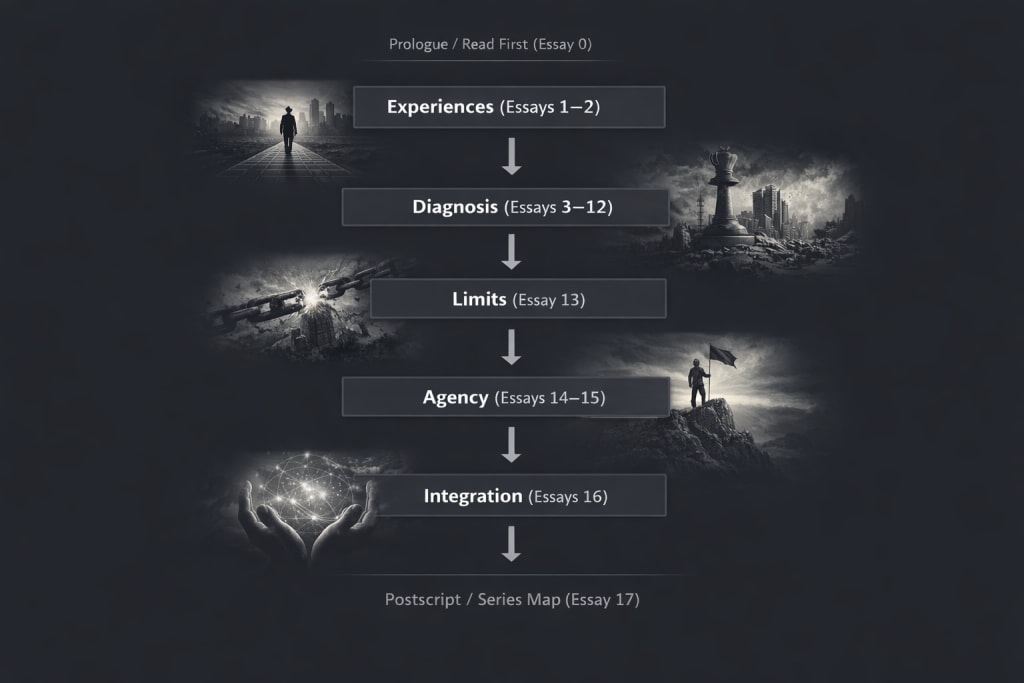
If earlier essays traced how legitimacy erodes, how coercion replaces consent, and how systems collapse through withdrawal, this essay clarifies why participation fails to stop that process. Voice without control is not governance. It is venting. Control without voice is domination. Sustainable systems require both.
When participation becomes ceremonial, it no longer anchors legitimacy. It merely decorates authority. Restoring substance requires more than encouraging people to speak. It requires ensuring that speaking changes what power is allowed to do.
About the Creator
Peter Thwing - Host of the FST Podcast
Peter unites intellect, wisdom, curiosity, and empathy —
Writing at the crossroads of faith, philosophy, and freedom —
Confronting confusion with clarity —
Guiding readers toward courage, conviction, and renewal —
With love, grace, and truth.
Keep reading
More stories from Peter Thwing - Host of the FST Podcast and writers in Humans and other communities.
(11) Collapse by Withdrawal
- The Myth of Sudden Collapse - Popular imagination tends to picture societal collapse as dramatic and explosive. Revolutions, riots, coups, and public uprisings dominate historical storytelling because they are visible and narratively satisfying. They provide a clear beginning, a clear antagonist, and a clear moment of rupture. In reality, most complex systems do not fail this way. They fail quietly, gradually, and often without a single defining event. Collapse is rarely the result of collective rage reaching a boiling point. It is more often the result of collective disengagement reaching a critical mass.
By Peter Thwing - Host of the FST Podcast2 months ago in Humans
Cross-Cultural Dating Challenges Solved With Patience Respect And Open Dialogue
Cross-cultural dating often presents challenges due to differing traditions, values, and communication styles. Patience is essential when understanding your partner’s background and habits. Cultural norms around family, social etiquette, or even daily routines may initially feel unfamiliar or confusing. By approaching these differences with curiosity rather than frustration, couples can prevent misunderstandings and strengthen their connection. Patience allows each partner to adjust gradually, fostering empathy and tolerance. Over time, this measured approach builds a foundation of trust and mutual appreciation, making the relationship resilient to the challenges inherent in blending distinct cultural perspectives.
By Mark Hipster6 days ago in Humans


Comments
There are no comments for this story
Be the first to respond and start the conversation.