
(11) Collapse by Withdrawal
Why Systems Fail Through Exhaustion Rather Than Revolt

- The Myth of Sudden Collapse -
Popular imagination tends to picture societal collapse as dramatic and explosive. Revolutions, riots, coups, and public uprisings dominate historical storytelling because they are visible and narratively satisfying. They provide a clear beginning, a clear antagonist, and a clear moment of rupture. In reality, most complex systems do not fail this way. They fail quietly, gradually, and often without a single defining event. Collapse is rarely the result of collective rage reaching a boiling point. It is more often the result of collective disengagement reaching a critical mass.
This misconception matters because it leads both citizens and institutions to look for the wrong warning signs. Governments prepare for unrest rather than apathy. Media anticipates outrage rather than withdrawal. Elites fear rebellion while ignoring exhaustion. By the time overt conflict appears, the system has usually already lost its legitimacy. The revolt, if it comes at all, is not the cause of collapse. It is a symptom of a failure that has already occurred.
- How Legitimacy Actually Erodes -
Legitimacy does not vanish overnight. It erodes incrementally as expectations repeatedly fail to align with experience. People comply with systems when they believe effort will be reciprocated, rules will be applied fairly, and participation will have meaning. When those assumptions are violated consistently, trust decays not through anger but through learning. Individuals adjust their behavior based on observed outcomes, not official claims.
Over time, people stop expecting institutions to serve them. They lower standards, reduce engagement, and limit exposure. Civic duty becomes conditional. Participation becomes performative or transactional. This erosion is quiet because it is rational. People are not rebelling. They are conserving energy in an environment that no longer rewards contribution. Legitimacy drains away long before authority notices.
- Withdrawal as Rational Adaptation -
When systems become extractive, uneven, or coercive, withdrawal becomes the most rational response available to ordinary people. Open resistance is costly and often futile. Compliance without belief is safer. Disengagement allows individuals to preserve stability within their own lives even as collective structures decay. People focus on family, informal networks, and private arrangements, minimizing interaction with institutions wherever possible.
This withdrawal is often misinterpreted as apathy or moral failure. In reality, it is adaptive behavior. People do not withdraw because they no longer care about society. They withdraw because caring is no longer effective. When effort produces no return and participation carries disproportionate risk, disengagement becomes a form of self-preservation rather than indifference.
- The Hollowing Out of Institutions -
As withdrawal spreads, institutions hollow out from the inside. They continue to operate procedurally, but their social function deteriorates. Laws exist, but compliance becomes minimal and strategic. Elections occur, but participation declines or becomes purely expressive. Public offices remain staffed, but competence erodes as incentives favor loyalty and risk avoidance over effectiveness.
This hollowing process is difficult to detect from within the system because metrics remain superficially stable. Forms are filed. Meetings are held. Budgets are passed. Yet the connective tissue between institutions and the public weakens. Authority persists without belief. Order remains without trust. The system appears intact until it is suddenly unable to respond to stress.
- Why Elites Misread the Warning Signs -
Elites often misinterpret withdrawal as stability. The absence of protest is taken as consent. Low engagement is mistaken for satisfaction. Silence is read as acceptance. This misreading is reinforced by insulation. Those at the top experience the system as functional because they are buffered from its failures. Their interactions with institutions remain smooth, responsive, and flexible.
This creates a dangerous illusion. Elites prepare for revolt while ignoring disengagement. They invest in security rather than legitimacy. They expand enforcement rather than reciprocity. Each response accelerates withdrawal by increasing pressure without restoring trust. The system grows more rigid as its foundation weakens.
- Exhaustion as the Final Threshold -
There comes a point at which withdrawal transitions into exhaustion. People no longer have the energy to adapt further. Informal networks strain under accumulated pressure. Private coping mechanisms fail. The margin for error disappears. At this stage, the system’s inability to respond becomes visible not through revolt, but through breakdown. Services fail. Supply chains fracture. Bureaucracies stall. Emergencies compound.
This is the moment often mistaken for sudden collapse. In reality, it is the delayed expression of long-term erosion. The system fails not because people rise up, but because too many people have already checked out. There is no surplus trust, energy, or cooperation left to absorb shock.
- Why Coercion Cannot Prevent Exhaustion -
Faced with exhaustion, systems often double down on coercion. They attempt to force participation, compliance, and productivity through pressure rather than consent. This response is understandable but counterproductive. Coercion can compel action in the short term, but it accelerates burnout in the long term. It extracts effort without replenishing trust.
As coercion expands, the cost of participation rises further. People withdraw more deeply or disengage entirely. The system becomes trapped in a feedback loop where enforcement substitutes for legitimacy and legitimacy never recovers. Control increases as resilience declines.
- The Difference Between Control and Capacity -
A critical distinction emerges at this stage between control and capacity. A system may retain the ability to compel behavior while losing the ability to function effectively. Orders are given, but execution falters. Compliance is achieved, but outcomes deteriorate. The appearance of authority masks the absence of capacity.
This distinction explains why collapse often surprises those in power. They mistake obedience for effectiveness. They interpret compliance as health. In reality, capacity depends on voluntary cooperation, initiative, and trust. Once those are gone, no amount of control can substitute for them.
- Why Collapse Feels Sudden Only in Retrospect -
To those living through it, collapse often feels abrupt because the preceding erosion was normalized. Each adjustment felt manageable. Each concession seemed temporary. Each failure was absorbed privately. Only when the accumulated effects overwhelm individual coping strategies does the scale of decay become apparent.
Looking back, the signs are obvious. Declining participation. Rising cynicism. Procedural complexity. Expanding coercion. These are not random. They are indicators of withdrawal. Collapse feels sudden only because recognition lags reality.
- The Path That Was Missed -
Collapse by exhaustion is not inevitable. It is the result of repeated refusal to restore reciprocity. Systems fail when they choose insulation over accountability, coercion over legitimacy, and control over capacity. At multiple points, structural realignment could reverse erosion by reattaching authority to consequence and rebuilding trust.
Those opportunities are often ignored because they threaten existing power arrangements. Short-term stability is prioritized over long-term resilience. By the time exhaustion is visible, the cost of repair has multiplied. Restoration becomes harder precisely because withdrawal has already drained the resources needed to attempt it.
- Withdrawal as the Final Verdict -
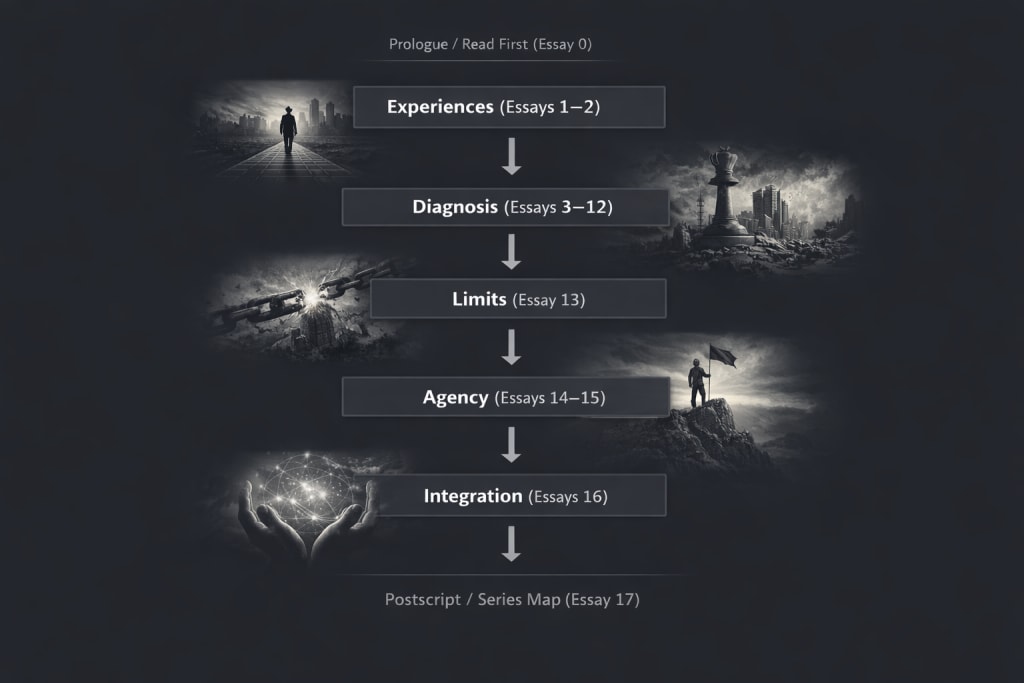
If earlier essays traced how power detaches from consequence, how law becomes unequal, how fear governs populations, how coercion turns inward, and how redistribution bypasses exposure, this essay completes the arc. Systems do not fail because people rebel. They fail because people stop investing in them.
Withdrawal is the final verdict rendered by a population that no longer believes participation is worthwhile. It is quieter than revolt, slower than collapse, and more devastating than either. A system can survive anger. It cannot survive indifference.
About the Creator
Peter Thwing - Host of the FST Podcast
Peter unites intellect, wisdom, curiosity, and empathy —
Writing at the crossroads of faith, philosophy, and freedom —
Confronting confusion with clarity —
Guiding readers toward courage, conviction, and renewal —
With love, grace, and truth.
Keep reading
More stories from Peter Thwing - Host of the FST Podcast and writers in Humans and other communities.
(10) Coercion Turned Inward
- The Original Direction of State Power - In its legitimate form, state coercion is directional. It is aimed outward at external threats and inward only to the extent necessary to preserve basic order and adjudicate disputes. The justification for this power has always rested on reciprocity. Citizens accept the state’s monopoly on force because it is constrained, predictable, and ultimately protective. Coercion exists to secure the conditions under which ordinary life can proceed, not to manage citizens as subjects. When this orientation holds, the state’s power is dangerous but bounded, and its legitimacy derives from the fact that it is exercised on behalf of the public rather than against it.
By Peter Thwing - Host of the FST Podcast2 months ago in Humans
Experienced Dating Partners Share Insights On Conflict Resolution And Trust Building
War is an inseparable aspect of any relationship, in particular, romantic relationships. Advanced dating couples realize that conflicts do not necessarily mean that they are failing but that they can learn. Differences in communication style, values or expectations are usually the source of conflicts. By understanding that conflicts will always arise, couples will be able to work around them instead of defending themselves.
By Mark Hipster4 days ago in Humans



Comments
There are no comments for this story
Be the first to respond and start the conversation.