
(10) Coercion Turned Inward
How Unequal Enforcement Converts Government Into a Weapon Against Its Own Citizens


- The Original Direction of State Power -
In its legitimate form, state coercion is directional. It is aimed outward at external threats and inward only to the extent necessary to preserve basic order and adjudicate disputes. The justification for this power has always rested on reciprocity. Citizens accept the state’s monopoly on force because it is constrained, predictable, and ultimately protective. Coercion exists to secure the conditions under which ordinary life can proceed, not to manage citizens as subjects. When this orientation holds, the state’s power is dangerous but bounded, and its legitimacy derives from the fact that it is exercised on behalf of the public rather than against it.
That legitimacy is fragile. It depends not on the absence of coercion, but on its symmetry. When coercive power is applied evenly and transparently, it is experienced as law. When it is applied selectively, it is experienced as domination. The moment enforcement becomes unequal, the direction of state power subtly shifts. Coercion ceases to be a shared constraint and becomes a directional force, aimed disproportionately at those least able to resist it. The state still claims neutrality, but its behavior reveals a different orientation.
- How Unequal Enforcement Redirects Power -
Unequal enforcement does more than create unfair outcomes. It reorients the entire coercive apparatus of the state. Once elites are insulated from consequence, enforcement cannot flow upward without destabilizing the system. Investigations become politically sensitive. Prosecutions become risky. Accountability becomes discretionary. As a result, coercive capacity seeks safer targets. It moves toward those without protection, influence, or institutional leverage.
This redirection is not ordered from the top in explicit terms. It emerges organically through incentive alignment. Agencies learn which cases advance careers and which threaten them. Prosecutors learn which targets are praised and which provoke backlash. Regulators learn where pressure is rewarded and where it is punished. Over time, coercion becomes routinized against the public while remaining exceptional against the powerful. The state’s force does not diminish. It concentrates.
- When Law Becomes an Instrument Rather Than a Boundary -
Law functions as a boundary only when it constrains everyone it governs. Once enforcement is unequal, law ceases to mark limits and begins to serve as a tool. Rules are no longer experienced as mutual obligations but as instruments deployed selectively to shape behavior. The same statute that is rigidly enforced against one group becomes flexible and negotiable for another. Compliance ceases to be a shared civic duty and becomes a survival strategy.
This transformation changes how people relate to authority. Instead of asking what the law requires, people begin asking how it will be applied to them. Legal analysis gives way to risk assessment. Trust gives way to caution. The law no longer provides clarity. It generates uncertainty. That uncertainty is itself coercive, because it compels obedience through fear of arbitrary enforcement rather than respect for predictable rules.
- The Expansion of Nonviolent Coercion -
When coercion turns inward, it rarely manifests as overt violence. Modern systems rely on nonviolent tools that are more efficient, less visible, and easier to justify. Fines, fees, licensing requirements, audits, inspections, compliance mandates, asset seizure, and administrative penalties become the primary mechanisms of control. These tools do not appear tyrannical in isolation. They appear procedural, technical, and necessary.
Collectively, however, they exert constant pressure. They constrain movement, limit opportunity, and punish deviation. Because they operate through formal processes, resistance can be framed as lawlessness rather than dissent. The state does not need to threaten force openly. It only needs to make noncompliance costly and unpredictable. Coercion becomes ambient rather than episodic.
- Why This Feels Like a Gun Pointed Inward -
To those subjected to it, unequal enforcement feels less like governance and more like threat. The state’s power is always present, always capable of being activated, and always unevenly applied. People sense that they are being managed rather than represented, disciplined rather than protected. The law feels directional, aimed downward, enforcing compliance without offering reciprocity.
This perception is often dismissed as paranoia or exaggeration. Yet it follows directly from observable patterns. When enforcement targets the same populations repeatedly, when accountability flows around elites, and when coercive tools expand while trust collapses, the conclusion is not emotional. It is rational. The state’s power has turned inward to preserve a structure that no longer commands voluntary consent.
- Why Reformers Become Targets -
Once coercive power is oriented inward, reformers become uniquely threatening. They challenge not just policy, but orientation. Efforts to restore equal enforcement or reattach consequence to power threaten the architecture that shields elites from exposure. Such efforts are therefore treated as destabilizing regardless of their content. Reformers are scrutinized more aggressively, regulated more tightly, and framed more negatively than those who operate within the system’s assumptions.
This response is structural rather than personal. A system that relies on inward coercion to maintain stability cannot tolerate challenges to that coercion without undermining itself. Reform becomes risk. Dissent becomes disorder. Accountability becomes extremism. The coercive apparatus is then justified as necessary to protect order, even as it is used to suppress the very changes that could restore legitimacy.
- The Psychological Effect of Internalized Coercion -
Living under inward-facing coercion reshapes behavior long before it provokes open resistance. People become cautious, disengaged, and risk-averse. They avoid attention, minimize participation, and lower expectations. Compliance becomes habitual rather than principled. Civic life contracts not because people reject responsibility, but because responsibility is no longer reciprocated.
This internalization of coercion is one of the most damaging effects of unequal enforcement. The state does not need to act forcefully in every instance. The possibility of action is enough. When people expect enforcement to be arbitrary and asymmetrical, they self-regulate in ways that preserve the system without requiring constant intervention. Control becomes psychological as much as legal.
- Why This Is Unsustainable -
A government that relies on inward coercion can persist for a long time, but it cannot remain stable indefinitely. Coercion can enforce compliance, but it cannot generate legitimacy. Over time, the cost of enforcement rises as trust declines. More pressure is required to achieve the same level of order. Bureaucracy expands. Penalties increase. Surveillance intensifies. Each measure buys temporary stability at the cost of long-term resilience.
Eventually, the system becomes brittle. Small disruptions produce disproportionate reactions. Minor challenges provoke heavy-handed responses. The state’s power appears strong, but its foundation is weak. It governs through pressure rather than consent, and pressure cannot substitute for legitimacy forever.
- Coercion as a Symptom of Structural Failure -
It is tempting to treat inward coercion as evidence of authoritarian intent. That framing misidentifies the cause. Coercion turns inward not because leaders desire tyranny, but because legitimacy has eroded and accountability has been displaced. The state fills the resulting vacuum with force, not by choice, but by necessity. Coercion becomes the only remaining mechanism of control.
This is why reforms that focus solely on rhetoric or leadership fail. Without restoring equal enforcement and reattaching consequence to power, coercion will remain structurally necessary. The system will continue to manage its population rather than represent it.
- The Line Between Governance and Domination -
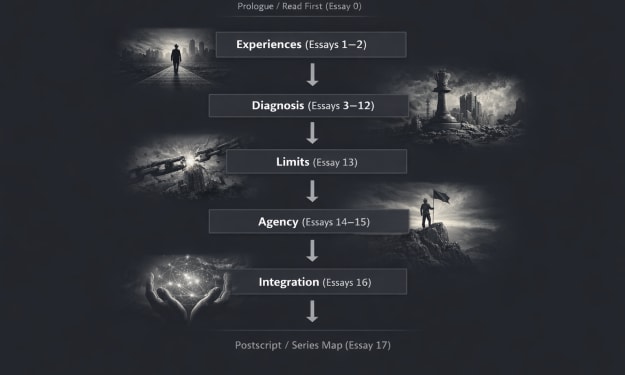
If earlier essays traced how representation became abstract, how authority detached from consequence, how law became unequal, how fear governed populations, and how power legislated itself, this essay shows the operational outcome of those dynamics. Unequal enforcement turns government into a coercive instrument aimed inward. The state ceases to function primarily as a mediator of collective life and becomes a mechanism for preserving its own structure.
The difference between governance and domination is not intent. It is orientation. When power is constrained and reciprocal, governance is possible. When power is insulated and directional, domination emerges. Restoring legitimacy requires reversing that orientation, not through slogans or elections alone, but through structural realignment that binds power to consequence once again.
About the Creator
Peter Thwing - Host of the FST Podcast
Peter unites intellect, wisdom, curiosity, and empathy —
Writing at the crossroads of faith, philosophy, and freedom —
Confronting confusion with clarity —
Guiding readers toward courage, conviction, and renewal —
With love, grace, and truth.
Keep reading
More stories from Peter Thwing - Host of the FST Podcast and writers in Humans and other communities.
(9) Power Legislating Itself
- The Structural Impossibility of Self-Restraint - Every system that concentrates power eventually confronts the same structural problem: those with authority are asked to regulate themselves. This is often framed as a moral question, a test of character, integrity, or civic virtue. In reality, it is a design failure. Systems that rely on self-restraint misunderstand how incentives operate over time. Human beings respond to reward, insulation, and opportunity predictably, regardless of stated values. Expecting those who benefit from power to voluntarily limit that power is not idealism. It is abdication of structural responsibility.
By Peter Thwing - Host of the FST Podcast2 months ago in Humans
When Institutions Reward the Disordered
The claim that modern society has “gone insane” circulates constantly in political commentary. The phrase is crude. The frustration behind it is real. When citizens watch institutions make decisions that appear detached from ordinary human consequences, people begin searching for explanations. Some assume incompetence. Others assume corruption. A smaller but growing group points to a psychological explanation known as political ponerology.
By Dr. Mozelle Martin3 days ago in Humans
Top tipple tricks
Been thinking a lot about drinking, lately. Not least because of a recent episode of over-indulgence and the inevitable after effects. Some readers may recall the earlier articles I wrote about beating the booze. Here I set out an experiment in techniques for cutting down on my alcohol intake. The experiment was successful, the techniques worked, and I have armed myself with an arsenal of weapons in the war against the demon drink. I have yet to fire the first round however. It's all a question of timing (perhaps procrastination).
By Raymond G. Taylor3 days ago in Psyche



Comments
There are no comments for this story
Be the first to respond and start the conversation.