
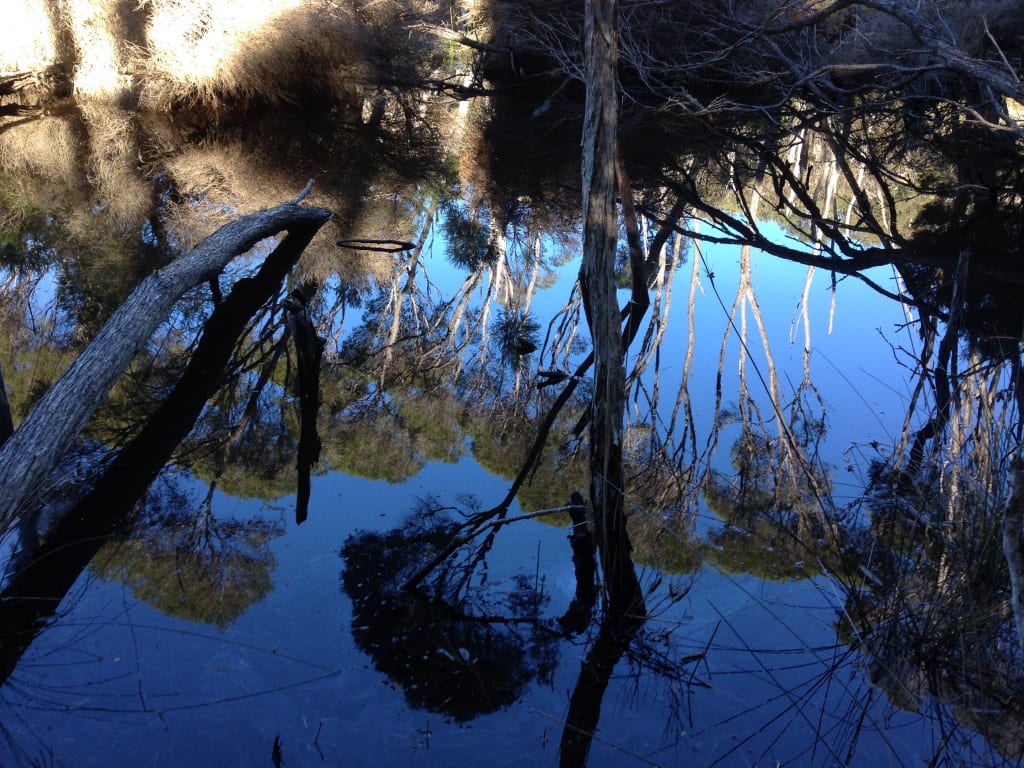
The cabin in the woods had been abandoned for years, but one night, a candle burned in the window. Muck-smudged glass glowed brown and something under the crooked front verandah shifted nervously. From inside came the sound of rusted bed springs giving up a long held weight. A family of wild pigs, rooting in the deep, wet mulch at the base of the ancient red gums that surrounded the cabin, shrieked and bolted for the the river.
The bush sighed as an icy breeze slid down the mountain and the thing in the cabin put its boots on.
*
Tilly awoke to the sound of giggling. It had to be Mary. Her sister was a night-chuckler, sometimes a night-guffawer, a habit that was both endearing and creepy.
“Cut it out, Mar!” Tilly called and was startled by the close quartered echo of her own voice. Because she wasn’t in her high-ceilinged bedroom in Melbourne anymore and Mary wasn’t in the next room. She was in a caravan and Mary was in the bed right next to her, snoring quietly, her round little face still and pale in the moonlight.
From outside came the giggling again, then an excited murmuring and the splashing of water.
Tilly eased herself to the foot of the bed, tip-toed to the door and slipped into the night.
The giggling had stopped.
Directly ahead of Tilly was the camping gazebo that now passed for the family living/dining room and kitchen, behind that the hulking dark ruin of the old farmhouse Mum had made it her mission to restore. To her right was the black bush of the mountain and to her left the slope down to the river. It was all so unfamiliar and unreal in the pale blue wash of the moon it could have easily been a dream.
A chill breeze off the mountain pricked her skin and suggested otherwise. It was early summer, but that wind still carried the sting of snow.
“Tilly?”
She spun back to face the caravan, expecting to see Mary peering out at her from the doorway, but the door was shut. Mum’s caravan, parked a couple of metres along from her own, was also dark and closed tight.
“Tilly. Down here!”
She heard the giggling again.
It was coming from the river.
She turned in that direction and, absolutely certain that she should not, began to walk down the hill. The river took a sharp turn there, as though it was trying to avoid the property. The bend had worn a deep, wide pool into the clay, a swimming hole that Mum was sure Tilly and Mary would grow to love.
In the water now were two girls, roughly the same age as Till and her sister. They grinned as they saw Tilly approaching, their teeth as white as the moon.
“Hello, Tilly,” said the eldest.
Her hair was long and black; her companion’s just as dark, but cut in a ragged bob. Both of them wore long-sleeved white dresses that reminded Tilly of the family christening robe her mum sometimes got out of an old tea chest to show her girls. That tea chest was in a shipping container behind the old farmhouse now, along with a thousand other things from their Melbourne house. Mum said that the container couldn’t be opened until the old/new place was fixed up.
Lockup was the word she used.
When the house was ready it would be at lockup.
Tilly thought of all her stuff in the shipping container. Her whole life sealed up in an airless black void.
That’s what life had been since Dad died.
Her whole life in lockup.
Tilly was in the river. She did not know how it had happened.
The girls were laughing again. Close.
The eldest spoke directly into Tilly’s ear and she felt a pain from it between her eyes like an ice-cream headache.
“You have to swim with us, Tilly. Your mum was right. You’ll love the water hole.”
Tilly tried to pull away but hands were on her wrists, tight rings of cold fingers tugging her down and now her scalp burned as someone grabbed hold of her hair and tugged. She opened her mouth to scream just as her face was pressed into the water.
*
“Tilly’s pissed herself!”
Mary was jumping up and down at the the foot of the bed.
Tilly, groggy and confused, picked up a pillow to throw.
“Shut up, you little shi..”
The pillow was damp. So were the sheets she peeled back to find that…so was she.
She leapt out of the bed and put her hands on her sister’s shoulders to still her. Immediately the little girl wiggled away.
“Don’t touch me! Your hands are freezing!”
“I’ll do more than touch you if you don’t settle down. You can’t tell Mum about this. She’ll freak out and this is the first day of work on the house. This is her big day and we can’t ruin it.” Till was aware that she was being too aggressive and loud, but she couldn’t help it. Her heart was beating horribly fast from the sudden awakening and there was a nasty stabbing pain between her eyes. Still, she was eleven and Mary was six: she ought to know better than to yell at a little girl. Her heart hurt as she saw Mary’s eyes welling.
“I’m sorry I sound cross,” Tilly softly said. “I promise I’m not. And look—” She grabbed the front of her shirt, held it up to her nose and took a deep sniff. She saw Mary’s face brighten with happy disgust. “It’s not wee. Just sweat or something. It’s getting pretty warm in here.” It was true. Her shirt and pants were actually starting to steam. “Go out and get some of that fresh country air. I’ll be with you in a sec.”
“I like our old air better,” said Mary. She opened the door, letting in a puff of new summer and the blare of a tradie’s radio, and trudged off into the day.
Tilly peeled off her clothes. It wasn’t until she reached into her bag for a fresh T-shirt that she saw the bruises on her wrists.
*
Tilly tried, but could not get her mother’s attention to talk about what had happened in the night. The builder she’d got to help them with the house had said that the foundations they’d needed to reinforce before any more work could be done on the house weren’t as bad as he’d first thought. Mum was buzzing and distracted by the news. She seemed to think that just because this first part of the restoration had been so easy the rest of it would be, too.
Tilly didn’t think so. The house was a mess: a rotted dead body. No floor, skeletal walls, roof half caved in. And there was a weird smell to the place; rotten food.
It was the bits that hadn’t been eaten up that made Tilly most feel like this wasn’t a place they could ever live in happily.
A lounge chair. A bath. Dishes.
It made her uncomfortable that the house had been abandoned like that.
Around midday Mum put the gas stove on to cook sausages for lunch and promptly forgot all about them when she got an idea about the plumbing and went to check on the pipes in the bathroom.
Tilly hadn’t seen her mother this happy since before Dad died.
Mal, the builder, rescued lunch. While he was turning the sausages Tilly stood beside him, cutting onions.
“Nice jewellery,” he said, nodding at the jumble of bracelets that cluttered her wrists. She’d fished them out of her backpack that morning to cover the bruises.
“Thanks.” Till wriggled her wrists for him. He gave an appreciative whistle. “My Melbourne friends made them for me just before we left. Gave them to me at my my going away party.”
It wasn’t true. She’d not had any really good friends, at least none good enough to make her bracelets or throw a party. Actually, she would have been surprised if anyone at school had noticed she’d gone.
She’d made the bracelets herself from a kit.
“How come this house got left like it is?” Tilly asked.
He shrugged. “You ever hear of the Great Depression?”
Tilly said no.
“It was a very bad time,” Mal said. “People had no money, no jobs. It hit little towns in the country like this worst of all. People just walked off their farms because they couldn’t afford to work them anymore. They went to bigger towns looking for work. Never came back.”
“That’s sad,” Tilly said. She handed the chopping board to Mal and he slid the onions into the pan. “Do you know anything about the people that lived here?”
Mal answered quickly. “No.” Then he gave Tilly a smile. “You know, it was a little bit before my time.”
“When did it happen?”
“A hundred years ago.”
“No way! Nobody else wanted the house in all that time? How’s it even still standing?”
“I’ve often wondered that myself.” Mal frowned at the onions as he poked them around with a barbeque fork. They were cooking too quickly, going black. “Floods don’t reach here. It’s close to the river, but that drop down to the bend is steep. The river is very deep there. It’s okay to swim, but be careful. You’ve got to know the river. My grandfather always said that to me growing up around here and it’s true.” He picked out some of the least salvageable onion bits and flicked them to the dirt. “And this place? I dunno, it’s been lucky, I guess. Maybe being so close to the mountain protects it a fair bit from the weather.” He gave Tilly a quick grin. “Maybe it’s been waiting for you guys.”
A shriek came from the house. Mum appeared, soaked and laughing. She did a little dance to a song that was playing on Mal’s radio, another one of the classic hits that the station the radio was tuned to kept bragging was all it played. That, and news every half hour, which Tilly could now recite by heart: Prime-Minister Albanese was visiting Ukraine; there had been another shooting in America; a boy had been found drowned in a dam in a town not far from here; it was flooding up north.
“Fiona?” Mal said. “What’s goin’ on?”
“The plumbing you said was broken?” Tilly’s mum grinned and wrung her long hair out like a wash cloth. “I just tried the shower and got a shower!”
“That’s impossible,” Mal said, actually sounding a little cross. “Some of the pipes aren’t even there; the rest are rusted to buggery or burst.”
Fiona grabbed Tilly in a soaking cuddle.
“We’re gonna be at lockup sooner than we thought, baby girl.” Even with her face pressed to her mum’s wet chest, Tilly could tell Fiona was on the verge of crying, but for once these would be happy tears.
Fiona kissed her on the top of the head and told her to go fetch her sister for lunch.
As Till trudged up the hill to where Mary had been playing all morning, lining up all forty-one of her Beanie Babies to face start of the thick bush up the mountain, she could hear Mal and her mother in a discussion that soon seemed to become an argument.
By the time Mary and Tilly got back to the gazebo Mal was gone.
*
That night, two candles burned in the window of the cabin. The thing inside warmed its hands by them, enjoying the forgotten sensation on its tender new flesh, just as it had relished the smell of meat cooking down the mountain in the daytime.
The wild pigs knew better than to return.
This bush was no longer for the living.
*
She awoke to whispering this time. Her heart fluttered as she lay on her back, listening. She was frightened, but in a distant, numb sort of way, as though she was observing herself in this situation rather than actually a part of it. She had felt this way ever since her father had died. Mary and Tilly had been playing on the beach. Mum and Dad had gone for a quick swim. Only Mum had come back.
Everything since then had been like watching a movie.
She heard her name being called softly from the river. She tried to sit up but found herself kept surprisingly firmly in place by an arm Mary had tossed over her in her sleep. Tilly gently pried herself free and slipped outside.
The girls were in the water again. Behind them, on the blunt little clay shore at the base of the cliff, were two boys. The eldest, about nine, seemed to have been rolling in the mud. He wore long shorts and braces and smiled at Tilly sadly. The other boy scared her. He was very young, dressed only in swimmers with Paw Patrol characters on them. He sat like a dumped doll; hands by his sides, legs crookedly out, staring dully at the water.
Tilly felt a hand slip into her own and found that was once more she was standing in the river.
“We’re awfully sorry about last night, Tilly.” It was the older girl. Once again, her voice sounded very close. “My name’s Amelia. Daddy calls me Milly. That’s why I knew we had to be friends.”
“My name’s Matilda,” said Tilly.
Amelia’s pale brow furrowed for an instant, shadows in the moonlight, and then she smiled, moonlight itself.
“Yes, but it’s what our daddies called us that matters.”
“I’m Evelyn,” the younger girl said. “Daddy called me Evie.”
“When he called you at all.” Amelia rolled her eyes and her next words were spoken even deeper into Tilly’s ear, causing that sharp pressure between her eyes to return. “She doesn’t even rhyme.”
“You’re suh-sisters?” Tilly’s teeth were beginning to chatter. She had only come knee deep into the river, but the numbness she felt in her calves was creeping up her spine and the chill of the girls’ words so deep in her ears was so sharp she thought it might split the bones in her skull.
She could not stay here much longer.
“And he’s our brother, Bill,” said Evie, pointing to the muddy boy standing on the shore. “He’s dumb. He follows us around everywhere and rolls in the mud so he thinks he’s invisible and we won’t see him. But we do see him.”
“We see everything,” said Amelia. “Everything all the time.”
“Who is the other boy?” As she said it, the boy in the Poor Patrol swimmers cocked his head very slightly, as though he was curious to hear the answer to her question. Tilly winced as those dead eyes seemed to land on her.
“He’s our new friend,” Amelia said, “just like you.”
“If you want me to be your friend why did you hurt me?”
Evie let out a pathetic sob. Amelia sighed.
“That was Evie,” she said. “Please excuse her. It’s just that we haven’t had a new friend to swim with in such a long time. She becomes over-eager. It happens all the time, the silly thing. It can be very lonely here. Valley Field is so far away from everything else. It’s another world.”
Tilly thought about how there was no phone reception here. About how the only buildings in the town she had seen were a rundown church and community hall, although where the ‘community’ was she couldn’t say. Mum said everybody lived up in the hills, hidden away in the bush. When Till and Mary started school in Eden in January, it was going to take them an hour and a half each way to get there and back by bus.
Just so Fiona didn’t have to be sad anymore.
Another world.
“Very lonely.” Amelia squeezed Tilly’s hand, then smiled. “But not anymore.”
*
She awoke with a smile on her face, the caravan bathed in the pale wash of dawn. She turned to see Mary’s back, her face pressed against the wall, then lifted the sheet to check herself—quite dry—and gasped as the light reflected off silver on her wrist.
She remembered Amelia lifting her arm to see the bruises Evie had left on her wrist, Amelia frowning at Tilly’s homemade friendship bracelets.
She’d slid them from Tilly’s arm into the river.
You don’t need these anymore. Just this…
She’d planted a tingling kiss on Tilly’s wrist and Till had felt a warmness course through her, washing away the numbness and the ice-cream headache and the dull throb of the bruises.
There was a new bracelet on her wrist now; a delicate silver chain bound by a plate with old-timey writing.
Tilly held it to her face and squinted.
Milly & Tilly, it read, Valley Field ’32, “Another World”.
She shivered with delight and immediately thought of the lovely sensation of Milly’s cool kiss on her wrist.
She checked the skin under the bracelet and her other wrist.
The bruises were gone.
“It’s magic, Tilly.” Fiona was leaning into the caravan, beaming. “Come see.”
*
The house had a new floor; shiny polished wood in every room. Tilly could smell paint and varnish and sawdust.
Fiona put an arm across her daughter’s shoulders and pulled her close, at the same time leaning to whisper in her ear. Tilly wished she wouldn’t do that. It spoiled a special memory, intruded on a secret feeling.
“This place loves us, Tilly,” she said. “Loves us and wants us to stay. It’s magic, baby girl. Look…” She turned Tilly to the mountain, the bush still a dark blue mass in the dawn gloom, although for a brief moment Till thought she saw a flickering yellow spark up there.
“Magic,” Fiona whispered.
Now she turned Tilly right around the other way. As she moved, Till saw Mary peeking out of the caravan window, then quickly ducking away when she saw her sister see her.
Above the mountains, on the other side of the valley, the sky was a dazzling pink.
“Magic.” Fiona put a hand on the back of Till’s head and ran fingers through her hair, stopping occasionally to tug at a tangle, not entirely gently.
“Magic,” Tilly agreed, relishing the feel of the silver chain on her skin.
“Bastard.” Fiona yanked her hand from Tilly’s head, scraping her scalp with one of her nails. Tilly felt a hot wetness back there.
“Mum!”
Fiona stalked towards the hill that led down to the river. Tilly felt a stab of fear and raced after her, but she’d stopped at the crest and was yelling up at the road.
“I see you watching us!”
Tilly shaded her eyes against the brightening sky and saw Mal’s mustard-coloured truck stopped in the road above the water hole, almost camouflaged against the dirt.
“We don’t need you!” Fiona hollered. “Just keep on driving, mate! Us girls are just fine, thanks!”
She gave him the finger and laughed as he started the truck and sped off.
“Mum, what are you doing? Mal’s our friend!”
Fiona turned back to the house. “Ah, it just pisses me off. Some people just don’t believe in magic.” She laughed. “He’ll be back though. We’ve still got his radio.”
She turned it on and up.
More classic hits.
More radio bulletins: Albanese was heading back to Australia, vowing to confront the energy crisis head on; Carlton was having its best year in twenty; three more children had drowned, two of them in Eden. Authorities were warning parents to be more vigilant.
Fiona and Tilly danced all day.
There really wasn’t much else to do.
Mary stayed by her line of toys facing the bush. When Tilly asked her why, she said that something was in the woods on the mountain, but would be coming down soon.
Tilly told her she was crazy.
*
Five candles burned that night. Beyond them the cabin creaked and groaned as a dark shape paced back and forth, alternately moaning its sadness and barking its fury, learning to walk again.
*
In the morning the house had a roof: a great expanse of shining iron.
Fiona said it was time to open the shipping container and start bringing their stuff into their new home.
They would be at lockup soon.
It was a busy day and Mary didn’t help, just kept her strange vigil at the tree-line. When Tilly complained, Fiona said to leave her sister be. There were no rules in Valley Field, no obligations.
Still, Tilly was troubled. Her meeting with Amelia in the night had not gone well.
There had been three new children shore, besides Bill and the boy in the Paw Patrol swimmers: a teenage girl in an expensive looking Nike swimsuit, slick and wet; a blonde boy who looked about Mary’s age, in sodden checked shirt and jeans; a chubby toddler in a water-heavy nappy and singlet.
All of them slack-jawed and dull-eyed, sitting with limbs splayed and crooked, watching the water and seeing nothing while Bill stood over them, muddy, mute and sad.
More friends, Amelia said. And more to come. So many more.
Swim with us, Tilly.
But Tilly could not. No matter how she tried, no matter how much she thought she wanted to, she could not bring herself to go more than knee-deep into the water hole.
And for the first time she did not wake up in her bed, but was left alone in the dark water.
*
By the time they had emptied the shipping container it was late in the day. The house looked strange all set up but unfinished. It still smelled bad, that trace of rotting meat had not dissipated, but Fiona said it would. In time.
As the valley fell to shadow Tilly sat by the water hole on the bank at the bottom of the hill facing the cliff to the road, wondering if she would ever see Amelia again.
The surface of the water hole began to pucker in a series of small eruptions.
“Tilly.”
There was movement at the top of the cliff and more pebbles fell, bouncing off the shore into the water. A face appeared over the edge of the clifftop.
“Mal?”
“Stay there.” His face was dark in the deepening shadow. “I need to talk to you.”
He glanced over her head to the house, then edged himself onto the cliff-face, unleashing another volley of rubble. As it bounced into the water Tilly saw something pale move in the deep part of the hole, then vanish.
“I don’t think you should come here,” Tilly said.
“I didn’t tell you the truth, Tilly.” He’d come fully over the edge now, was easing himself lower. He would have been much better off coming down with his face to the cliff, but he clearly wanted to keep an eye on the hill up to the house.
“I was lying when I said I didn’t know about the people who lived in the house. Everyone in Valley Field knows. And they know to keep away.”
Tilly saw more movement in the water beneath the splashes and bubbles made by the pebbles and falling clay.
“Please don’t come any further, Mal,” Tilly pleaded. “Please, just go away.”
“I think your mother knows, too. I think that’s why she brought you here. And it’s why she won’t listen to me.” He was trying to keep his voice low, but couldn’t keep from grunting with the effort it took to keep coming down the cliff without falling. “It’s why you have to get your sister and leave this place. Now.”
“But why?” Tilly couldn’t help herself. “Who lived here?”
“The family was called Dunst. Mother and father; two daughters and a boy. They came here just as the Depression took hold; somehow had money when no-one else did, somehow built a house overnight. Nobody knows where they came from, but they had been on the move for a long time before here. It was the sisters. Everywhere they went there were accidents. Drownings. Their father was trying to protect them, hide them, keep them away from other children…but then it started to happen here. The old man must have had enough. Shot his wife, then himself. The brother found them, snapped, drowned both girls in this water hole, wrote it all down and disappeared.”
For a moment Tilly couldn’t speak. When she found her voice again it was cracked and hollow.
“How could the girls have killed the children if they were never allowed near them?”
Mal stopped climbing, just faced Tilly and shook his head. She couldn’t see his eyes.
“All I know is that in 1932 sixteen children drowned in separate instances in Valley Field alone. The year before that—the year before the Dunst family built their magic house—the number was one. The year after that—the year after Bill Dunst killed his witch sisters—the number was zero.” He started to move again, even more careful now that the sun was so low. The tone in his voice became a little lighter as he came closer to the shore, although he was still not quite halfway.
“My grandfather had another bit of the story which he only told when he was on the beers.”
“What was that?” Tilly said, really not wanting to know the answer.
“Pop used to say the kids that drowned were found with one of the sister’s names scratched on their wrists.” He swore as one of his handholds came loose.
Tilly fingered the chain of her bracelet.
Milly & Tilly.
Valley Field ’32.
More friends.
And more to come.
The sun disappeared behind the house-side mountain and there they all were—Paw Patrol and Nike; the little boy in jeans and the toddler…and more.
So many more.
Mal cried out as he saw them and fell face-first with a sickening thump into the clay, then rolled into the water. Pale arms shot out to greet him, encircling his neck, choking his screams as he tried to fight back. Tilly shrieked as she saw Evie’s grinning face appear alongside Mal’s. Her scream died in her throat as Evie opened her mouth wide then brought her moonlight teeth down hard into Mal’s cheek before disappearing with him under water.
“Leave him alone!” Tilly wailed. “Leave him alone and I’ll swim with you! Leave them all alone and I’ll swim with you forever!”
Amelia appeared then, swimming up from the deepest part of the hole, then gliding up out of the water to float above them all, her arms outstretched, her smile serene and welcoming.
“Then swim with us, my darling,” she said, “right now.”
Trembling and crying, Tilly waded into the river.
“Tilly, no!!!”
Tilly turned to see Mary stumbling down the hill towards her. Behind the little girl there was more movement in the gloom.
“You don’t hafta to do it, Tilly! You don’t hafta!”
“Yes, she does,” snapped Fiona, emerging from the shadows at the foot of the hill to shove Mary aside. The little girl squealed as she tumbled into the darkness. There was a thump, and Mary was silent.
“No!” Tilly turned, desperate to get back to the shore and help her sister, but a hand clamped on her ankle and she fell. She twisted back towards to the river and saw Evie, her face slick with blood, that awful grin back in place, another hand planted further up Tilly’s leg to drag her into the water.
And now Fiona was helping, shoving Tilly from behind.
“Just go, Matilda,” she grunted. “Give them what they want. Give me, what I want. What I deserve.” She had her arms under Tilly’s, thrusting her forward. Tilly coughed and spluttered as the water came up over her chest. “It’s okay, baby girl. You’ll still be with us. You’ll be with us forever. I’ll come and see you every day. I promise you I will. And I’ll have a house and I’ll be happy. And maybe…maybe if you swim good and deep…maybe your daddy will come back to me, too! Don’t you want that, baby girl? Don’t you want mummy to have magi—”
There was another awful thump and Fiona collapsed into the water. Evie released Tilly’s leg, hissing as she drew back into the water and out of sight. Till turned to see a man towering over her, a bloody rock in his hands.
Bill.
She did not know how she knew this, but she was sure of it.
The girls’ brother had come back down the mountain to put things right again.
One look up at Amelia was all it took to be absolutely certain. Her pretty face was almost split entirely in two by her outraged but entirely silent scream. Bill lifted the rock high above his head and threw it at his sister. She caught and it began to descend back into the river.
Within a second she was gone, as were the lost souls on the shore.
*
Tilly walked with Bill as he carried Mary to the caravan. She had a nasty bump on her left temple, but she was going to be all right.
Then Tilly walked in silence with Bill to the edge of the bush. For the last part of the climb up the mountain, on impulse and in thanks, she took his hand. The flesh against hers felt smooth and new, but also as though it might be coming loose, its brief work done.
She watched the bush swallow its secret whole, then sat and wept.
*
No candles burned in the cabin window that night.
This bush was for the living.
About the Creator
Jamie Forbes
I'm an award winning playwright and have written for radio, television and film. I've had several short stories and articles published and also work as a musician and actor. Recently, I finished my first novel, Colderwood.
Keep reading
More stories from Jamie Forbes and writers in Horror and other communities.
The Teppes
On the Far South Coast a pissy, fickle spring held on until the seventeenth day of what was supposed to be summer, when a storm came. A ripsnorter. An east coast low coiled itself up out of nowhere and tried to heave the ocean ashore. 368 millimetres of rain fell on Kialla, a seaside town that was popular with tourists when there were such a thing, before COVID. All that rain fell between 1pm and midnight. The sea churned, turned Kialla Beach inside out. A flûte, not seen by anyone who cared to report it after sailing out of Botany Bay two hundred and thirty years ago, saw the sun and gave up its ghosts.
By Jamie Forbes4 years ago in Horror
Silver Screen Magic with Mae West
American actress and singer Mae West became a popular film actress during the Great Depression. She started entertaining in vaudeville, then performed on Broadway, and finally went to Hollywood. She signed up with Paramount Pictures and made her debut in the 1932 film “Night After Night.” She also starred in musicals, comedies, and crime dramas. The American Film Institute named her one of the best classic Hollywood actresses.
By Rasma Raisters7 days ago in Geeks


Comments
There are no comments for this story
Be the first to respond and start the conversation.