
On the Far South Coast a pissy, fickle spring held on until the seventeenth day of what was supposed to be summer, when a storm came. A ripsnorter. An east coast low coiled itself up out of nowhere and tried to heave the ocean ashore. 368 millimetres of rain fell on Kialla, a seaside town that was popular with tourists when there were such a thing, before COVID. All that rain fell between 1pm and midnight. The sea churned, turned Kialla Beach inside out. A flûte, not seen by anyone who cared to report it after sailing out of Botany Bay two hundred and thirty years ago, saw the sun and gave up its ghosts.
They had been holding their breath for a very long time.
In the morning it was hot.
*
The warmer weather would see Kialla fall in line with rest of the country, for which summer had bloomed on time, and right at the end of lockdown. Vaccine uptake was high and the politicians who were still standing after the tumult of the previous two years assured their virus-weary nation that they could see a light at the end of the tunnel.
Australia had made it through.
It was gonna be a great summer.
Hoo-bloody-ray.
It would be Ellen Burnside's last.
Too bloody bad.
The arthritis had become intolerable. It'd started two years ago in her right knee. A dull niggle every time she turned in that direction became the regular thrust of a butcher's knife. Soon the other knee started up and so did her hips, ankles, even her toes. Getting out of a chair cued a symphony of bright pains. She hobbled like an ancient at the age of 59. Her swollen joints audibly creaked as though she were a boat run aground. Now it was starting in her shoulders, arms and fingers.
Those were the last straws.
She'd crisscrossed the country to meet doctors and try their treatments. She'd ordered from the most dubious of websites. The last had sent her a large, suspiciously light parcel filled with plastic bottles with nothing in them but cotton wool. She'd taken that with a laugh and as a sign.
There was a common theme in all of the advice she sought, and it had not made her laugh.
It made her bloody angry.
Swimming, she was constantly told, helped.
Well, it hadn't helped her.
Swimming was all Ellen Burnside had done with her life, when she could help it, since before she could remember. She taught it, coached it, watched it, travelled for it, wrote about it, spoke about it and did it; most often open water swimming. She'd swum unfeasible stretches of the coast, rivers and lakes of her own country and, when she could afford it, off Mexico, Sweden, Honduras, Hawaii and England. She'd done lochs in Scotland and the Ger Kennedy in Antartica. She'd forsaken every other thing she'd been told she was supposed to do with her life because swimming was her life. Her intention had always been to do it until she couldn't.
And here she was.
She began the long and, for her now, for her like this, painfully slow descent into the Hour Glass.
*
Buddy Nolan went flat chat that morning. The bike asked him to; begged him to. He'd bought it right before this latest—and longest—lockdown and had not had a chance till now to take it for a real scramble along his favourite track, a tricky bush trail that went from the back of his block in the thickly forested hills above town, right down into the scrub above the beach. It was madness to be riding the way he liked to ride before dawn hours after a once-in-a-hundred-years (but weren't they all these days?) downpour, but after two years of working from home, mad is was what he felt. Which probably explained why he'd been okay with paying thirteen grand for a bicycle.
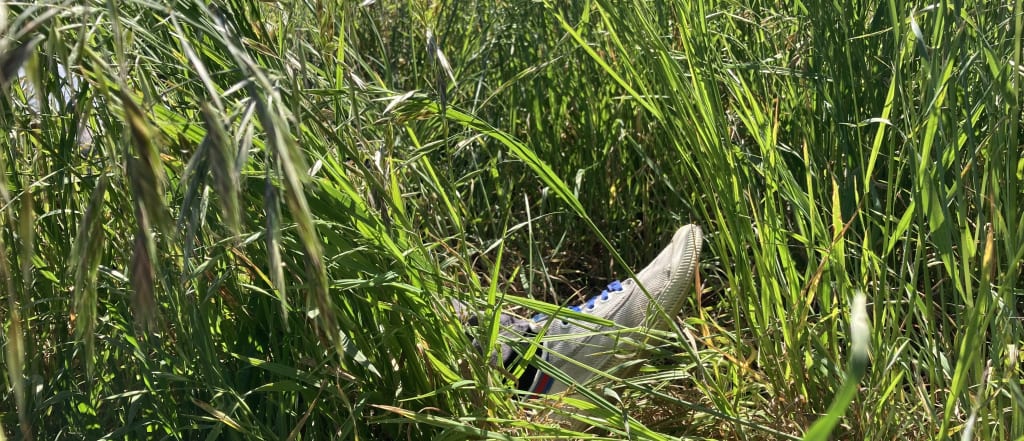
A shape that he'd soon realise had been the lack of a shape parted the bracken to his right. A force that felt real enough to not be remembered as invisible slammed into his front wheel, bending it almost into a right angle. Buddy shot over his handle bars into sandy scrub. The thick-rimmed glasses that gave him his nickname shot off his face as though intent on pursuing whatever had caused the accident. Buddy was not sure where along the track he had come off. He got up onto all fours and shook himself like a wet dog, didn't seem to be more than scratched, bruised and a little winded. From the direction in which his glasses had gone the ocean roared, restless from the storm. The sky was lightening and Buddy saw that he'd stopped just short of tumbling into the Hour Glass, a gorge cut into the coast ten kilometres up from the town's main beach, almost completely sheltered from the sea by rounded rock walls, after which was a bowl shaped bay. He'd no idea he'd come this far. Usually even he would have taken it easy along this part of the track. He spotted his glasses and crawled tentatively forward to reach for them when the bracken around him erupted. Something charged by him, hitting him in the shoulder, knocking him on to his side. At first he thought his shoulder was burning—as though a motorbike had scraped him and he'd been burned by a hot exhaust pipe—but, no, it was cold he felt, like snow had been ground into the shoulder skin exposed by his sleeveless tee. It hurt more than anything he'd done to himself coming off the Canyon and he tried to cry out but nothing came. Something was covering his mouth. His fillings shrieked as an icy intrusion burnt his gums, the back of his throat, the linings of his cheeks, and his lips were mashed hard against his teeth, bringing the bright, hot taste of blood. His eyes bugged painfully as the horror of suffocation turned his body into a frenzy of desperate spasms and thrashings. Lying on his side he kicked out and punched, arching his back like a cat. The thing on his face withdrew and still Buddy couldn't breathe, felt as though his lungs had collapsed like old balloons. He got up onto his knees and saw whatever had hit him—whatever had kissed and sucked at him—charging off down the sheer drop into the gorge. Or rather, he saw the effect it had; bracken and long grass trampled, roots yanked up and torn, sand and rocks dislodged. Like its predecessor, it seemed to be otherwise invisible.
Buddy put his glasses back on and stood unsteadily, shivering; still feeling the cold that had violated him, despite the gathering warmth of the day.
He made himself breathe. Slowly. In and out. It was hitched and ragged at first, but the stodgy, hot air helped him slow himself.
With his vision properly restored and the gorge brightening below him, Buddy saw that he was close to the stairs that led down to the beach.
And that the two things that simply weren't there were about to charge into the painfully hobbling Ellen Burnside, just as she stepped onto the sand.
*
He thought about hurling himself down the steep embankment, trying to roll with it, and then thought that he had come close enough to death already and that he wouldn't be doing Ellen any good with his neck, back, or both, broken. Instead, he turned to make his way back up to the track, taking one frantic step before he was down again, tripped over the poor wreck of his bike. Cursing, still unable to shake the chill or properly catch his breath, he disentangled himself and found the entrance to the stairs that led down to the Hour Glass beach. Taking three or four steps at a time down four steep zigzagging flights, he felt the wet, sticky-thick heat of the incoming day against his face. It was going to be a scorcher. Still his insides felt frozen, his blood slow and thin.
Ellen was on her side, curled up in a foetal position when he finally got to her, her gnarled hands pressed as flat as they could go to her face. The sand around her was scuffed. Buddy saw handprints, dozens of them.
“Ellen? Are you okay? It's Buddy Nolan. From the paper.”
He wanted to bend down and touch her, but knew how easily she hurt.
“Ellen.”
Despite himself he was reaching gingerly out to her when she took her hands from her face and hissed in a breath. Her eyes were wide in what Buddy thought was both terror and wonder. She pointed a crooked finger across the glassy water on the shore-side of the Hour Glass at one of the golden-brown rock walls. It glistened as the bushland above shed the night's deluge, here and there starting to steam in the sun. It was an extraordinary sight that became unsettling upon closer inspection. Something wasn't right. The flow of water was being interrupted, pushed out, diverted, as though the rock face was itself in constant motion, as though it was rearranging itself. All along the cliff things were moving under the flow of rainwater.
“Teppes,” said Ellen, and that terror and wonder was in her voice as well. “I should have let them take me.”
*
Buddy wanted to help her up, make sure she wasn't injured, but she insisted he sit by her in the circle of handprints, which he now saw broke away in the direction of the water. He cast about for her gear. Ellen was a familiar site on the coast. Buddy had written several articles about her, but most folks around here didn't need to subscribe to the struggling Chronicle (and didn't, which is why it was in such strife) to know who the lady in the black one-piece and grey Crocs doing her stretches on the pier or beach was. She always had a big canvas shoulder bag with her, a cheery but faded rainbow patterned thing that hauled her bits and pieces—nose-plugs, swim-cap, notebooks, sunscreen and a giant, shaggy beach towel featuring a smiling koala wearing Speedos, sunglasses and zinc cream. This quickly heating morning, Buddy couldn't see the bag. Ellen didn't even seem to be wearing her Crocs. He didn't need too much encouragement to sit by her, though. He needed the sun on him (he was still so cold) and to properly catch his breath. And he needed to keep watching that wall. It was disturbing but hypnotic.
“My grandfather first told me about them. Most of the old families that fished around here heard the stories one time or another. Too crazy not to be true.”
“Stories about what?”
“The Teppes. What happened to you up there? You're pretty bashed up.”
Buddy hadn't really examined himself, but now that he did he saw that Ellen was right. His knees were grazed where his bike shorts ended and his calves were cut. There was crusty blood on the knuckles of his shaking hands. None of this concerned him in the slightest. What was beginning to disturb him quite deeply was the chill in his veins and that he still couldn't catch his breath. In fact, the two problems seemed to be coalescing. His lungs were cold and tight, it felt as though ice crystals were forming in his chest.
“Something hit my bike,” he heard himself say, although it felt distant. He couldn't look away from those things, those somethings, swarming on the cliff face, only visible by the shapes they made in the cascading water. “Then something else hit me while I was down. It was like...it tried to grab me...”
“And kiss you?”
Buddy tried to answer but could not. He told himself he was too shocked that she knew what had happened, but really he couldn't find the breath.
“They tried to do the same to me but I'd seen them on the cliff as I was coming down the stairs—or rather, didn't see them—and the stories the fishermen used to tell came back to me. Strange, because I hadn't thought about them since I was a child. It's best not to when you do what I like to do. You don't want to spend the sort of time I do in the water thinking about breath-stealing ghosts. It'd put you right off your game.”
“Breath-stealing ghosts?” Buddy whispered. It was all he could do.
“The ones that hit us must have been scouting. They're hungry. Not enough people in the water because of lockdown. They'll be here soon though. Soon they'll be well fed.”
“I don't under...I don't...”
“How long did the thing kiss you? You're in a bad way. When I heard them coming for me I forced out my breath. That's how you get them to leave you alone.”
Buddy concentrated hard, but could only speak in thin gasps.
“I was winded...from the fall. Didn't have...air in me. But...it tried. Got into my mouth. My throat. So...cold.”
She put a lumpish hand on his hitching back.
“I can feel it,” she said. “You'll warm up. I'm sure you'll be fine.”
She didn't sound sure.
“Les Teppes was a French ship commanded by a woman named Cunégonde. A pirate. More than that. A pirate of pirates; a pillager of pillagers. She played a very long game and led a pack of murderously loyal bastards who she'd groomed and planted on other pirates' ships. In 1785 she took a skeleton crew on Les Teppes to intercept a three-ship pirate party led by an old mate of hers, Oscar Levassuer, who'd just raided Indian ships headed for Mecca and come away with a great amount of loot. What Levassuer didn't know was that one in three of his men were secretly working for Cunégonde. As soon as Les Teppes came in sight those men rose up, slaughtered their mates and transfered themselves and the goodies over to Cunégonde, leaving the three ships and what was left of their crews to be caught up to by some pissed off, heavily armed Mughai warships. It would have been a great plan if the Teppes-men had been able to control their bloodlust, which, of course, they couldn't. Perhaps they'd gotten a little more than they bargained for with their treasure; a little more than they understood. They fought with each other, killed Cunégonde when she tried to calm them down, and within a week the ship had run onto a reef somewhere off Mauritius. It was another French ship, L'Astrolabe, that found the wreck. The crew was still there, still trying to drag loot up from the reef onto what remained of Les Teppes, diving down, coming back up, diving down, coming back up, still filled with rage. Strangest part was it had been a year since Cunégonde's raid.”
“How...how did...how did they...”
“How did they survive all that time? Well...this is where the story gets tricky. The crew of L'Astrolabe swore to a man that they had taken on board the survivors of a wreck, but by the time they got to their next port of call, Botany Bay, early '87, there was not a soul from Les Teppes to be found on L'Astrolabe. The French crew reckoned they must have jumped overboard to swim back to Mauritius and get back to rescuing their treasure. If they'd ever been aboard at all. Or perhaps they were still there, just not in a completely physical sense. There were reports of things going bump in the night. Crew members grew sick...breathless...cold. And if that wasn't enough mystery for you, how about this? Within a few months L'Astrolabe left Botany Bay and disappeared. Well...until now.”
*
The Hour Glass was a very popular spot because it offered something for everyone. If you wanted to paddle in the sheltered shallows of the inner bay you could have a lovely, safe and lazy time while your more adventurous companion satisfied their dangerous tastes through the gap in the walls in the outer bay, where the surf banked high and crashed hard. Ellen's Croc-less feet nudged aside slick, black splinters that rimmed the smooth water of the inner bay. She thought the wood was French, churned up by the storm after a long time buried at sea.
Until now.
She thought those must have been the last words Buddy Nolan had heard her speak before he stopped breathing. He wouldn't be missing anything. They were the last words she would ever speak. She looked back up the beach. Buddy was gone and now to her left something slipped into the water, trailing a curling line of foam as it moved across to the cliff face. Ellen felt unseen eyes on her from the walls as she stepped into the water her for her final swim. It was too shallow to swim properly here; she'd have to wade through the walls and find the sea proper. She heard her knees creak and felt that old pal pain blooming for the last time. She heard the Teppes slide into the water behind her. She thought she might swim down to where the rest of what remained of L'Astrolabe lay, swim until she got that cold kiss and traded her breath for the longest swim of all.
*
By midday the temperature was in the mid-thirties. People came to play and the Hour Glass was packed with breathless life; diving down, coming back up, diving down, coming back up...
...diving down.
It was the first day of the holidays.
Summer had well and truly, finally, begun.
About the Creator
Jamie Forbes
I'm an award winning playwright and have written for radio, television and film. I've had several short stories and articles published and also work as a musician and actor. Recently, I finished my first novel, Colderwood.
Keep reading
More stories from Jamie Forbes and writers in Horror and other communities.
You've Got To Know The River
The cabin in the woods had been abandoned for years, but one night, a candle burned in the window. Muck-smudged glass glowed brown and something under the crooked front verandah shifted nervously. From inside came the sound of rusted bed springs giving up a long held weight. A family of wild pigs, rooting in the deep, wet mulch at the base of the ancient red gums that surrounded the cabin, shrieked and bolted for the the river.
By Jamie Forbes4 years ago in Horror
One to See, One to Speak, One to Listen
Contains gore and horror some readers may find disturbing. Rated 14+ Author's Intro: This story is meant to revive the Gothic literature so famously crafted by one of my favourite writer's, Edgar Allen Poe, and as such, the language and style is deliberately antiquated. Thank you for reading my all time favourite work of horror - Les
By Call Me Les20 days ago in Horror



Comments
There are no comments for this story
Be the first to respond and start the conversation.